Bluetti AC180 Review: The Solar-Friendly Workhorse
6 min read
On this page
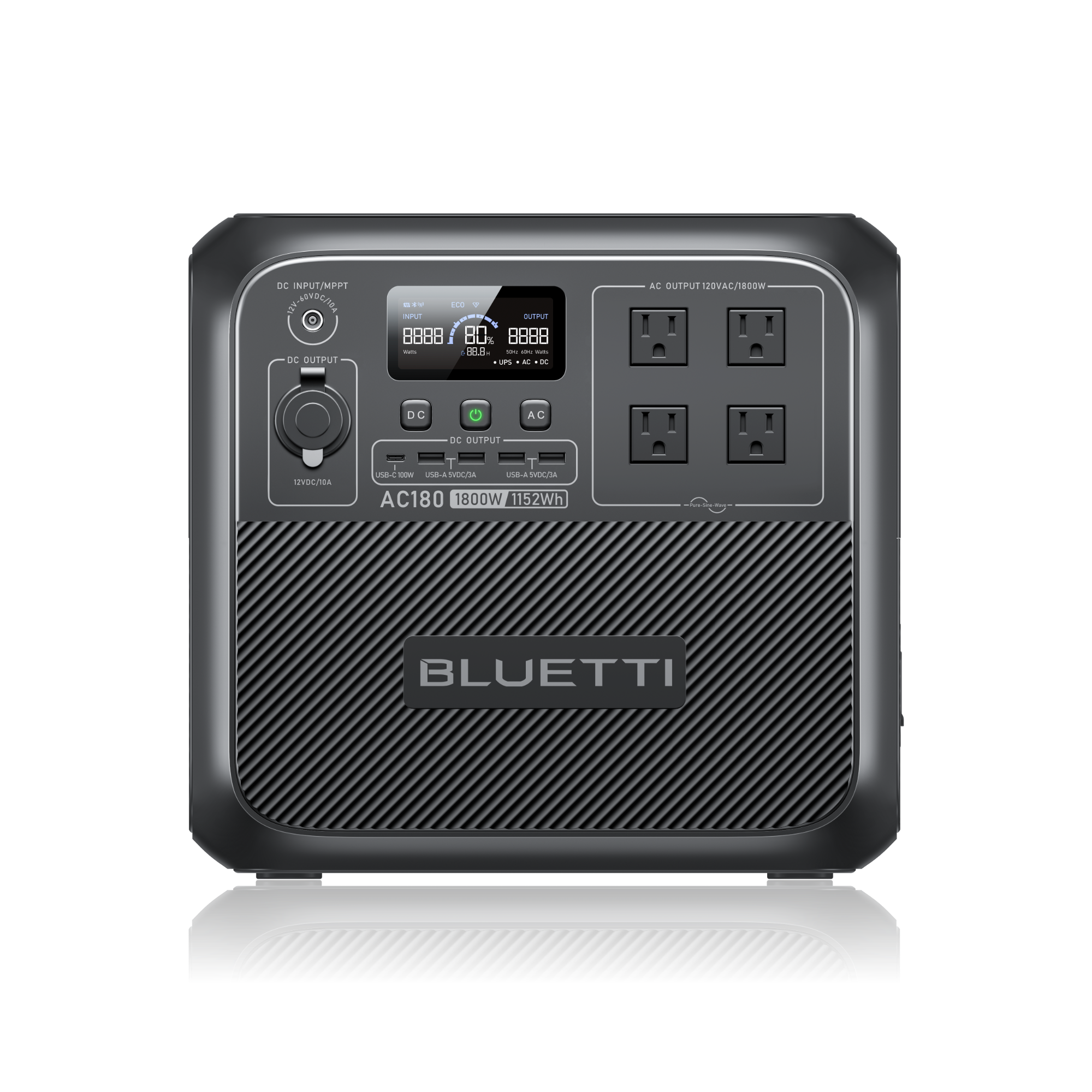
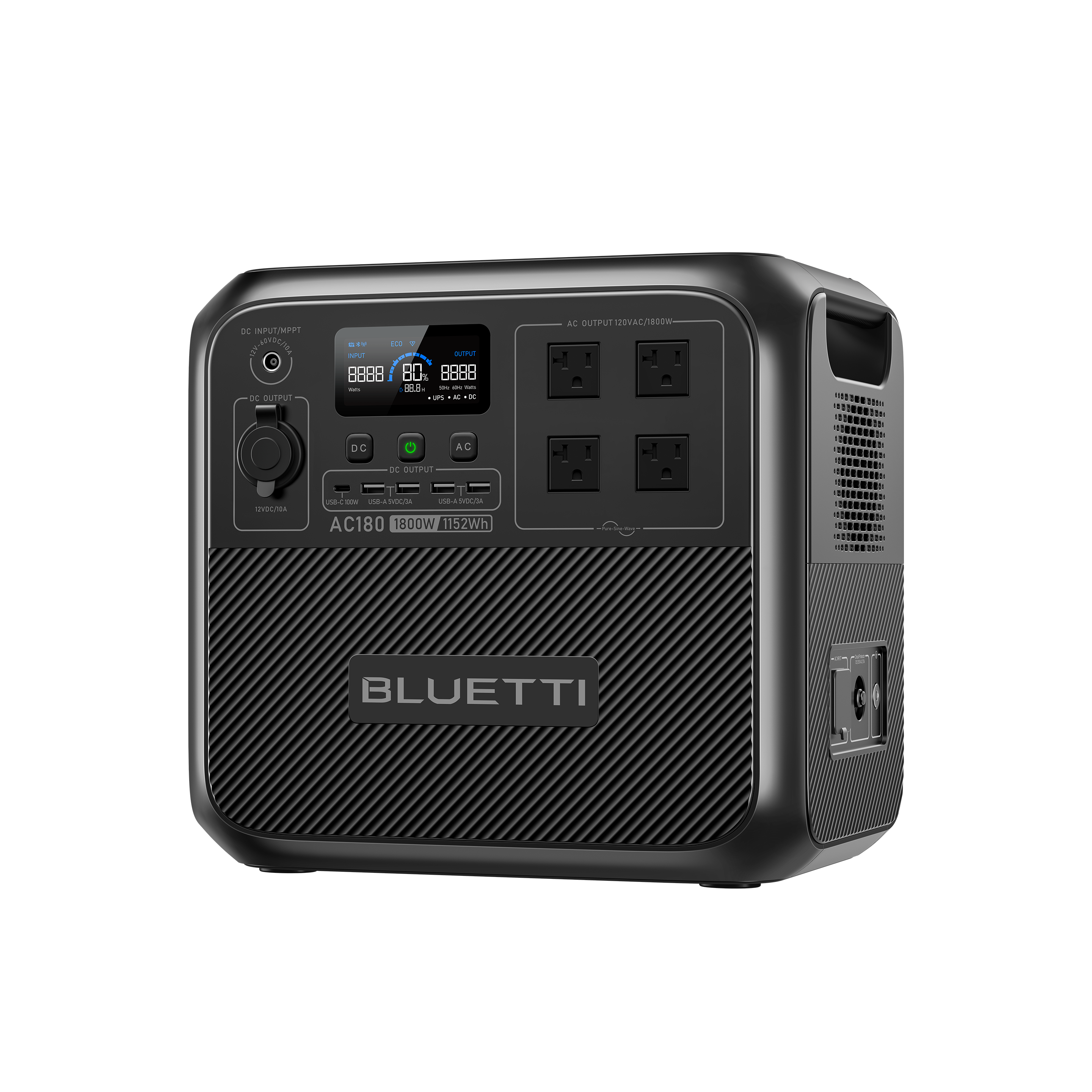
The Bluetti AC180 pairs the biggest battery in its class (1152Wh) with 1800W of output, 1440W turbo charging, and a 15W wireless charging pad. Based on published specs, expert reviews, and owner feedback, here's what it does well, where it…
The short version
The Bluetti AC180 is the capacity leader of the mainstream 1kWh class: 1152Wh — about 12% more energy than the EcoFlow Delta 3 Plus and 8% more than the Jackery Explorer 1000 v2 — with 1800W of continuous output, 1440W turbo AC charging (0–80% in ~45 minutes), and thoughtful extras like a 15W wireless charging pad on top. The trade-offs are real: at 35.3 lbs it's the heaviest station in its class, it's not expandable, and there's no 12V regulated DC5521 pair. But at 2026 sale prices around $424 against a $499 list, it's frequently the cheapest dollars-per-watt-hour in the 1kWh category — a lot of battery for the money.
This is a research-based review: every spec below comes from BLUETTI's official documentation, and the strengths and weaknesses reflect patterns across published expert reviews and verified owner feedback. We did not bench-test this unit.

Bluetti AC180 key specs (verified)
| Spec | AC180 |
|---|---|
| Capacity | 1152Wh (36Ah LiFePO4) |
| AC output | 4 outlets (US), 1800W continuous, 2700W Power Lifting |
| Battery chemistry / cycle life | LiFePO4 — 3500+ cycles to 80% capacity |
| AC recharge | 1440W Turbo: 0–80% in ~45 min, full in ~1.3–1.8 hrs |
| Solar input | 500W max (12–60V, 10A) |
| Car charging | 12V/24V via cigarette lighter port |
| UPS | ≤20 ms switchover |
| USB ports | 1× USB-C (100W), 4× USB-A (15W per pair) |
| Other DC | 1× car port (12V/10A), 1× 15W wireless charging pad |
| Expandable | No |
| Connectivity | Bluetooth, BLUETTI app |
| Weight / dimensions | 35.27 lbs (16 kg) / 13.39 × 9.72 × 12.48 in |
| Warranty | 5-year warranty |
Specs sourced from BLUETTI's official AC180 user manual and BLUETTI's official product pages.
Standout features
1. The most watt-hours for the money
1152Wh is the largest capacity among the mainstream 1kWh stations, and the AC180 is routinely the cheapest per watt-hour — sale prices around $424 work out to roughly $0.37/Wh, well under the class norm. If your priority is maximum runtime per dollar, the math favors the AC180.
2. Turbo charging without a brick
The 1440W AC input is built into the unit — no external power brick to lose — and hits 80% in about 45 minutes. Three charge modes (Silent ~260W, Standard ~1000W, Turbo 1440W) let you trade speed for quiet: Silent mode runs at just ~45 dB for overnight top-ups.
3. A genuinely useful port selection
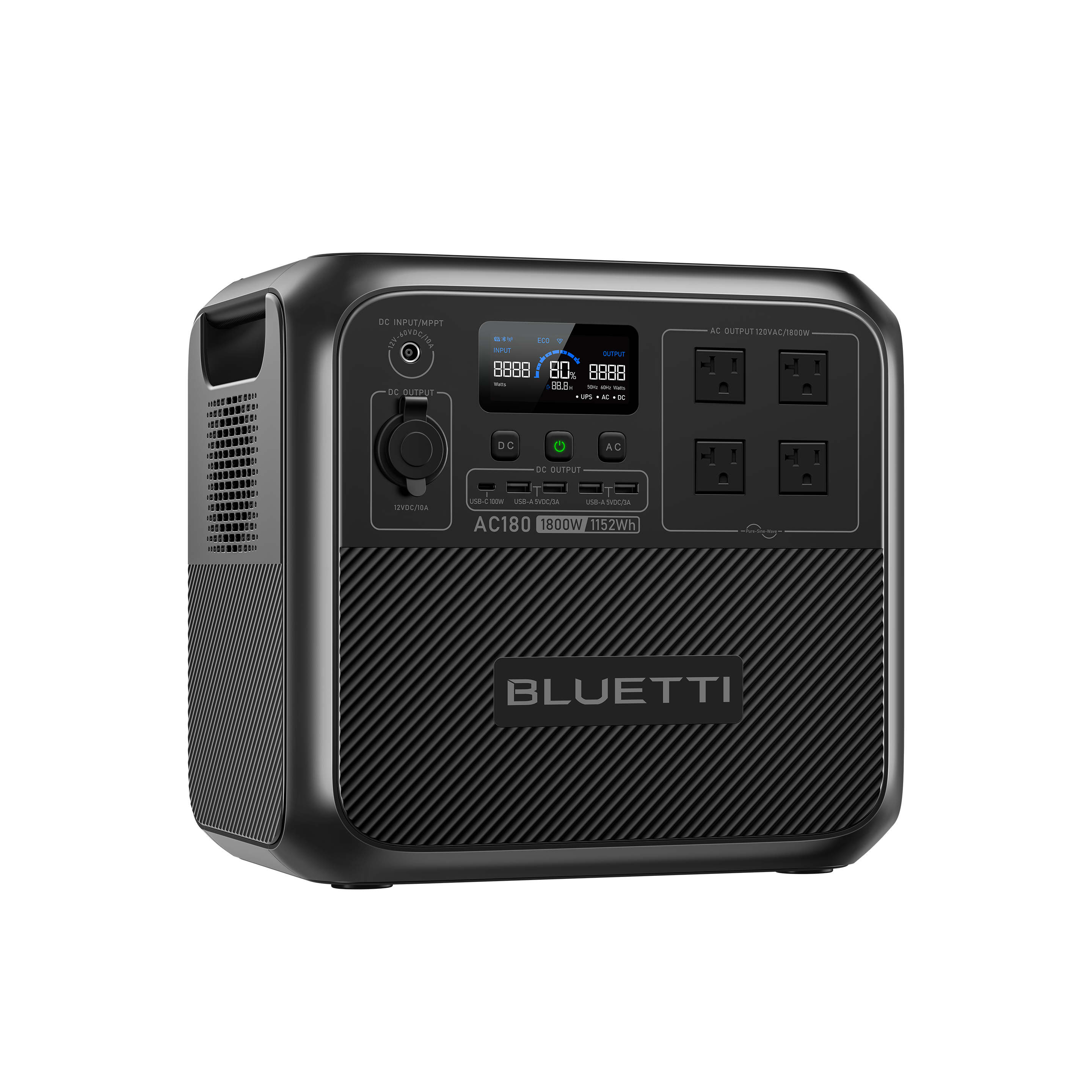
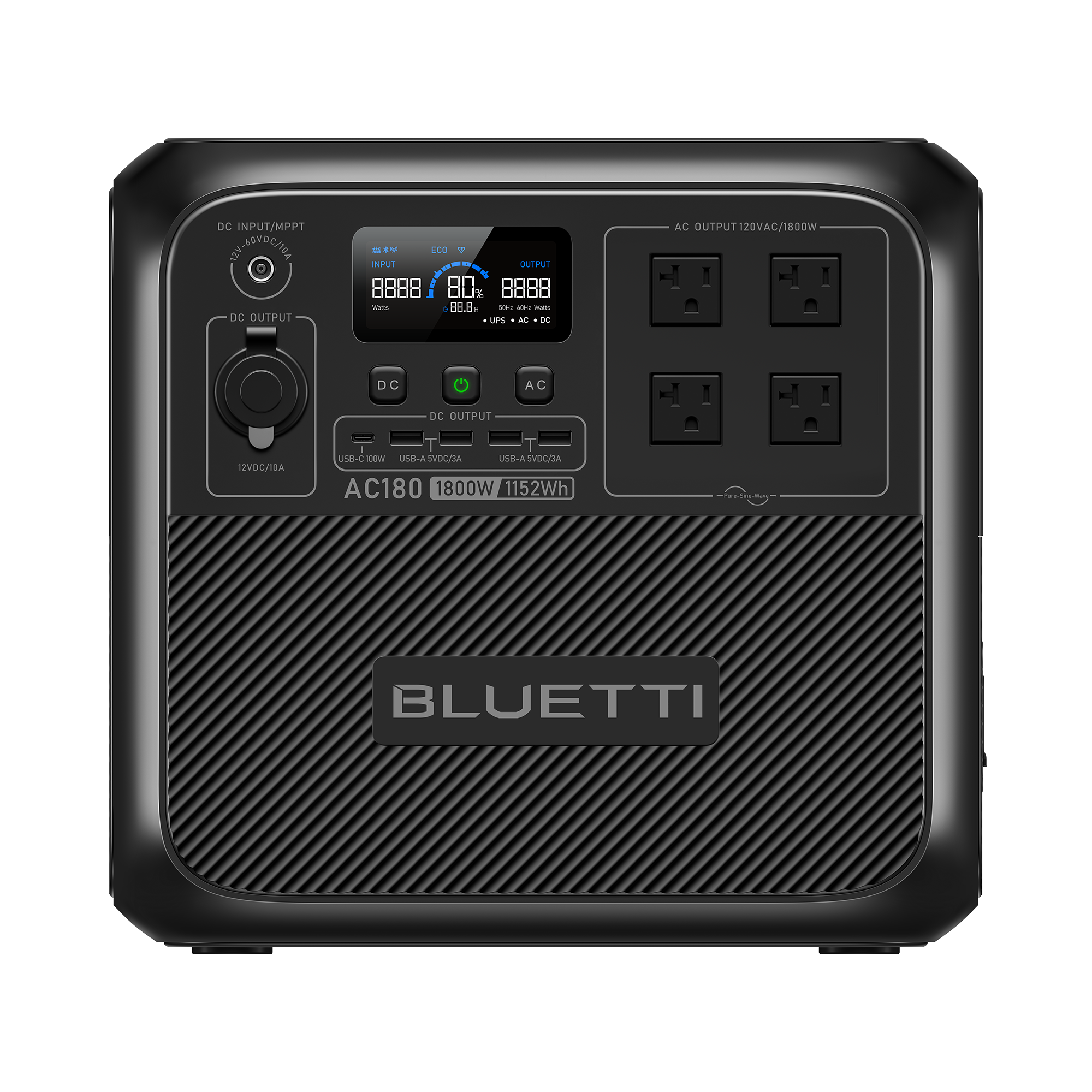
Four AC outlets, a 100W USB-C, four USB-A ports, a 12V car socket, and the 15W wireless charging pad on top — 11 outputs total. The wireless pad is a small thing that gets used constantly: drop your phone on top during an outage and it's one less cable to manage.
4. Power Lifting for stubborn heating loads
The 2700W Power Lifting mode lets the inverter run high-draw resistive loads (space heaters, hair dryers, electric kettles) above its 1800W rating by adjusting voltage — handy for the occasional high-draw appliance, though it's not a substitute for sustained capacity.
Battery & charging, in detail
Four charging paths: AC (Silent/Standard/Turbo), solar (500W max MPPT), car (12V/24V), and generator. The 500W solar input refills the battery in roughly 2.8–3.5 hours in good sun — solid for the class, though well behind the EcoFlow Delta 3 Plus's 1000W dual input. The ≤20 ms UPS switchover covers routers, PCs, and CPAP machines. One notable limitation: no Wi-Fi, only Bluetooth — the app works within ~30 feet, so no checking your station's state from across town. Pass-through charging is supported, so it can charge and discharge simultaneously.
Real-world use cases (with honest capacity math)
The following are watt-hour estimates at ~85% inverter efficiency, unless noted as BLUETTI's published figures:
Home backup during an outage
The extra capacity shows here: a full-size fridge (~150W cycling) should run roughly 13–18 hours — the longest single-charge fridge runtime in the mainstream 1kWh class. Four AC outlets mean the fridge, router, a lamp, and phone chargers can all stay plugged in without a power strip.
CPAP overnight
A 40W CPAP runs an estimated ~22 hours — nearly three nights. The UPS mode keeps it running through grid blips without interruption.
Camping and road trips
A 12V portable fridge (~60W) runs an estimated 16–22 hours, and the flat top with the wireless pad doubles as a phone-charging shelf at the campsite. But at 35.3 lbs, this is the station you carry once from the car to the tent — not the one you hike with.
What it won't do
It's not expandable, so 1152Wh is the ceiling — for multi-day outages you'll be refilling from solar or the wall daily. And while Power Lifting handles brief high-draw loads, sustained 2000W+ appliances need a bigger station.
What could be better
The consistent criticisms across expert reviews and owner feedback:
- 35.3 lbs — the heaviest in its class. More than 11 lbs heavier than the Jackery Explorer 1000 v2. It has two handles and it's manageable, but "portable" is doing heavy lifting here.
- No capacity expansion. The 1152Wh ceiling is generous for a non-expandable unit, but when you outgrow it, you're buying a whole new station.
- Bluetooth only — no Wi-Fi. Remote monitoring from outside Bluetooth range isn't possible, which feels dated next to the Wi-Fi-connected competition.
- Low-draw efficiency lags. In independent testing, the AC180 has trailed rivals on efficiency with small loads (phones, routers) — the extra capacity partly offsets this, but it's worth knowing if your use is mostly small electronics.
- No 12V DC5521 outputs. Just the single car-port socket for 12V gear — fine for most, but 12V enthusiasts (12V fridges, ham radio) get fewer options than on some rivals.
Who should buy it
- Budget-conscious backup buyers — the lowest cost per watt-hour in the 1kWh class at typical sale prices.
- Anyone prioritizing maximum single-charge runtime — 1152Wh is simply more outage than 1024Wh.
- Solar users on a budget — 500W of solar input at this price point is strong value.
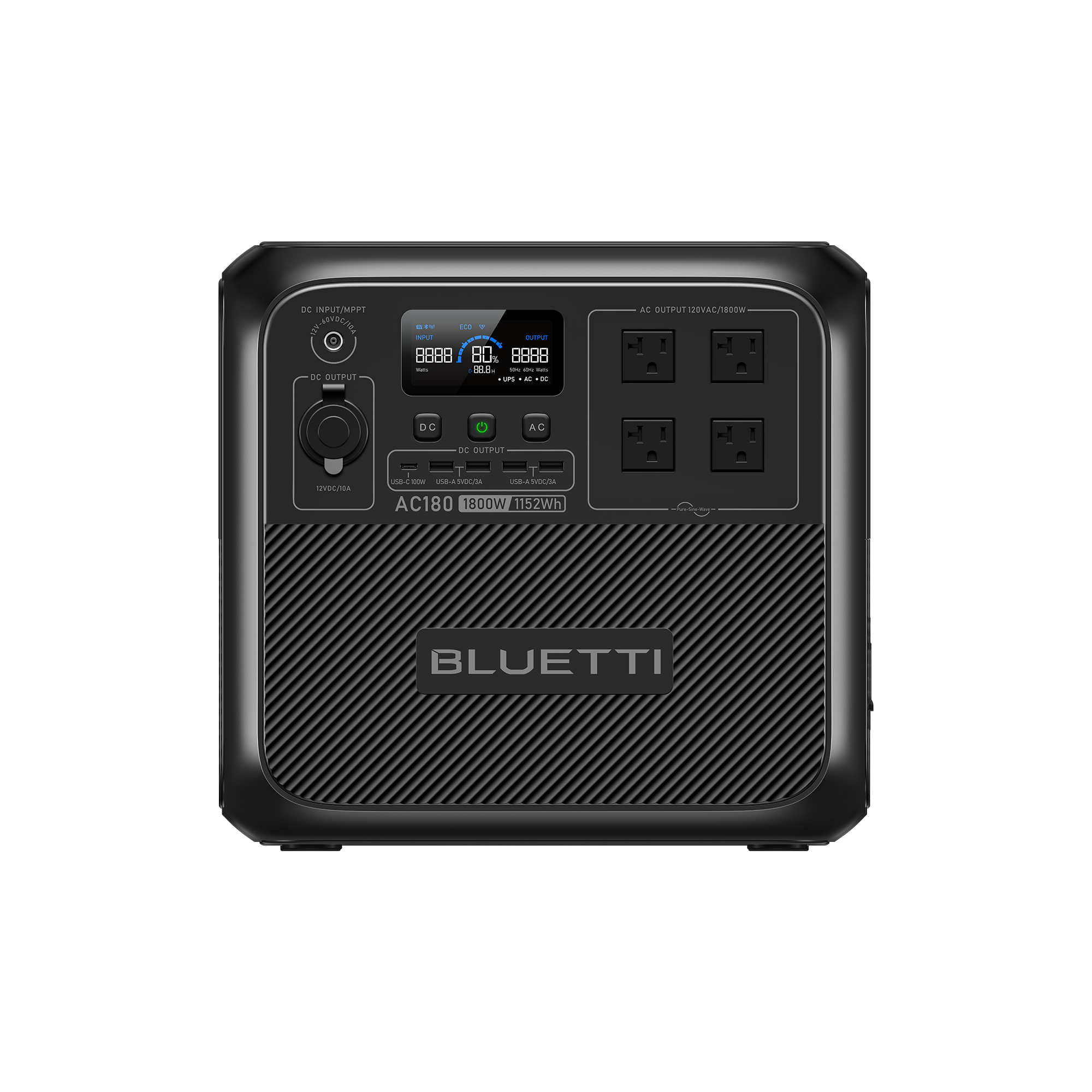
- Households needing many outlets — 11 outputs including the wireless pad cover a crowded outage setup.
Who should skip it
- If you'll carry the station often, the 35.3-lb weight is a genuine burden — the Jackery Explorer 1000 v2 is 11+ lbs lighter.
- If you might need more than 1152Wh someday, buy an expandable station now (EcoFlow Delta 3 Plus, Anker C1000).
- If you want Wi-Fi remote monitoring, look elsewhere.
FAQ
How long does the Bluetti AC180 take to charge?
About 45 minutes to 80% and 1.3–1.8 hours to full on Turbo AC (1440W). Solar takes roughly 2.8–3.5 hours with 500W of panels in good sun. Silent mode (~260W) is the slowest but quietest at ~45 dB.
Can the Bluetti AC180 power a refrigerator?
Yes — the 1800W inverter handles a full-size fridge easily, and the 1152Wh battery should keep one cold for roughly 13–18 hours depending on the fridge's duty cycle.
Is the Bluetti AC180 expandable?
No. The AC180 has no extra-battery port — 1152Wh is the maximum capacity.
Does the Bluetti AC180 have UPS mode?
Yes — switchover is ≤20 ms, fast enough to keep routers, computers, and CPAP machines running through a grid interruption.
What is the Bluetti AC180 warranty?
5 years, per BLUETTI.
Verdict
The AC180 is the value heavyweight of the 1kWh class — literally. No other mainstream station gives you 1152Wh, 1800W, turbo charging, and a 5-year warranty at this price: around $424 on sale as of October 2026 works out to roughly $0.37 per watt-hour, the best in the category. You pay for it in pounds (35.3 of them) and in missing features (no expansion, no Wi-Fi). If the station will mostly sit in one place as outage insurance, those compromises barely matter — and nothing else keeps a fridge cold this long for this little money.
Pricing note: the AC180 is frequently discounted — observed around $424 during October 2026 sales against a $499 list. Check the current price before buying.
About our reviews
Specs come from published manufacturer data sheets, cross-checked against owner feedback. Figures go stale. Check the current data sheet before you buy. This is not electrical or purchasing advice.
Related guides
 ReviewsDJI Power 500 Review: The Drone Pilot's 512Wh StationThe DJI Power 500 packs 512Wh of LFP storage with 1000W of continuous output, a full recharge in 70 minutes, and DJI's SDC…
 ReviewsDJI Power 1000 Review: The Drone Pilot's 1kWh StationThe DJI Power 1000 packs 1024Wh of LiFePO4 storage with 2200W of continuous output — the strongest 1kWh inverter in its class…
 ReviewsJackery Explorer 2000 v2 Review: Light & FastThe Jackery Explorer 2000 v2 is the lightest 2kWh power station in its class at 39.5 lbs, with a 52-minute emergency recharge,…