Jackery Explorer 2000 v2 Review: Light & Fast
7 min read
On this page
The Jackery Explorer 2000 v2 is the lightest 2kWh power station in its class at 39.5 lbs, with a 52-minute emergency recharge, 2200W of output, and 4000-cycle LiFePO4 cells. Based on published specs, expert reviews, and owner feedback,…
The short version
The Jackery Explorer 2000 v2 is Jackery's answer to a simple question: what if a 2kWh power station weighed under 40 lbs? At 39.5 lbs, it's the lightest and smallest 2kWh LiFePO4 station in its class (Jackery claims 40% smaller and 34% lighter than the previous generation), with 2200W of continuous output, a 52-minute emergency recharge via the app, and 4000-cycle cells rated for 70%+ capacity. It's not expandable, it only has three AC outlets, and Jackery's own FAQ advises against using it with medical devices — but for homeowners and campers who move their power station around, the portability is the whole argument. At around $899 on sale (list $999) on jackery.com as of Oct 2026, it's one of the best-value 2kWh stations available.
This is a research-based review: every spec below comes from Jackery's official documentation, and the strengths and weaknesses reflect patterns across published expert reviews and verified owner feedback. We did not bench-test this unit.

Jackery Explorer 2000 v2 key specs (verified)
| Spec | Jackery Explorer 2000 v2 |
|---|---|
| Capacity | 2042Wh (44.8V / 45.6Ah LiFePO4) |
| AC output | 3 outlets, 120V/60Hz, 2200W continuous, 4400W surge |
| Battery chemistry / cycle life | LiFePO4 — 4000 cycles to 70%+ capacity (~11-year theoretical service life per Jackery) |
| AC recharge | Emergency Super Charge (via app): 0–80% in ~52 min, 0–100% in ~1.33 hrs; regular AC: ~1.7 hrs |
| Solar input | 2× DC 8mm ports, up to 21A/400W max |
| Car charging | 12V car adapter supported (~24 hrs for a full charge) |
| USB ports | 1× USB-C (100W), 1× USB-C (30W), 1× USB-A (18W) |
| Other DC | 1× car port (12V/10A) |
| Expandable | No — Jackery points expandability-seekers to the Solar Generator 2000 Plus |
| Connectivity | Smart app control (Bluetooth/Wi-Fi): monitoring, Emergency Super Charge toggle, quiet mode |
| UPS mode | <20ms switchover (bypass mode) |
| Noise | 30dB in Quiet Mode, 45dB at full load (1m, per Jackery's data note) |
| Weight / dimensions | 39.5 lbs (17.9 kg) / 13.2 × 10.4 × 11.5 in |
| Warranty | 3-year warranty + 2 extra years free on jackery.com purchases |
Specs sourced from Jackery's official product page and Jackery's published tech specs.
Standout features
1. The lightest 2kWh station you can buy
39.5 lbs is the number that defines this unit. Against the Bluetti AC200L (61.6 lbs) and even the EcoFlow Delta 3 Max (44.8 lbs), the 2000 v2 is meaningfully easier to carry room to room, load into a car trunk, or haul to a campsite. Jackery's GaN inverter and compact cell packaging are what make the weight possible — and owner feedback consistently cites the weight as the reason they chose it.
2. 52-minute emergency recharge
Activate Emergency Super Charge in the Jackery app and the unit pulls maximum AC power to hit 80% in about 52 minutes, or full in ~1.33 hours. Regular AC charging takes ~1.7 hours. In a storm-prep scenario — grid still up, outage forecast tonight — that's the difference between a full battery and a half-empty one.
3. 30dB quiet mode for indoor use
Jackery publishes an official noise figure: 30dB in Quiet Mode (45dB at full load, measured at 1m). Quiet Mode is toggled through the app and makes the unit genuinely bedroom-adjacent for light loads — routers, phones, laptops. Few competitors publish a quiet-mode dBA figure at all.
4. 4000-cycle LFP battery with ChargeShield 2.0
The LiFePO4 cells are rated for 4000 cycles to 70%+ capacity — Jackery translates that to roughly 11 years of theoretical service life at one cycle per day. ChargeShield 2.0 adds 62 layers of protection (over/under-voltage, temperature, short-circuit). Jackery also claims ~95% charge retention after 12 months of storage, so it can sit in a closet between emergencies without babysitting.
Battery & charging, in detail
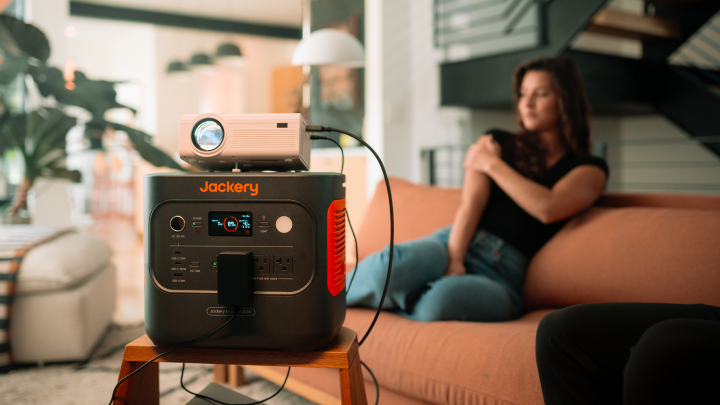
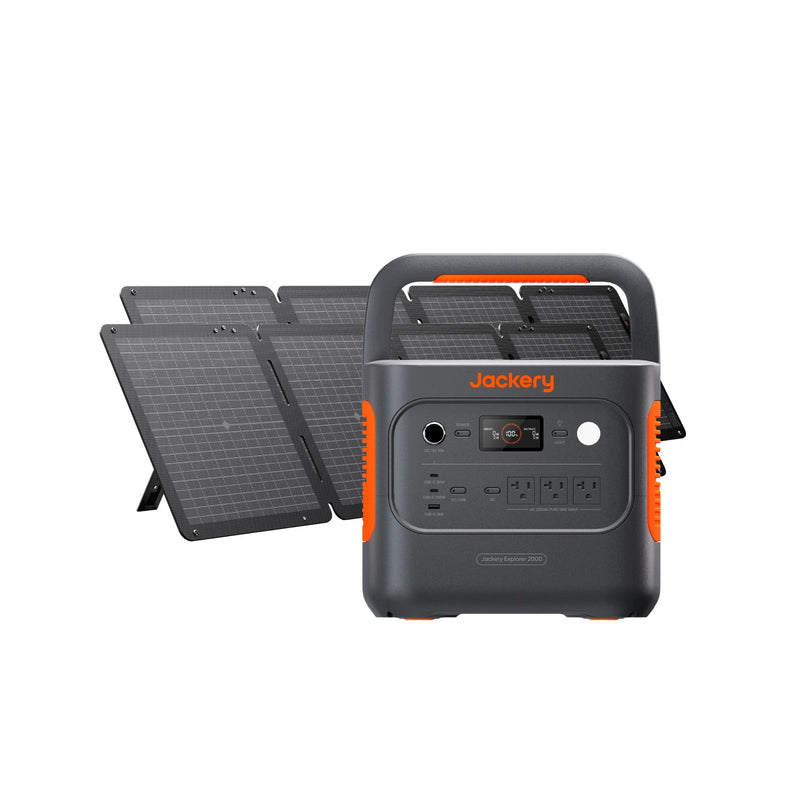
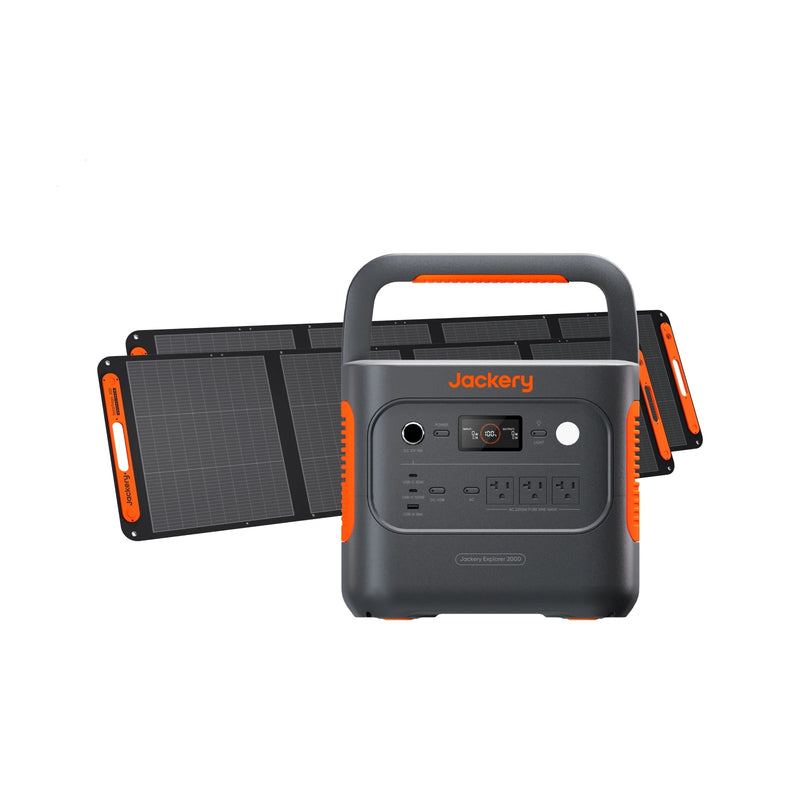
Wall charging is the strong suit: 1.7 hours standard, ~1.33 hours in Emergency Super Charge. Solar is the weak link — the dual DC inputs cap at 400W combined, so a full solar refill takes a full day of good sun (Jackery's own figures show 7.5 hours with two 200W panels, 15 hours with one). Car charging is a ~24-hour trickle, fine for topping off on a road trip but not a recharge strategy. Pass-through charging works — the unit can power devices while it recharges — and the <20ms UPS switchover keeps routers, computers, and NAS boxes online through a blackout.
Real-world use cases (with Jackery's published runtime figures)
The figures below are Jackery's own published estimates for the 2000 v2:
Home backup during an outage
Jackery rates a household refrigerator (520W) at 3.2 hours — enough to ride out a short outage, though a full-size fridge's lower duty cycle stretches that in practice. A portable air conditioner (900W) gets about 2 hours; a light (5W) runs 155 hours. Pair it with the <20ms UPS and the essentials (router, NAS, phones) never notice the outage.
Kitchen duty
A coffee maker (1120W) brews for about 1.8 hours; a microwave (1160W) heats for ~1.5 hours; an electric kettle (1600W) boils for ~1.1 hours. The 2200W inverter handles all of these one at a time with room to spare — but 2042Wh means high-draw cooking is a minutes-per-day affair, not hours.
Camping and road trips
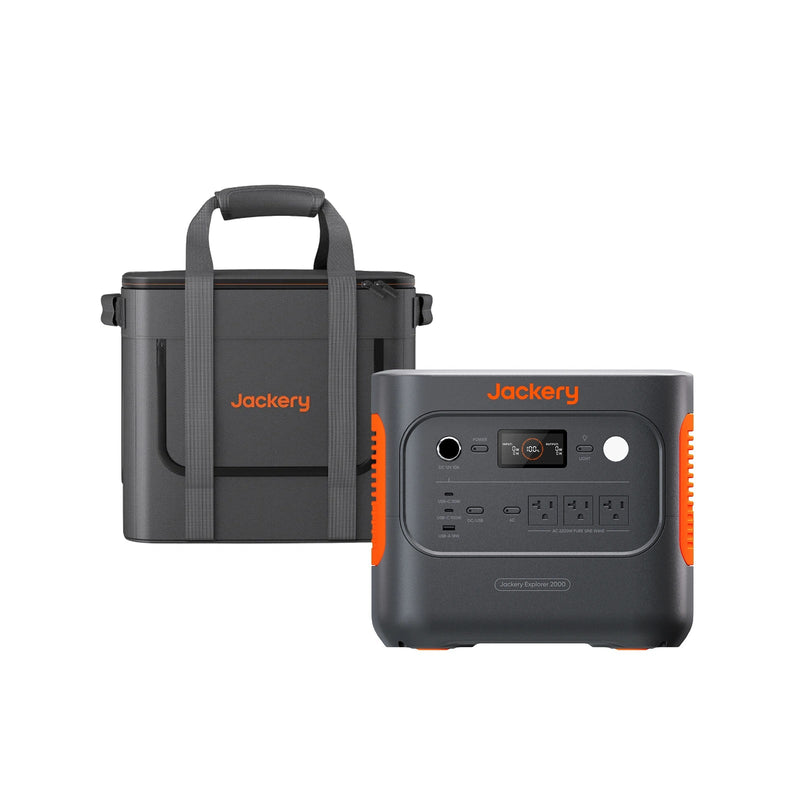
A laptop (80W) charges about 24 times; phones charge dozens of times over. At 39.5 lbs with a folding handle, it's the easiest 2kWh unit to get from the garage to the campsite. The optional Extreme Guard carrying bag adds cold-weather protection for winter camping.
What it won't do
It won't expand — if 2042Wh isn't enough, you're buying a bigger unit, not a battery. It won't run a well pump or central AC. And per Jackery's own FAQ, it should not be used with medical devices, life-support equipment, or business-critical systems — Jackery explicitly recommends against it, which matters for CPAP users (see our CPAP sizing guide).
What could be better
The consistent criticisms across expert reviews and owner feedback:
- Not expandable. The 2000 Plus exists for a reason — the v2 is a fixed 2042Wh. If your needs might grow, this is a hard ceiling.
- Only three AC outlets. The Bluetti AC200L has five (plus a TT-30 RV port). Three is fine for essentials but tight for a busy backup setup.
- 400W solar cap. EcoFlow and Bluetti rivals accept 500–1200W. Solar-first users will refill this unit slowly.
- Modest USB. One 100W USB-C and one 30W USB-C — fine for a laptop and phone, but dual-140W rivals (Anker) serve multi-device households better.
- No medical-device use per Jackery. The FAQ explicitly discourages medical/life-support use. CPAP users should look at EcoFlow, Bluetti, or Anker units instead — and consult their doctor regardless.
- Price has crept up. Older promos hit ~$849; the current sale is ~$899 (list $999) as of Oct 2026. Still strong value, but the discount depth varies.
Who should buy it
- Anyone who moves their power station — the 39.5-lb weight is the single best reason to choose this over heavier 2kWh rivals.
- Homeowners wanting quiet indoor backup — the 30dB quiet mode and <20ms UPS make it a credible always-plugged-in unit.
- Campers and RVers who want 2kWh without the hernia — easiest big battery to load into a vehicle.
- Value shoppers — ~$899 on sale for 2042Wh of LFP with a 5-year (3+2) warranty is hard to beat.
Who should skip it
- If you need expandability, buy the Jackery Solar Generator 2000 Plus or a Bluetti AC200L.
- If you run medical equipment like a CPAP, Jackery's own guidance says no — look at the EcoFlow Delta 3 Max, Bluetti AC200L, or Anker Solix C2000 Gen 2.
- If solar is your main recharge source, the 400W cap is limiting — the Bluetti AC200L (1200W) refills 3× faster from the sun.
FAQ
How long does the Jackery Explorer 2000 v2 take to charge?
About 1.7 hours from a wall outlet in regular mode, ~1.33 hours to full in Emergency Super Charge mode (activated via the app; 0–80% in ~52 minutes). Solar takes 7.5 hours with two 200W panels in good sun; car charging takes ~24 hours.
Is the Jackery Explorer 2000 v2 expandable?
No. Jackery's own FAQ confirms it is not expandable. For an expandable Jackery, look at the Solar Generator 2000 Plus.
Can I use the Jackery Explorer 2000 v2 with a CPAP machine?
Jackery explicitly recommends against using its power stations with medical devices, including CPAP machines. If you need CPAP backup, consider the EcoFlow Delta 3 Max, Bluetti AC200L, or Anker Solix C2000 Gen 2 instead — and check with your doctor.
How quiet is the Jackery Explorer 2000 v2?
Jackery publishes 30dB in Quiet Mode and 45dB at full load (measured at 1m). Quiet Mode is toggled in the app and suits light indoor loads.
What is the Jackery Explorer 2000 v2's warranty?
3 years standard, plus 2 extra years free when purchased from jackery.com — 5 years total, competitive with EcoFlow and Bluetti.
Verdict
The Explorer 2000 v2 wins on the two things that matter most in daily use: it's the lightest 2kWh station in its class, and it recharges in under an hour when it counts. The 4000-cycle LFP battery, 30dB quiet mode, and ~$899 sale price round out a genuinely strong value proposition. The trade-offs — no expansion, three AC outlets, a 400W solar cap, and Jackery's medical-device disclaimer — are real but clearly telegraphed. If your priority is a portable, quiet, fast-charging 2kWh box for home backup and camping, this is the one to beat. If you need to grow capacity later or power medical gear, look elsewhere.
About our reviews
Specs come from published manufacturer data sheets, cross-checked against owner feedback. Figures go stale. Check the current data sheet before you buy. This is not electrical or purchasing advice.
Related guides
 ReviewsDJI Power 500 Review: The Drone Pilot's 512Wh StationThe DJI Power 500 packs 512Wh of LFP storage with 1000W of continuous output, a full recharge in 70 minutes, and DJI's SDC…
 ReviewsDJI Power 1000 Review: The Drone Pilot's 1kWh StationThe DJI Power 1000 packs 1024Wh of LiFePO4 storage with 2200W of continuous output — the strongest 1kWh inverter in its class…
 ReviewsJackery Explorer 300 Plus Review: Small and SimpleThe Jackery Explorer 300 Plus pairs 288Wh of LiFePO4 storage with a 300W inverter in an 8.27-lb box built for camping and travel.…