Jackery Explorer 300 Plus Review: Small and Simple
3 min read
On this page
The Jackery Explorer 300 Plus pairs 288Wh of LiFePO4 storage with a 300W inverter in an 8.27-lb box built for camping and travel. Based on published specs and owner feedback, here's how it compares to newer rivals — and one important…
The short version
The Jackery Explorer 300 Plus is the friendliest little power station in its class: 288Wh of long-life LiFePO4 storage, a 300W pure-sine inverter, genuinely simple one-button operation, and a design that fits in a backpack at 8.27 lbs. It's ideal for camping electronics, drones, cameras, and keeping phones and laptops alive during short outages. The trade-offs are real, though: a single AC outlet, slower 2-hour wall charging, a 100W solar ceiling, and — importantly — Jackery has shifted its lineup to the newer Explorer 300 v2, so the Plus is getting harder to find new. Still worth buying at the right price; just know what you're getting.
This is a research-based review: every spec below comes from Jackery's official documentation, and the strengths and weaknesses reflect patterns across published reviews and verified owner feedback. We did not bench-test this unit.

Jackery Explorer 300 Plus key specs (verified)
| Spec | Jackery Explorer 300 Plus |
|---|---|
| Capacity | 288Wh (LiFePO4) |
| AC output | 1 outlet, 300W continuous, 600W surge, pure sine wave |
| Battery chemistry / cycle life | LiFePO4 — 3000 cycles to 80%+ capacity |
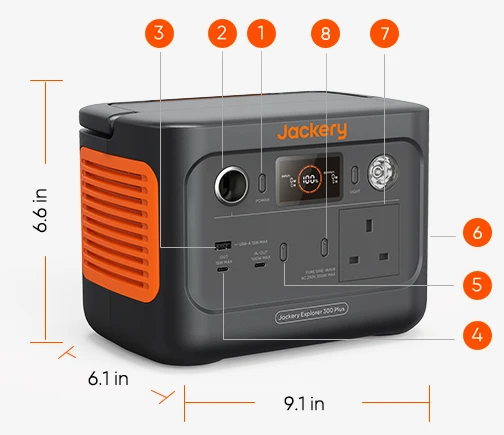
| USB ports | 1× USB-C 100W (in/out), 1× USB-C 15W, 1× USB-A 15W |
| Other DC | 1× car port (12V/10A), built-in LED light |
| AC recharge | ~2 hours (wall) |
| Solar input | 100W max (12–27V, 5A) — ~9.5 hrs with SolarSaga 40W, ~4–5 hrs with 100W panel |
| Car recharge | ~5.5 hours (12V) |
| USB-C recharge | ~4 hours at 100W |
| EPS (emergency power supply) | Yes — <20 ms switchover, pass-through charging supported |
| Noise | Whisper-quiet design; silent charging mode rated ≤45 dB |
| Safety | ChargeShield tech, 52 protection mechanisms, UL 94V-0 flame-retardant shell |
| Expandable | No |
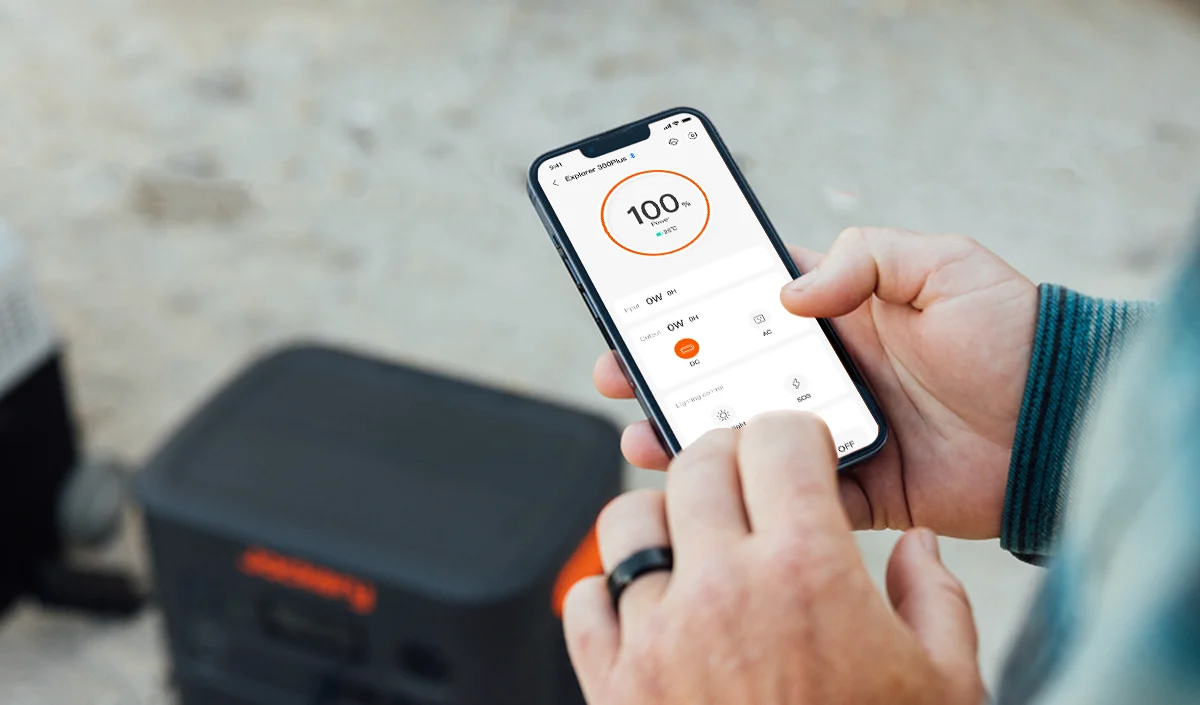
| Connectivity | Wi-Fi + Bluetooth, Jackery app (battery, input/output monitoring) |
| Weight / dimensions | 8.27 lbs (3.75 kg) / 9.1 × 6.1 × 6.6 in |
| Warranty | 3+2 years (register for the extended 2) |
Specs sourced from Jackery's official product pages and user documentation.
Standout features
1. Simplicity as a feature
Where rivals bury you in menus, the 300 Plus does the basics well: one main power button, clearly separated AC/DC controls, a readable display, and an app that shows battery level, input, and output without fuss. For buyers who want a power station that "just works" — parents, grandparents, first-time campers — this approachability is a genuine advantage.
2. Genuinely packable
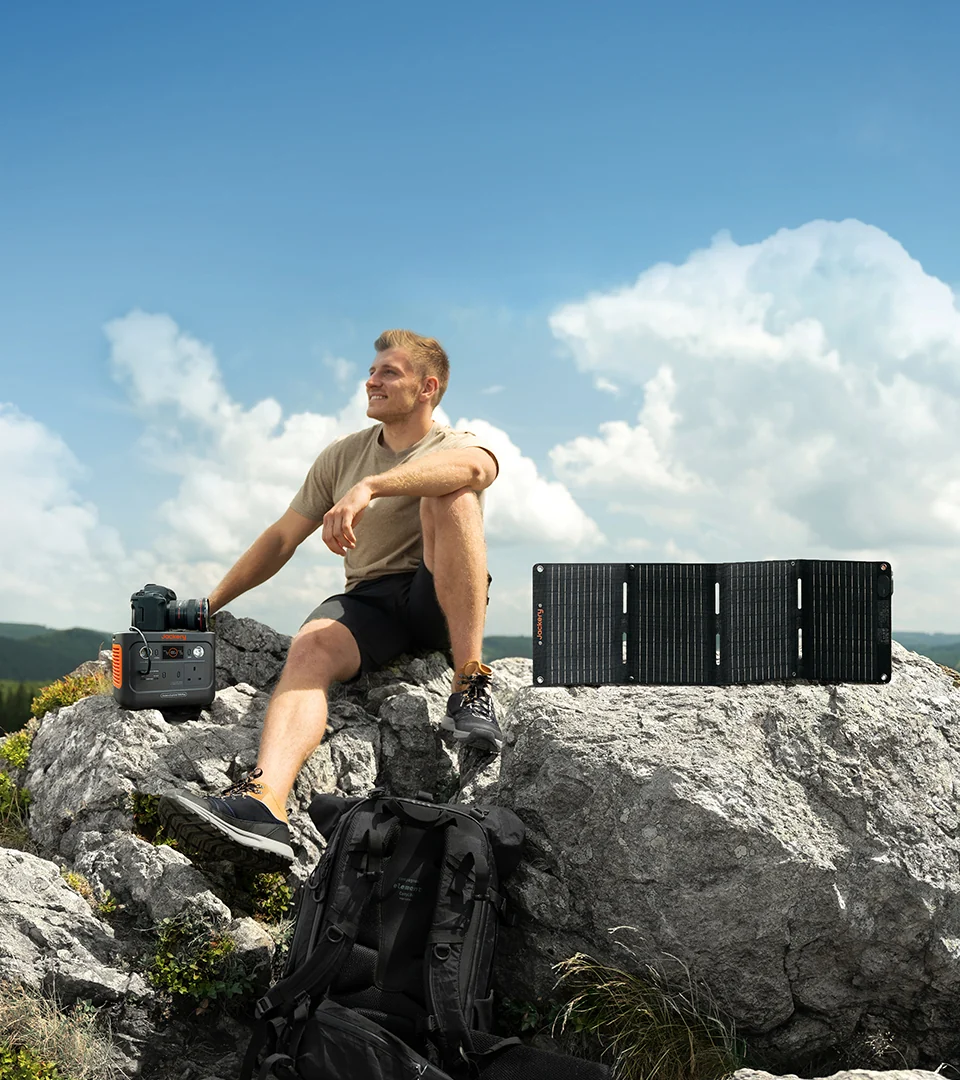
At 8.27 lbs with a foldable handle and a 9.1-inch footprint, it's the lightest unit in the ~300Wh class from a major brand. Jackery's whole pitch — "solar generator in your backpack" — is credible here: the unit plus the book-sized 40W SolarSaga panel weighs about 11 lbs combined.
3. A decade-grade battery
The LiFePO4 cells are rated for 3000 cycles to 80%+ capacity, and Jackery markets a 10-year service life. Combined with ChargeShield's stepped charging algorithm and 52 protection mechanisms, this is a unit built to be used hard and last.
4. Quiet and safe indoors
No fumes, no fuel, and a silent charging mode rated at or below 45 dB. It's safe to run inside a tent, an RV, or a bedroom — the core promise of the whole category, executed cleanly.
Battery & charging, in detail
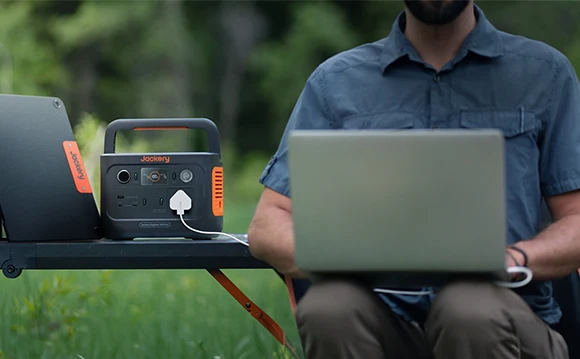
Charging is the 300 Plus's weakest area relative to newer rivals. The wall recharge takes about 2 hours — respectable, but EcoFlow's competing units do it in one. Solar is capped at 100W input, and Jackery warns against paralleling panels (voltage limits), so a full solar refill realistically takes 4–9.5 hours depending on panel size. On the plus side, the 100W bidirectional USB-C port doubles as a fast input: a 100W USB-C wall charger refills it in about 4 hours, which is handy on the road. Pass-through charging is supported, and the EPS mode switches in under 20ms — fine for a router, though not quite the <10ms true-UPS territory of the EcoFlow River 3 Plus.
Real-world use cases (with honest capacity math)
Using Jackery's published runtime figures and straightforward watt-hour math:
Camping and overlanding
This is home turf. Jackery rates a 90W drone at 5 charges, an 8.4W camera at 12 charges, a 60W mini-fridge at about 2.5 hours, and a 5W camp lamp at 22 hours. A weekend of phones, cameras, a drone, and camp lighting fits comfortably inside 288Wh.
Short outages and work-from-home
A laptop (80W) gets roughly 3 charges; a 20W fan runs about 11 hours; a Wi-Fi router (10W) runs roughly a full day. The 300W output covers the small electronics that matter most during a brief blackout — but a full-size fridge or microwave is firmly out of reach.
CPAP backup
A 40W CPAP runs roughly 6 hours — enough for most of a night with the humidifier off. The EPS mode keeps it running through a grid blip, making it a reasonable bedside backup.
What it won't do
300W of output and 288Wh of storage rule out anything with a heating element or a compressor: no full-size fridge, no coffee maker, no power tools beyond the smallest. And with a single AC outlet, you'll be reaching for a power strip the moment you plug in two things.
What could be better
Consistent observations from reviews and owner feedback:
- One AC outlet. The most common complaint — the original Explorer 300 had two. Everything else on the unit is good; this feels like a needless step back.
- Slower charging than rivals. Two hours from the wall and a 100W solar ceiling look dated next to EcoFlow's one-hour recharge and 220W solar input at a similar price.
- No expansion. What you buy is what you get — 288Wh forever. Rivals at this size offer add-on batteries.
- Availability. Jackery's US site now steers buyers to the Explorer 300 v2, and the Plus shows as sold out in several official stores. It's still widely available from retailers, but check stock — and compare against the v2, which adds dual AC outlets, faster charging, and a 4000-cycle battery.
- App is basic. The Jackery app covers monitoring well but lacks the scheduling and smart-outage features EcoFlow's app offers.
Who should buy it
- Campers, hikers, and overlanders who want the lightest, simplest ~300Wh unit from an established brand.
- Drone and camera users — the 100W USB-C port fast-charges modern gear, and the whole kit fits in a pack.
- First-time power station buyers who value simplicity over a spec sheet.
- Deal hunters — as the v2 takes over, retailer discounts on the Plus can make it a genuine bargain.
Who should skip it
- If you need 600W of output or a real UPS for a desk setup, the EcoFlow River 3 Plus is the stronger pick at a similar price.
- If you need to run a fridge or any appliance over 300W, step up to the 500Wh–1kWh class.
- If you want an expandable system that grows with you, look elsewhere — the Plus is a closed box.
FAQ
How long does the Jackery Explorer 300 Plus take to charge?
About 2 hours from a wall outlet, 5.5 hours from a car, around 9.5 hours with the 40W SolarSaga panel (4–5 hours with a 100W panel), or about 4 hours via 100W USB-C input.
Can the Explorer 300 Plus power a refrigerator?
A small 60W car/camping fridge, yes — about 2.5 hours per Jackery's figures. A full-size household fridge, no: 300W of output can't start its compressor.
Does the Jackery Explorer 300 Plus have an app?
Yes. The Jackery app (Wi-Fi/Bluetooth) shows battery level, input/output wattage, and lets you toggle the LED light and outputs.
Is the Explorer 300 Plus expandable?
No. The 288Wh capacity is fixed — there are no add-on batteries.
Is the Explorer 300 Plus still available?
It's getting harder to find new: Jackery's US site now promotes the Explorer 300 v2 as the current model, and the Plus is sold out in some official stores. Retailers still carry it — compare prices against the v2 before buying.
Verdict
The Explorer 300 Plus remains a lovely little power station — light, simple, safe, and backed by a real warranty — but it's a product at the end of its generation. Against the EcoFlow River 3 Plus it loses on output (300W vs 600W), charging speed (2h vs 1h), solar input (100W vs 220W), and UPS speed. Its case now rests on simplicity, weight, and price: if you find it meaningfully cheaper than its rivals, it's still a fine buy for camping and light backup. Otherwise, compare the newer Explorer 300 v2 or the River 3 Plus first.
Pricing note: Jackery lists the 300 Plus with the 40W SolarSaga panel at $399.99; standalone pricing varies by retailer as stock winds down. Check the current price — and the 300 v2's price — before buying.
About our reviews
Specs come from published manufacturer data sheets, cross-checked against owner feedback. Figures go stale. Check the current data sheet before you buy. This is not electrical or purchasing advice.
Related guides
 ReviewsDJI Power 500 Review: The Drone Pilot's 512Wh StationThe DJI Power 500 packs 512Wh of LFP storage with 1000W of continuous output, a full recharge in 70 minutes, and DJI's SDC…
 ReviewsDJI Power 1000 Review: The Drone Pilot's 1kWh StationThe DJI Power 1000 packs 1024Wh of LiFePO4 storage with 2200W of continuous output — the strongest 1kWh inverter in its class…
 ReviewsJackery Explorer 2000 v2 Review: Light & FastThe Jackery Explorer 2000 v2 is the lightest 2kWh power station in its class at 39.5 lbs, with a 52-minute emergency recharge,…