Bluetti Apex 300 Review: 3.8kW of Modular Muscle
7 min read
On this page
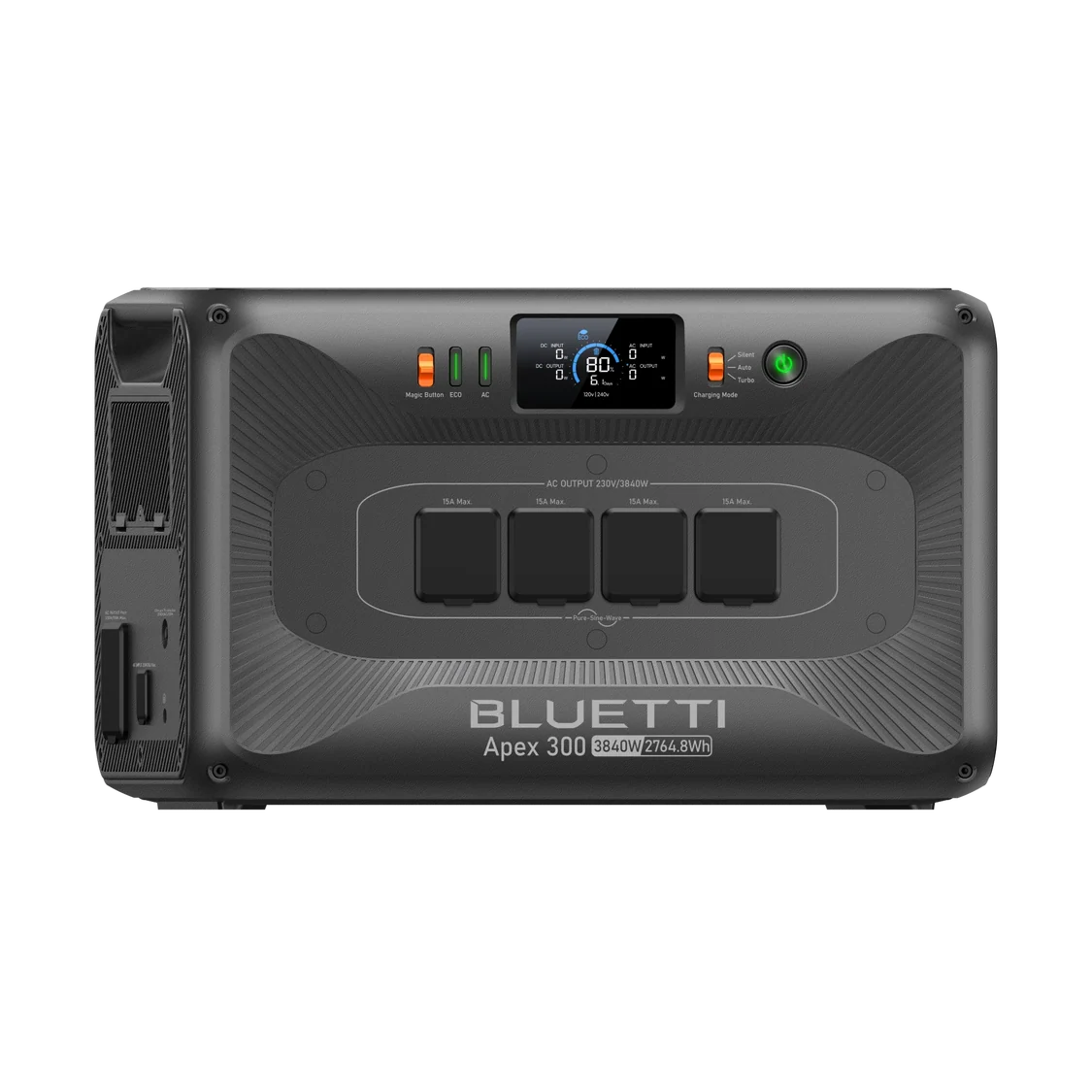
The Bluetti Apex 300 delivers 2,764.8Wh of storage, 3,840W of dual-voltage output, and 6,000-cycle automotive-grade cells in a system that scales to 58kWh. Based on published specs and launch coverage, here's who it's for — and the…
The short version
The Bluetti Apex 300 is a serious home-backup machine disguised as a portable power station: 2,764.8Wh of second-generation automotive-grade LiFePO4, a 3,840W inverter with true 120V/240V dual-voltage output, 2,400W of built-in solar input, and an 80%-in-45-minutes Turbo charge mode. Its 6,000-cycle battery is rated for up to 17 years of daily use, and the modular design scales from a single unit all the way to a 58kWh multi-unit system. The catches: it weighs nearly 84 lbs, it costs real money (around $1,599), and at this size it's "portable" only in the technical sense. For extended outages, RV life, and off-grid builds, it's one of the most capable units in its class.
This is a research-based review: every spec below comes from BLUETTI's official documentation, and the strengths and weaknesses reflect published reviews and owner feedback patterns. We did not bench-test this unit.

Bluetti Apex 300 key specs (verified)
| Spec | Bluetti Apex 300 |
|---|---|
| Capacity | 2,764.8Wh (51.2V/54Ah LiFePO4, 2nd-gen automotive-grade) |
| AC output | 3,840W continuous, 7,680W surge, dual 120V/240V, pure sine wave |
| Battery chemistry / cycle life | LiFePO4 — 6,000+ cycles to 80% capacity (up to ~17 years of daily use) |
| AC input / charging | Up to 3,840W Turbo — 80% in ~45 min, full in ~65 min (Standard 1440W / Silent 500W / Custom modes) |
| Solar input | 2× 1,200W MPPT (2,400W total, 12–60V); up to 6,400W with SolarX 4K accessory |
| AC outlets | 6 total, incl. NEMA TT-30R (RV) and NEMA 14-50R (240V) |
| USB / DC | 2× USB-C (100W each), 2× USB-A (15W), 12V/50A Anderson, 2× DC5521 |
| UPS switchover | 0 ms (US/JP) / 20 ms elsewhere |
| Bypass power | 50A / 12kW bypass for grid pass-through |
| Smart features | Wi-Fi + Bluetooth app, extreme-weather alerts, OTA updates, black start, hot-swappable batteries |
| Expandable | Up to 6× B300K batteries (~19.4kWh); up to 3 units in parallel → 58kWh / 11.52kW |
| Idle consumption | ~20W (low self-consumption design) |
| Weight / dimensions | 83.78 lbs (38 kg) / 20.67 × 12.87 × 12.6 in |
| Warranty | 5-year warranty |
Specs sourced from BLUETTI's official product pages and launch materials.
Standout features
1. Dual-voltage output that actually runs a house
3,840W continuous with both 120V and 240V output is the spec that separates the Apex 300 from the 1–2kWh crowd. The NEMA 14-50R and TT-30R outlets mean it can feed an RV directly, run a well pump or 240V tools, and — with expansion batteries — back up real household circuits. The 7,680W surge handles motor startups that would trip smaller inverters.
2. A battery rated for 17 years
The second-generation automotive-grade LiFePO4 cells are rated for 6,000+ cycles to 80% capacity — roughly double the cycle life of the 3,000-cycle standard in this class. Bluetti frames it as up to 17 years of daily use, and independent validation of the same cell standards has been reported for the Elite line. For a unit you buy as long-term outage insurance, longevity is the spec that matters most.
3. Turbo charging that respects your time
Turbo mode pulls up to 3,840W from AC and hits 80% in about 45 minutes — the fastest wall recharge in its class. Four AC charging modes (Standard, Turbo, Silent, Custom via app) let you trade speed for quiet or gentler treatment of the cells. Solar is equally serious: 2,400W built in, expandable to 6,400W with the SolarX 4K.
4. Built to grow into a whole-home system
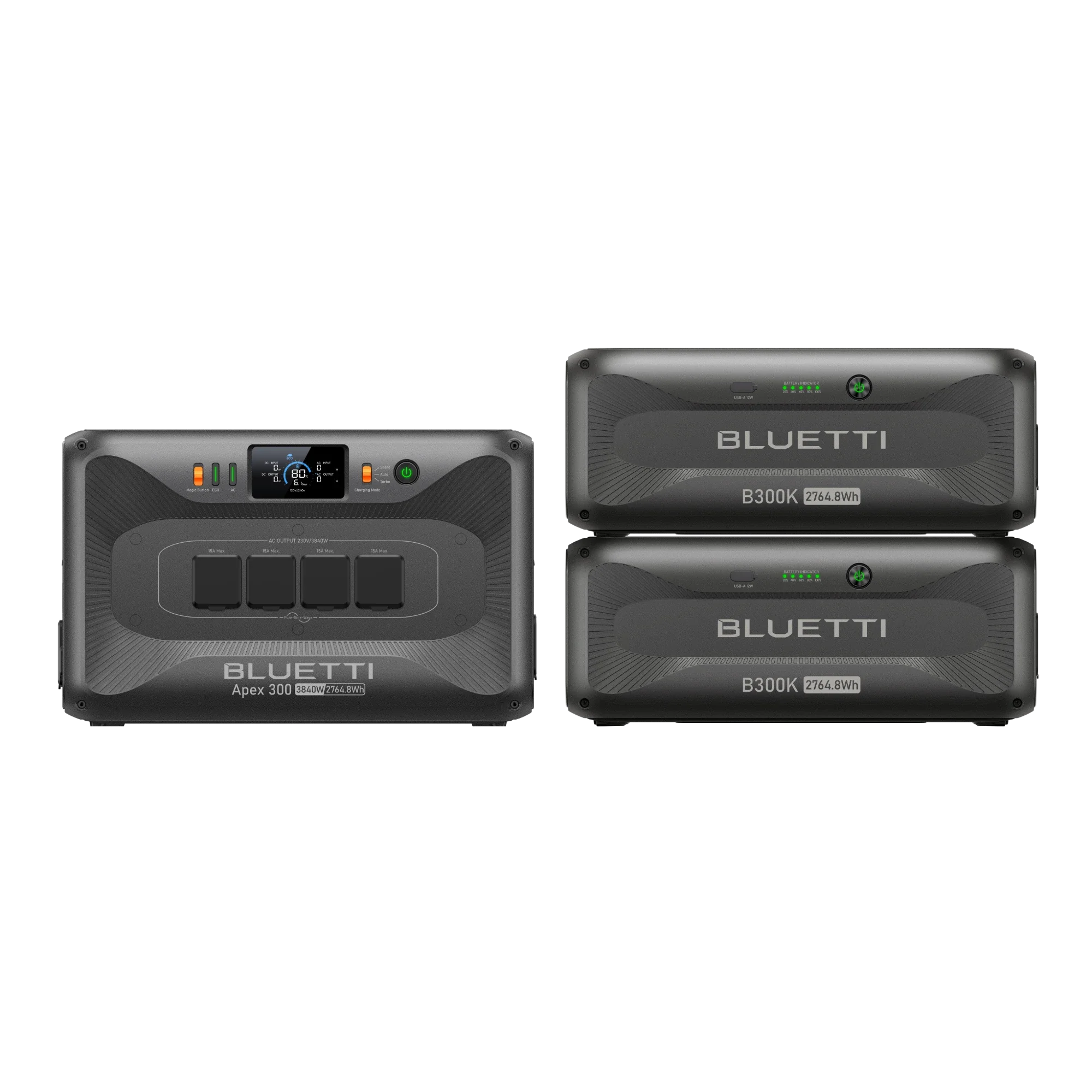
Few power stations scale like this: stack up to six B300K expansion batteries (hot-swappable, no shutdown needed) for ~19.4kWh, or parallel three Apex 300 units for 58kWh and 11.52kW of output. Add the black-start capability (restart from zero on solar alone) and ~20W idle draw, and it works as an always-on home gateway, not just an emergency box.
Battery & charging, in detail
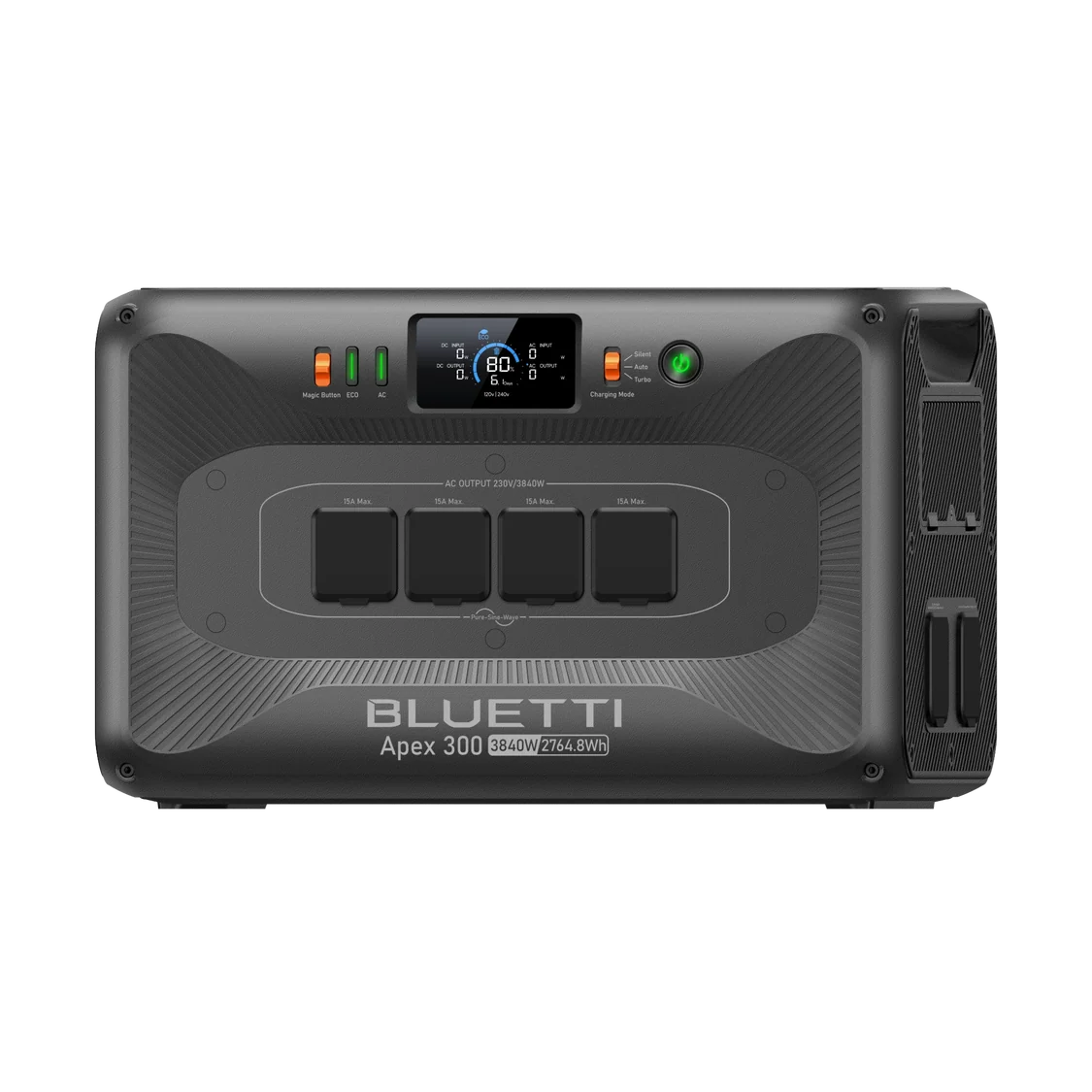
Charging flexibility is a genuine strength: wall (up to 3,840W Turbo), solar (2,400W dual-MPPT built in), car (12V/24V), generator, and combined AC+solar. The four charging modes are thoughtfully designed — Silent mode (500W) for overnight top-ups, Turbo for the pre-storm panic charge. Bluetti's EnerBalance AI manages cell balancing and keeps idle consumption around 20W, which matters when the unit sits plugged in for months between outages. The app adds extreme-weather alerts that can automatically switch the unit into emergency backup mode when a storm warning is issued — a thoughtful touch for the "set it and forget it" buyer.
Real-world use cases (with honest capacity math)
Extended home outages
A full-size fridge (~120W average with cycling) runs roughly 18–20 hours on the base unit alone — two days of food safety, or much longer with solar replenishment during the day. Add a router, phones, and LED lighting and the essentials hold for a full day-plus. With one B300K expansion battery (~5.5kWh total), you're into multi-day territory.
Well pumps and heavy loads
A typical 1/2 HP well pump (~1,000W running, up to ~4,000W surge) is comfortably inside the Apex 300's 3,840W continuous / 7,680W surge envelope — this is exactly the use case that kills 1–2kWh units. Sump pumps, garage door openers, and power tools are all fair game.
RV and off-grid
The TT-30R outlet plugs straight into an RV's 30A shore-power inlet, and 2,764.8Wh runs an RV's lights, fridge, fans, and electronics for a day or more. The 240V output and EV-charging support extend it to bigger toys.
What it won't do
It won't run central air conditioning for long — a 3-ton AC draws 3,500W+ and would drain the base unit in under an hour. Whole-home backup with HVAC needs the expanded multi-battery configuration. And at 83.78 lbs, "portable" means "two people or a hand truck," not "toss it in the trunk."
What could be better
Consistent observations from coverage and owner feedback:
- 84 lbs is a two-person lift. There's no built-in wheeled cart in the base package. If you plan to move it regularly, budget for a dolly or a permanent spot.
- Premium pricing. Around $1,599 for the base unit, and the expansion ecosystem (B300K batteries, SolarX 4K) adds up fast. The value case rests on the 6,000-cycle battery and scalability.
- UPS speed varies by region. The 0ms switchover applies to US/JP models; other regions get 20ms. Verify your region's spec if UPS performance is critical.
- Full solar potential needs the accessory. The headline 6,400W solar figure requires the SolarX 4K (sold separately); built-in is 2,400W — still excellent, but know the difference.
- New platform, shorter track record. Launched at CES 2025 with an Indiegogo campaign before retail — long-term reliability data is still accumulating compared to Bluetti's older AC-series workhorses.
Who should buy it
- Homeowners in outage-prone areas who want multi-day backup for fridges, well/sump pumps, and essential circuits — especially with one or two expansion batteries.
- RVers and off-gridders who need 240V, high surge capacity, and serious solar input in one box.
- Buyers who think in decades — the 6,000-cycle battery is the best longevity story in this class.
- Anyone planning a phased build — start with the base unit, add B300K batteries later, parallel units if you ever need to.
Who should skip it
- If your needs fit inside 1kWh (fridge for a day, phones, CPAP), a Delta 2 or Delta 3 costs half as much and weighs a third.
- If you need to carry it solo regularly, look at lighter 2kWh units with wheels.
- If you need whole-home HVAC backup, price out the full expanded system first — you're in installed-battery territory.
FAQ
How long does the Bluetti Apex 300 take to charge?
About 45 minutes to 80% (65 minutes to full) on Turbo AC charging, or around 40 minutes to 80% on solar with a full 2,400W array in optimal conditions.
Can the Apex 300 run a well pump or sump pump?
Yes. Its 3,840W continuous / 7,680W surge output handles typical 1/2 HP well and sump pumps, including their multi-thousand-watt startup surges.
Is the Bluetti Apex 300 expandable?
Yes — up to six B300K expansion batteries (~19.4kWh total), and up to three Apex 300 units can be paralleled for 58kWh and 11.52kW of output.
Does the Apex 300 work as a UPS?
Yes, with 0ms switchover on US/JP models (20ms in other regions) — fast enough to keep sensitive electronics running through an outage.
What is the Apex 300's battery lifespan?
Bluetti rates the automotive-grade LiFePO4 cells for 6,000+ cycles to 80% capacity — roughly up to 17 years of daily use — backed by a 5-year warranty.
Verdict
The Apex 300 is Bluetti's most convincing home-backup play yet: real 240V output, class-leading charge speeds, a 17-year battery story, and a genuinely modular path to whole-home scale. The weight and price are honest trade-offs for this much capability — this is infrastructure, not a camping accessory. If your outage plan involves well pumps, multi-day resilience, or a phased path to whole-home backup, the Apex 300 belongs at the top of your shortlist.
Pricing note: the Apex 300 retails around $1,599 in the US and has been seen around $1,425 during 2026 sales. Expansion batteries and accessories are separate — price the full system before committing.
About our reviews
Specs come from published manufacturer data sheets, cross-checked against owner feedback. Figures go stale. Check the current data sheet before you buy. This is not electrical or purchasing advice.
Related guides
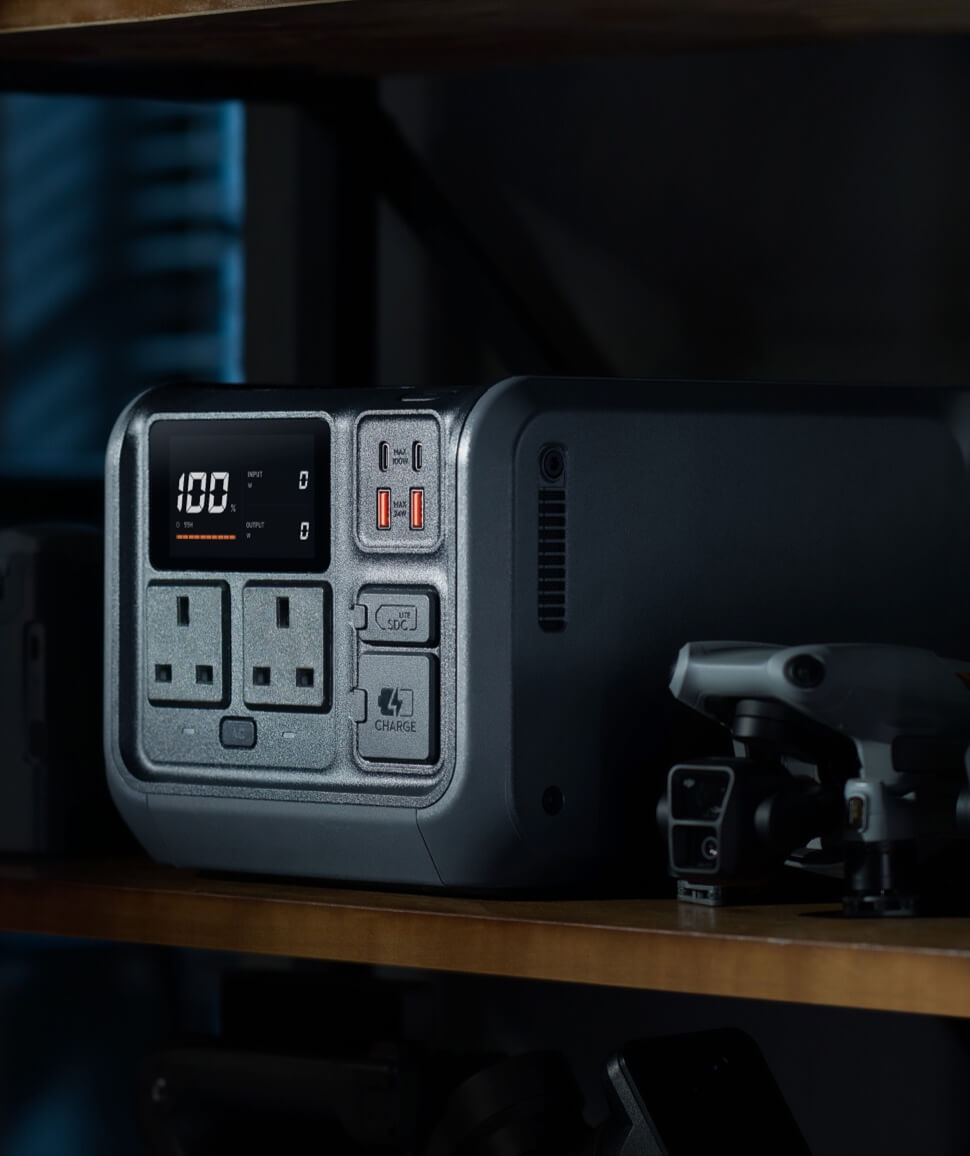 ReviewsDJI Power 500 Review: The Drone Pilot's 512Wh StationThe DJI Power 500 packs 512Wh of LFP storage with 1000W of continuous output, a full recharge in 70 minutes, and DJI's SDC…
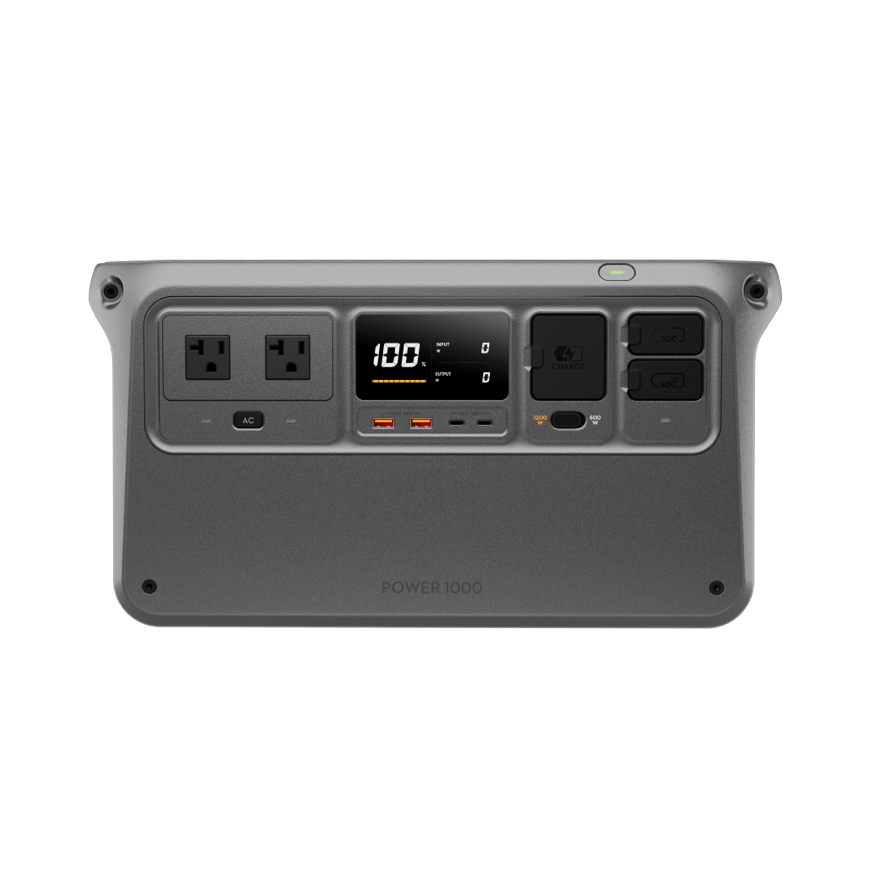 ReviewsDJI Power 1000 Review: The Drone Pilot's 1kWh StationThe DJI Power 1000 packs 1024Wh of LiFePO4 storage with 2200W of continuous output — the strongest 1kWh inverter in its class…
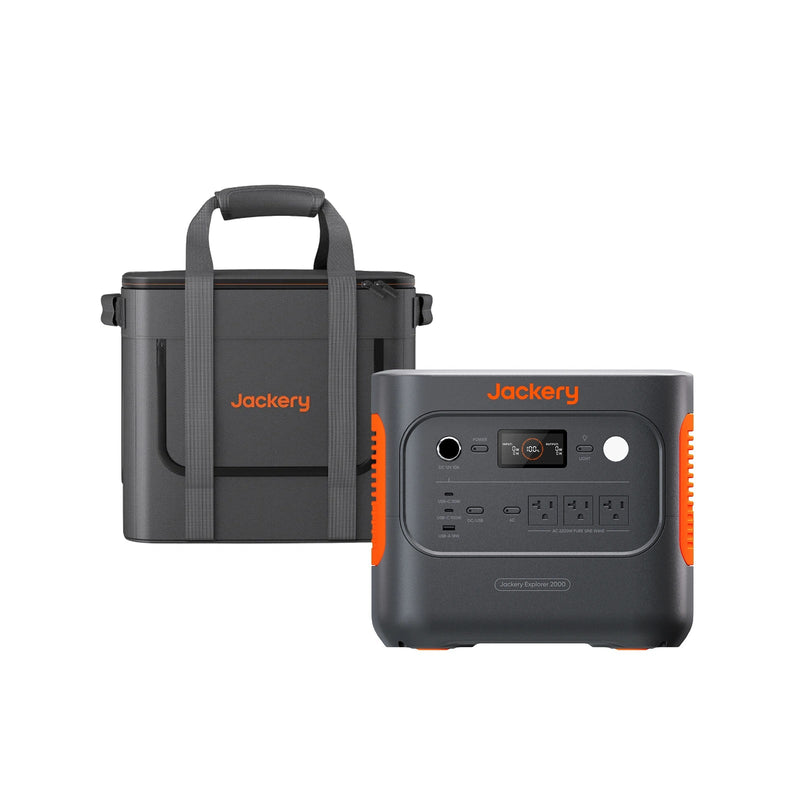 ReviewsJackery Explorer 2000 v2 Review: Light & FastThe Jackery Explorer 2000 v2 is the lightest 2kWh power station in its class at 39.5 lbs, with a 52-minute emergency recharge,…