EcoFlow Delta 3 Max Review: 2kWh Power, Fast Charge
8 min read
On this page
The EcoFlow Delta 3 Max packs 2048Wh of LiFePO4 storage and 2400W of output into a 45-lb box that recharges to 80% in about 68 minutes and runs at just 25dB under light loads. Based on published specs, expert reviews, and owner feedback,…
The short version
The EcoFlow Delta 3 Max is EcoFlow's refined 2kWh flagship in the DELTA 3 family: 2048Wh of long-life LiFePO4 storage, 2400W of continuous pure-sine-wave output (3400W with X-Boost), and X-Stream wall charging that hits 80% in roughly 68 minutes. EcoFlow also claims whisper-quiet operation — 25dB or less at loads up to 600W — and a sub-10ms UPS switchover, plus a genuinely useful Storm Guard mode that watches weather alerts and pre-charges the unit before a storm. The big caveat: unlike the older DELTA 2 Max, the standard 3 Max has no extra-battery expansion port — if you want to grow later, you need the 3 Max Plus instead. At around $1,399 on ecoflow.com as of Oct 2026, it's a premium pick, but for fast-charging home backup in a still-portable package, it's one of the strongest 2kWh options you can buy.
This is a research-based review: every spec below comes from EcoFlow's official documentation, and the strengths and weaknesses reflect patterns across published expert reviews and verified owner feedback. We did not bench-test this unit.

EcoFlow Delta 3 Max key specs (verified)
| Spec | EcoFlow Delta 3 Max |
|---|---|
| Capacity | 2048Wh (51.2V / 40Ah LiFePO4) |
| AC output | 4 outlets, 120V/60Hz, 2400W continuous, pure sine wave |
| X-Boost | Up to 3400W for high-draw resistive appliances |
| Battery chemistry / lifespan | LiFePO4 — EcoFlow estimates ~10 years of proper daily use (internal simulation data) |
| AC recharge | Up to 2300W X-Stream: 0–80% in ~68 min |
| Solar input | 500W max (0–80% in ~3.4 hrs in ideal sun, per EcoFlow) |
| Car / alternator charging | 12V/24V, 8A; up to 500W with EcoFlow's Alternator Charger via XT60 |
| USB ports | 1× USB-A (18W), 1× USB-C (100W), 2× USB-C (30W each, 30W shared total) |
| Other DC | 1× car port (12.6V/10A, 126W) — 9 total outlets |
| Expandable | No — no extra-battery port (the DELTA 3 Max Plus adds one, up to 10kWh) |
| Connectivity | Wi-Fi 2.4GHz + Bluetooth 5.0, EcoFlow app (Storm Guard, scheduling, firmware) |
| UPS mode | <10ms automatic switchover |
| Noise | ≤25dB at 600W load, measured at 1m (EcoFlow lab figure) |
| Weight / dimensions | 44.8 lbs (20.3 kg) / 19.4 × 9.4 × 12 in |
| Warranty | 5-year warranty (3-year standard + 2-year extended on app registration) |
Specs sourced from EcoFlow's official US product page and EcoFlow's DELTA 3 Max series spec comparison.
Standout features
1. 68-minute wall recharge with 2400W of headroom
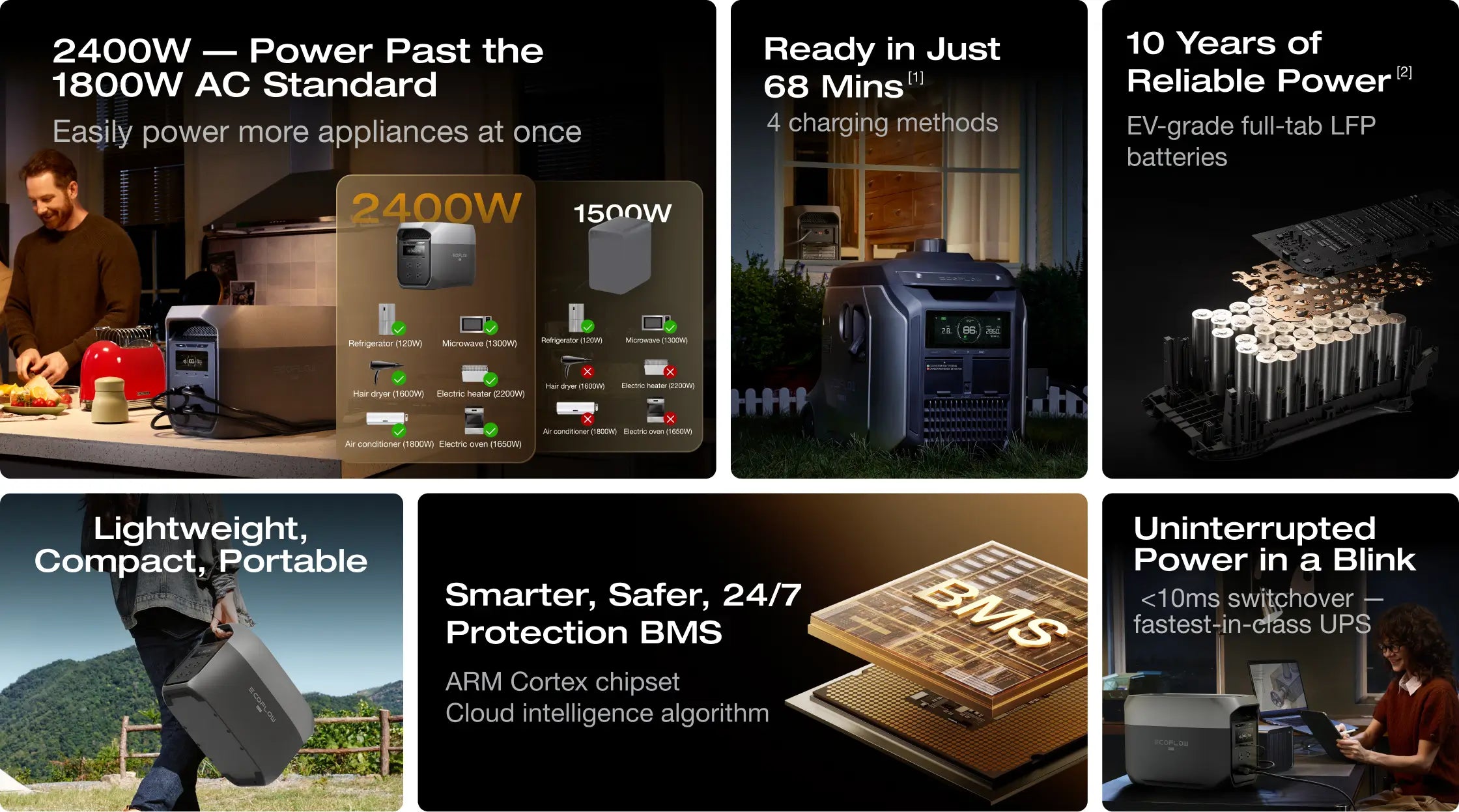
The headline spec is the combination of speed and muscle: 0–80% in about 68 minutes from a wall outlet, and 2400W of continuous output — enough for a fridge, microwave, coffee maker, or circular saw at the same time. X-Boost 3.0 pushes resistive loads like heaters and kettles up to 3400W. Multiple reviewers note that the fast recharge changes how you use the unit: it works as a daily power tool, not a box you charge the night before.
2. Whisper-quiet at realistic loads
EcoFlow publishes an official noise figure of 25dB or less at 600W (measured at 1m) thanks to X-Quiet 3.0 stepless fan control — roughly the level of a whisper. That covers fridges, routers, laptops, CPAP machines, and most everyday backup loads. Under heavy discharge (near 2400W) or full-speed charging the fans will still be audible, but at the loads most people actually run, this is one of the quieter 2kWh stations on paper.
3. Storm Guard: the app feature that actually matters
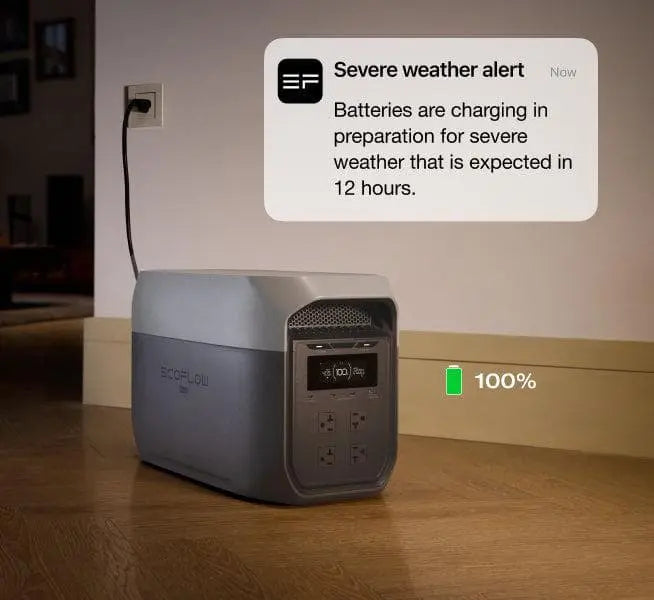
Storm Guard mode (activated in the EcoFlow app) monitors severe-weather alerts and automatically triggers AC charging so the unit is full before a storm hits. It's the kind of feature that sounds like marketing until a hurricane is 12 hours out — then it's the reason your fridge stays cold. Few competitors offer anything equivalent built into the app.
4. Sub-10ms UPS for always-on gear
With a switchover under 10 milliseconds, the Delta 3 Max can sit inline as a UPS for a router, NAS, or desktop PC — fast enough that most electronics never notice the grid dropped. Combined with the low idle noise, it's credible as a permanent bedside or office-desk backup.
Battery & charging, in detail
Four charging paths: wall (up to 2300W X-Stream), solar (500W max), car (12V/24V at 8A), and EcoFlow's 500W Alternator Charger through the XT60 port for topping up while driving. The 500W solar cap is the weak link for off-grid use — a full solar refill takes around 3.4 hours in ideal conditions with a full 500W array, per EcoFlow, which is slow next to the 68-minute wall charge. EcoFlow's automotive-grade full-tab LFP cells and cell-to-chassis structure are engineered for drop resistance and a roughly 10-year service life with proper use; the BMS (ARM Cortex-based) tracks state of charge, health, and temperature in real time.
Real-world use cases (with honest capacity math)
Runtime estimates below use straightforward watt-hour math (2048Wh × ~85% inverter efficiency ÷ load), cross-checked against EcoFlow's published appliance figures:
Home backup during an outage
A standard refrigerator (~120W) runs an estimated 12–14 hours — a full day of food safety for most short outages. Add a Wi-Fi router (10W, ~174 hrs) and phone charging, and the essentials stay up. A microwave (1300W) gets roughly an hour of cumulative cooking time. For outages stretching past a day, the 500W solar input or a generator (1800W max input supported) extends runtime.
CPAP overnight
A 40W CPAP runs an estimated 40+ hours — several nights per charge. (Heated humidifiers draw far more; check your machine's wattage.) The sub-10ms UPS mode makes the Delta 3 Max a credible bedside backup that keeps a CPAP alive through a blackout without a blip.
Workshop and job site
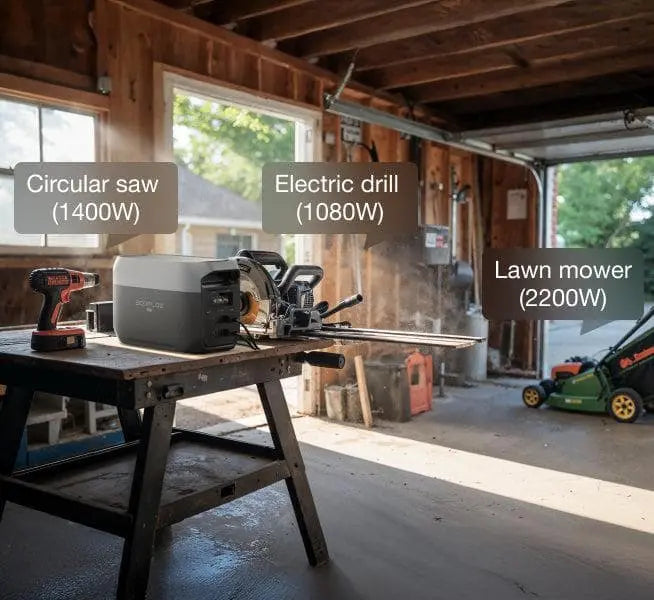
A circular saw (1400W) gets roughly 70 minutes of runtime; an electric drill (1080W) about 95 minutes; a lawn mower (2200W) around 45 minutes. The 2400W output means most corded tools run without tripping the inverter — the 68-minute recharge means you can top up over lunch.
Camping and RV
A 12V car fridge (~60W) runs an estimated 29+ hours; laptops charge ~29 times (60W); camp lighting runs for days. At 44.8 lbs it's a two-hand carry, not a backpack unit — but it replaces a noisy gas generator at the campsite.
What it won't do
2048Wh is not whole-home backup: central AC, an electric furnace, or a well pump will drain it fast. And the lack of an expansion port is a hard ceiling — if you think you'll need 4–8kWh later, the DELTA 3 Max Plus (expandable to 10kWh) or a Bluetti AC200L is the smarter buy.
What could be better
The consistent criticisms across expert reviews and owner feedback:
- No battery expansion. The single biggest structural drawback. The older DELTA 2 Max took extra batteries; the standard 3 Max doesn't. If your needs grow, you're buying a second unit or stepping up to the Plus.
- Solar input capped at 500W. Rivals in this class accept 800–1200W. For solar-first off-grid use, the wall charger is doing the heavy lifting here, not the sun.
- USB-C is modest. One 100W port and two 30W ports (30W shared) is fine for phones and one laptop, but the Anker Solix C2000 Gen 2's dual 140W USB-C ports are more useful for multi-laptop households.
- Premium price. At ~$1,399 on ecoflow.com as of Oct 2026, it lists well above sale prices of the Jackery Explorer 2000 v2 (~$899) and Anker Solix C2000 Gen 2 (~$899). Watch for holiday sales.
- 44.8 lbs is a real carry. 13% lighter than the DELTA 2 Max per EcoFlow, but still a two-handed lift up stairs. The Jackery 2000 v2 is ~5 lbs lighter in the same capacity class.
Who should buy it
- Homeowners in storm country who want fast-recharging backup with Storm Guard pre-charging and sub-10ms UPS for routers and PCs.
- Anyone who values quiet operation at realistic loads — the ≤25dB @ 600W figure is best-in-class on paper.
- Workshop / job-site users who'll use the 2400W output and 68-minute recharge daily — the fast top-up is the killer feature here.
- CPAP users wanting multi-night backup without a second thought — 40+ estimated hours per charge with UPS switchover.
Who should skip it
- If you plan to expand capacity later, buy the DELTA 3 Max Plus or a Bluetti AC200L instead — the standard 3 Max can't take extra batteries.
- If solar is your primary recharge source, the 500W cap is limiting; look at the Bluetti AC200L (1200W) or Anker Solix C2000 Gen 2 (800W).
- If budget is the priority, the Jackery Explorer 2000 v2 and Anker Solix C2000 Gen 2 both hover around $899 on sale with similar 2kWh capacity.
FAQ
How long does the EcoFlow Delta 3 Max take to charge?
About 68 minutes to 80% from a wall outlet with X-Stream fast charging. Solar takes around 3.4 hours to 80% with a full 500W of panels in ideal sun. Car charging is the slowest option.
Is the EcoFlow Delta 3 Max expandable with extra batteries?
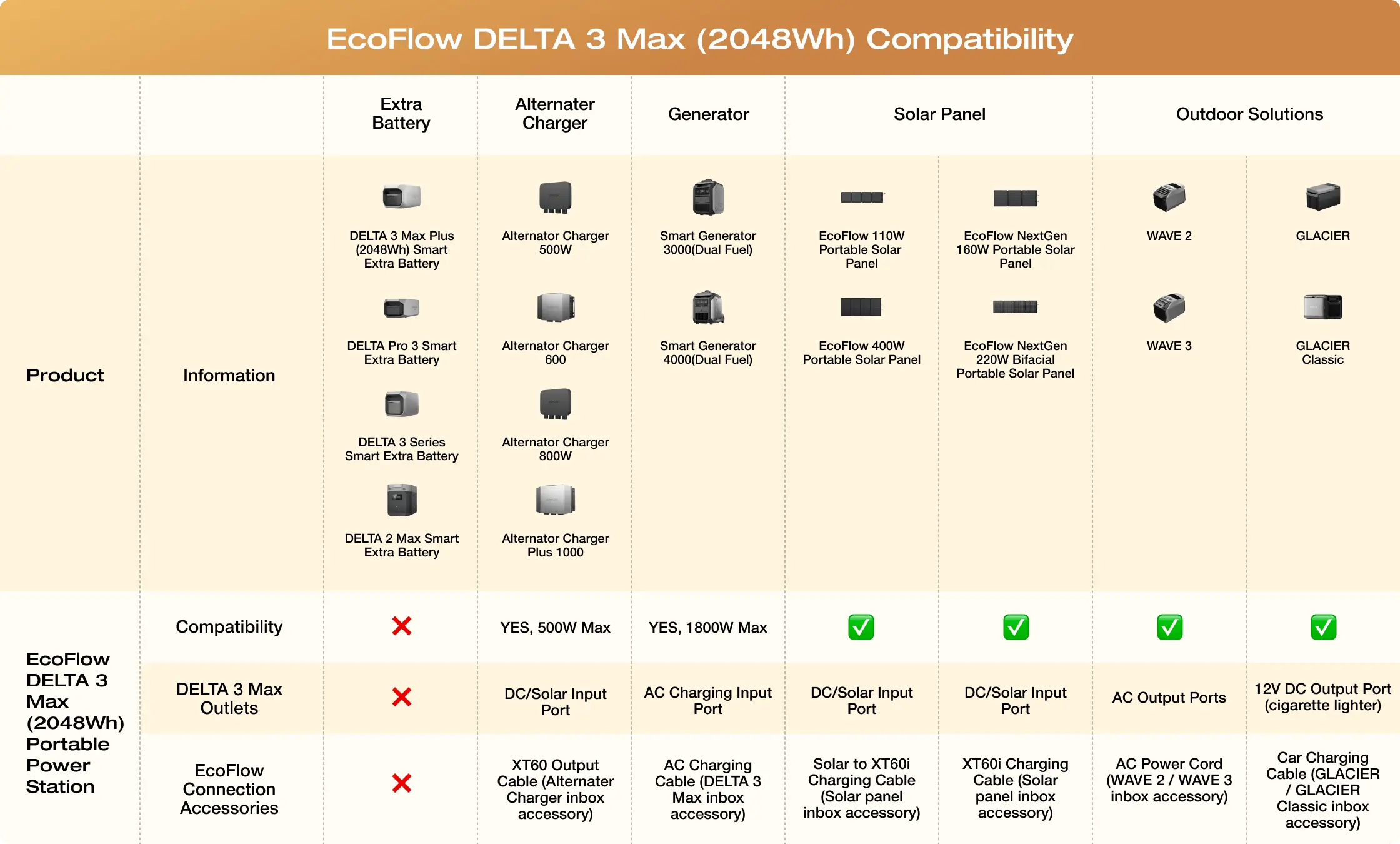
No. The standard DELTA 3 Max has no extra-battery port — EcoFlow's own compatibility chart confirms it. If expandability matters, the DELTA 3 Max Plus accepts extra batteries up to 10kWh total.
Can the EcoFlow Delta 3 Max power a refrigerator?
Yes. Its 2400W inverter easily starts a full-size fridge, and watt-hour math suggests roughly 12–14 hours of runtime for a ~120W fridge. The <10ms UPS mode also keeps it running through a blackout without interruption.
How quiet is the EcoFlow Delta 3 Max?
EcoFlow rates it at 25dB or less at loads up to 600W (measured at 1m) — whisper territory. Fan noise increases under heavy discharge or full-speed charging, as with every station in this class.
What is the EcoFlow Delta 3 Max's warranty?
A 5-year warranty: 3 years standard plus 2 extra years on app registration — among the best in the portable power station market.
Verdict
The Delta 3 Max is EcoFlow doing what EcoFlow does best: the fastest wall charging in the 2kWh class, genuinely quiet operation at realistic loads, and app features (Storm Guard, UPS) that solve real backup problems. The non-expandable battery and 500W solar cap are real limitations that push solar-first or growth-minded buyers toward Bluetti or the Max Plus. But if your use case is home backup, workshop duty, or RV power in a still-portable 45-lb box — and you catch it on sale below the ~$1,399 list price — it's an easy recommendation. Check current pricing before buying; EcoFlow runs deep promotional discounts.

About our reviews
Specs come from published manufacturer data sheets, cross-checked against owner feedback. Figures go stale. Check the current data sheet before you buy. This is not electrical or purchasing advice.
Related guides
 ReviewsDJI Power 500 Review: The Drone Pilot's 512Wh StationThe DJI Power 500 packs 512Wh of LFP storage with 1000W of continuous output, a full recharge in 70 minutes, and DJI's SDC…
 ReviewsDJI Power 1000 Review: The Drone Pilot's 1kWh StationThe DJI Power 1000 packs 1024Wh of LiFePO4 storage with 2200W of continuous output — the strongest 1kWh inverter in its class…
 ReviewsJackery Explorer 2000 v2 Review: Light & FastThe Jackery Explorer 2000 v2 is the lightest 2kWh power station in its class at 39.5 lbs, with a 52-minute emergency recharge,…