EcoFlow River 3 Plus vs Jackery Explorer 300 Plus
5 min read
On this page
Two 288Wh-class rivals, two philosophies: the EcoFlow River 3 Plus brings 600W of output and a true UPS, while the Jackery Explorer 300 Plus is lighter and simpler. Based on published specs, here's how they compare head-to-head — and…
Two small stations, two different answers
The EcoFlow River 3 Plus and the Jackery Explorer 300 Plus sit in the same ~288Wh class and cost roughly the same money — but they're built for different buyers. The River 3 Plus is the spec-sheet champion: double the AC output, a true sub-10ms UPS, one-hour recharging, and an expansion path to 858Wh. The Explorer 300 Plus is the simplicity pick: lighter, friendlier, and easier to live with, but with half the output, slower charging, and no room to grow. Here's the full head-to-head, based on each manufacturer's published specifications.
This is a research-based comparison: every figure comes from EcoFlow's and Jackery's official documentation. We did not bench-test either unit.

Side-by-side specs
| Spec | EcoFlow River 3 Plus | Jackery Explorer 300 Plus |
|---|---|---|
| Capacity | 286Wh LiFePO4 | 288Wh LiFePO4 |
| AC output | 600W continuous / 1200W surge | 300W continuous / 600W surge |
| AC outlets | 3 | 1 |
| USB-C | 1× 100W | 1× 100W (in/out) + 1× 15W |
| USB-A | 2× 12W | 1× 15W |
| Car port | Yes (126W) | Yes (12V/10A) |
| Backup switchover | <10 ms (true UPS) | <20 ms (EPS) |
| AC recharge | 0–100% in ~1 hour (380W) | ~2 hours |
| Max solar input | 220W (~1.5 hrs to full) | 100W (~4–9.5 hrs depending on panel) |
| Expandable | Yes — to 572Wh / 858Wh | No |
| Cycle life | 3000 cycles to 80% | 3000 cycles to 80%+ |
| Noise | <30 dB (lab-rated) | ≤45 dB silent mode |
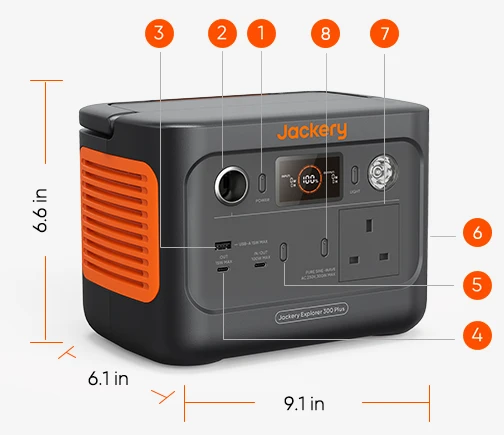
| Weight | 10.4 lbs | 8.27 lbs |
| Warranty | 5 years | 3+2 years |
| Typical price (Oct 2026) | ~$279 list (often $246–$299 on sale) | $399.99 w/ 40W panel bundle; standalone varies |
Head-to-head
Capacity: tie
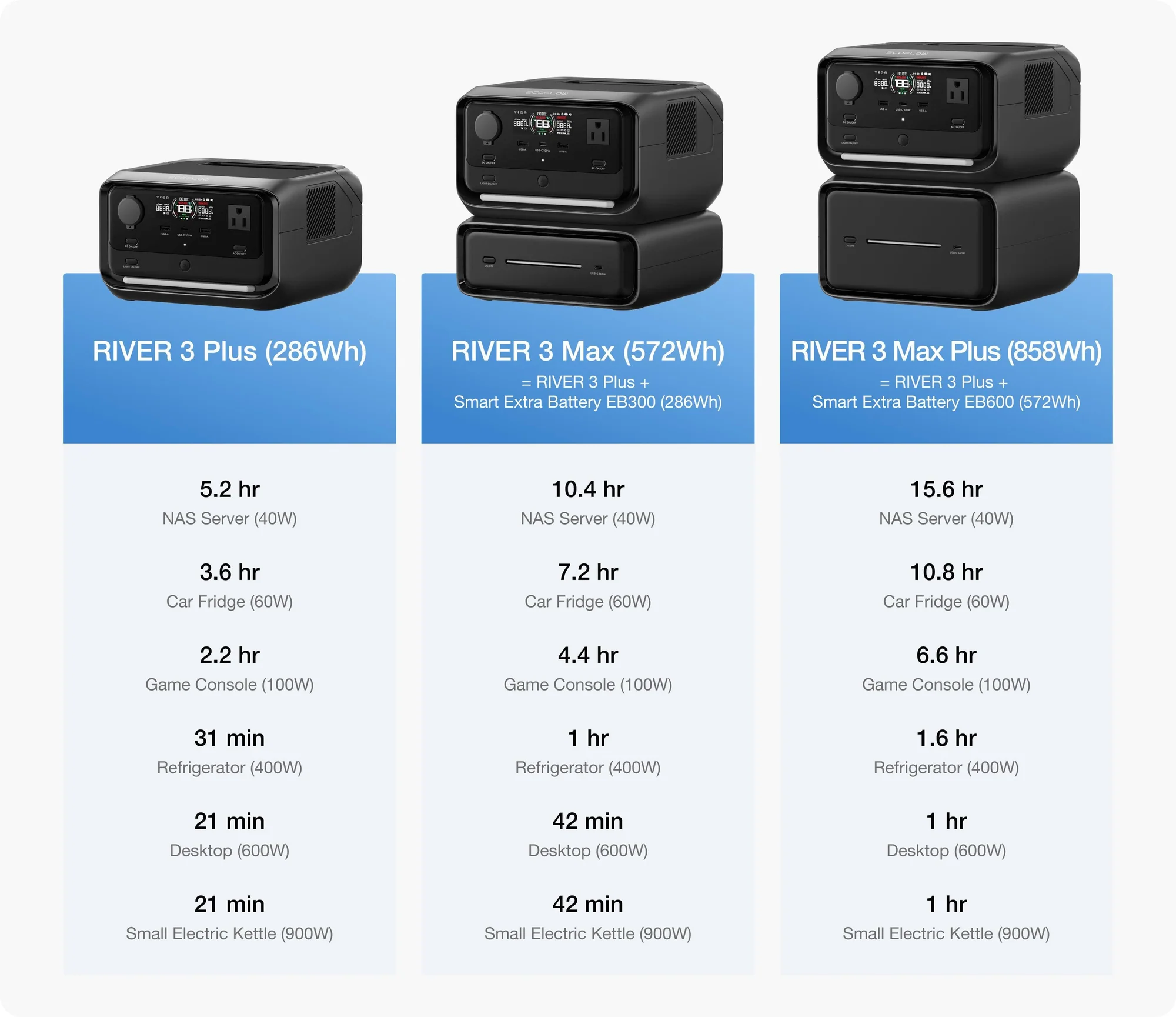
286Wh vs 288Wh is a rounding error — identical in practice. Both are device-charger-class units: phones, laptops, cameras, lights, and small fans, not fridges or kitchen appliances. Neither will carry you through a multi-day outage alone. Where capacity strategy differs is growth: the EcoFlow can add an EB300 or EB600 battery later (up to 858Wh total), while the Jackery is fixed at 288Wh forever. If you suspect your needs will grow — a bigger fridge for camping, longer outages, more devices — that upgrade path is worth real money.
Output: EcoFlow, by a mile
This is the decisive gap. 600W continuous (with 1200W X-Boost for resistive loads) vs 300W continuous means the River 3 Plus can run things the Jackery simply can't: a 500W desktop setup, a small power tool, a full-size blender in short bursts. Three AC outlets vs one is equally lopsided — the Jackery's single outlet is its most-criticized spec.
Charging: EcoFlow
One hour from the wall vs two. 220W of solar vs 100W. The River 3 Plus refills in roughly half the time on every input. Jackery's 100W bidirectional USB-C input is a nice consolation — a 100W USB-C brick refills it in ~4 hours on the road — but it's not enough to close the gap.
Portability: Jackery
Jackery's one clear win: 8.27 lbs vs 10.4 lbs, with a smaller footprint and a foldable handle. If the unit lives in a backpack or gets carried to a campsite by hand, two pounds matters. Both are one-hand portable; the Jackery is just more so.
Backup/UPS duty: EcoFlow
The River 3 Plus's <10ms switchover is a true UPS that keeps a PC or NAS alive; the Jackery's <20ms EPS is fine for a router but not rated for the same duty. EcoFlow even includes the UPS communication cable for graceful PC shutdown. For desk backup, it's not close.
Expandability: EcoFlow
The River 3 Plus grows to 572Wh or 858Wh with add-on batteries. The Explorer 300 Plus is a closed box — 288Wh forever. If there's any chance your needs grow, this matters.
Price and value: EcoFlow (usually)
The River 3 Plus lists at $279 and regularly sells for $246–$299. The Explorer 300 Plus's official bundle is $399.99 with a 40W panel; standalone pricing varies as stock winds down. On specs-per-dollar, the EcoFlow wins — though clearance pricing on the Jackery can flip the math, so check both.
Winner by use case
- Desk UPS / home internet backup: EcoFlow River 3 Plus — true UPS, 600W, three outlets.
- Ultralight camping and travel: Jackery Explorer 300 Plus — lighter, simpler, packable.
- CPAP backup: Either — both cover a 40W machine for ~6 hours; the EcoFlow's UPS edge helps for inline use.
- First power station / gift: Jackery Explorer 300 Plus — the friendlier learning curve.
- Best long-term value: EcoFlow River 3 Plus — more output, faster charging, expandable, longer warranty.
- Tightest budget (on clearance): Whichever is cheaper — check the Jackery's clearance price against the EcoFlow's sale price.
Price, value, and the long game
On sticker price alone, the River 3 Plus usually wins: $279 list with frequent sales around $246–$299, against the Jackery's $399.99 panel bundle (standalone pricing varies as stock winds down). But the real value gap is in longevity of relevance. The EcoFlow's 600W output, true UPS, and 858Wh expansion ceiling mean it stays useful as your needs grow — it can graduate from desk UPS to camping companion to light workshop power. The Jackery's fixed 288Wh and 300W output mean it's a finished product on day one: perfect if that's all you need, limiting if it isn't.
Warranty math favors EcoFlow too: 5 years vs 3+2 (the "+2" requires registration). And with Jackery steering new buyers toward the Explorer 300 v2, the Plus is increasingly a clearance item — great if the discount is deep, but compare it against the v2's price before committing, since the v2 adds dual AC outlets, faster charging, and a 4000-cycle battery.
FAQ
Which is better for camping: River 3 Plus or Explorer 300 Plus?
For car camping where weight matters less, the River 3 Plus — 600W runs more gear and the faster recharge matters on the road. For backpacking-style trips where every pound counts, the Jackery's 8.27 lbs wins.
Can either run a CPAP overnight?
Yes, both. A 40W CPAP (humidifier off) runs roughly 6 hours on either unit's ~288Wh battery. The EcoFlow's <10ms UPS makes it the better bedside inline backup.
Is the Jackery Explorer 300 Plus being discontinued?
Jackery hasn't announced a formal discontinuation, but its US site now promotes the Explorer 300 v2 as the current model and the Plus is sold out in several official stores. Treat it as a clearance-generation product and price-check accordingly.
Which one charges faster from solar?
The River 3 Plus: 220W max input refills it in ~1.5 hours with a full panel array, versus the Jackery's 100W ceiling (4–9.5 hours depending on panel size).
Verdict
On the spec sheet, the EcoFlow River 3 Plus wins this comparison clearly: double the output, triple the outlets, half the charge time, double the solar input, a true UPS, and an expansion path — at a similar or lower price. The Jackery Explorer 300 Plus's case is narrower but real: it's lighter, simpler, and often discounted as its successor (the Explorer 300 v2) takes over. Buy the EcoFlow for capability; buy the Jackery if you find it meaningfully cheaper and value simplicity and weight above all else.
About our reviews
Specs come from published manufacturer data sheets, cross-checked against owner feedback. Figures go stale. Check the current data sheet before you buy. This is not electrical or purchasing advice.
Related guides
 ComparisonsJackery Explorer 2000 v2 vs Bluetti Elite 200 V2The two best 2kWh values of 2026 head-to-head: Jackery Explorer 2000 v2 (2042Wh, 2200W, 39.5 lbs) vs Bluetti Elite 200 V2…
 ComparisonsBluetti Apex 300 vs Anker Solix F3800Two heavyweights of home backup: the Bluetti Apex 300 offers 3,840W and a 6,000-cycle battery, while the Anker Solix F3800…
 ComparisonsEcoFlow Delta 3 vs Delta 2: Should You Upgrade?The EcoFlow Delta 3 keeps the Delta 2's winning 1024Wh/1800W formula but adds faster charging, a quieter fan, a 4,000-cycle…