Jackery Explorer 1000 v2 Review: Light, Fast, Simple
7 min read
On this page
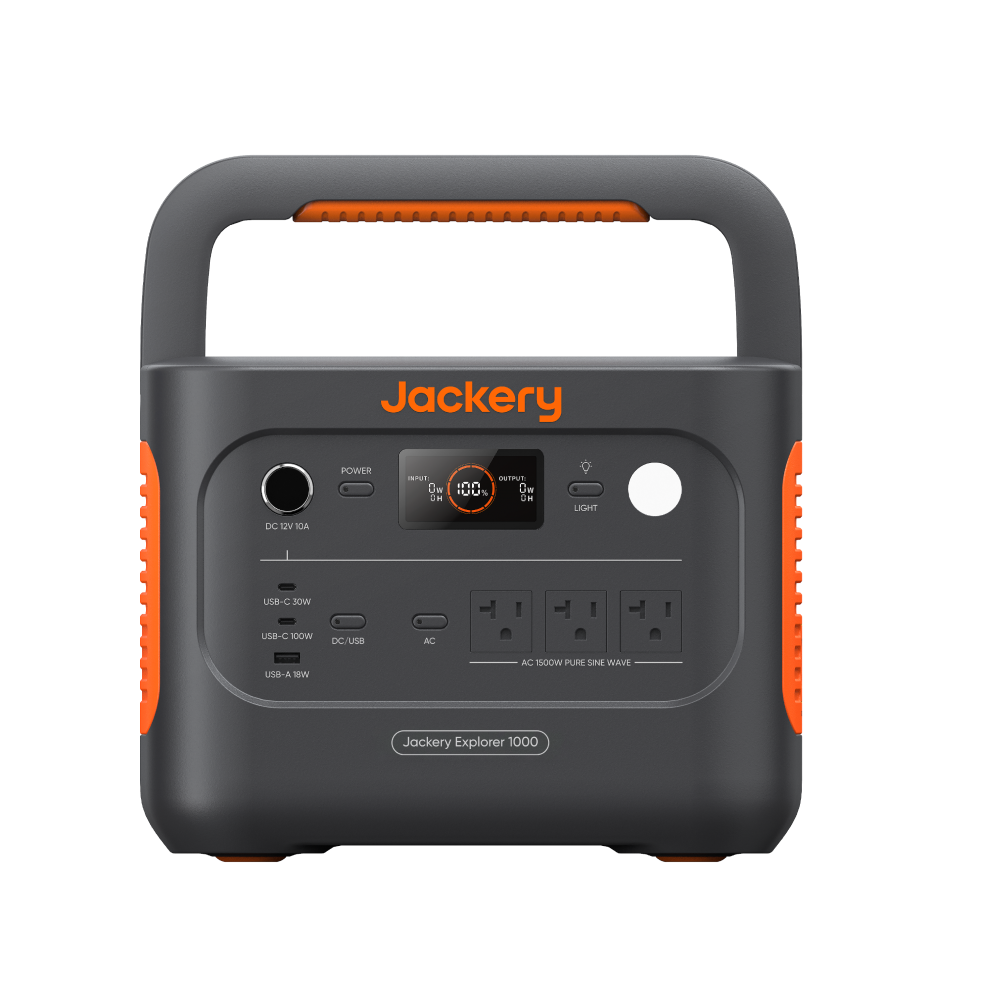
The Jackery Explorer 1000 v2 squeezes 1070Wh of LiFePO4 into a 23.8-lb body, recharges from empty in about an hour, and runs whisper-quiet. Based on published specs, expert reviews, and owner feedback, here's what it does well, where it…
The short version
The Jackery Explorer 1000 v2 is the 1kWh power station for people who value portability and simplicity over raw specs. It holds 1070Wh of LiFePO4 — slightly more than most 1kWh rivals — in a 23.8-lb body that's meaningfully lighter than the EcoFlow and Bluetti competition, recharges from empty to full in about an hour via its Emergency Charge mode, and runs at a whisper-quiet 22 dB in quiet charging mode. The trade-offs: 1500W of output (less than the 1800W class leaders), a modest 400W solar input, and no capacity expansion. At 2026 sale prices of roughly $469–$499 against a ~$559–$599 list, it's the easiest 1kWh station to live with — especially if you'll carry it often.
This is a research-based review: every spec below comes from Jackery's official documentation, and the strengths and weaknesses reflect patterns across published expert reviews and verified owner feedback. We did not bench-test this unit.

Jackery Explorer 1000 v2 key specs (verified)
| Spec | Explorer 1000 v2 |
|---|---|
| Capacity | 1070Wh (30.4Ah/35.2V LiFePO4) |
| AC output | 3 outlets (US), 1500W continuous, 3000W surge |
| Battery chemistry / cycle life | LiFePO4 — 4000 cycles to 70%+ capacity |
| AC recharge | ~1.58 hrs standard; Emergency Charge mode: 0–100% in ~59 min (via app) |
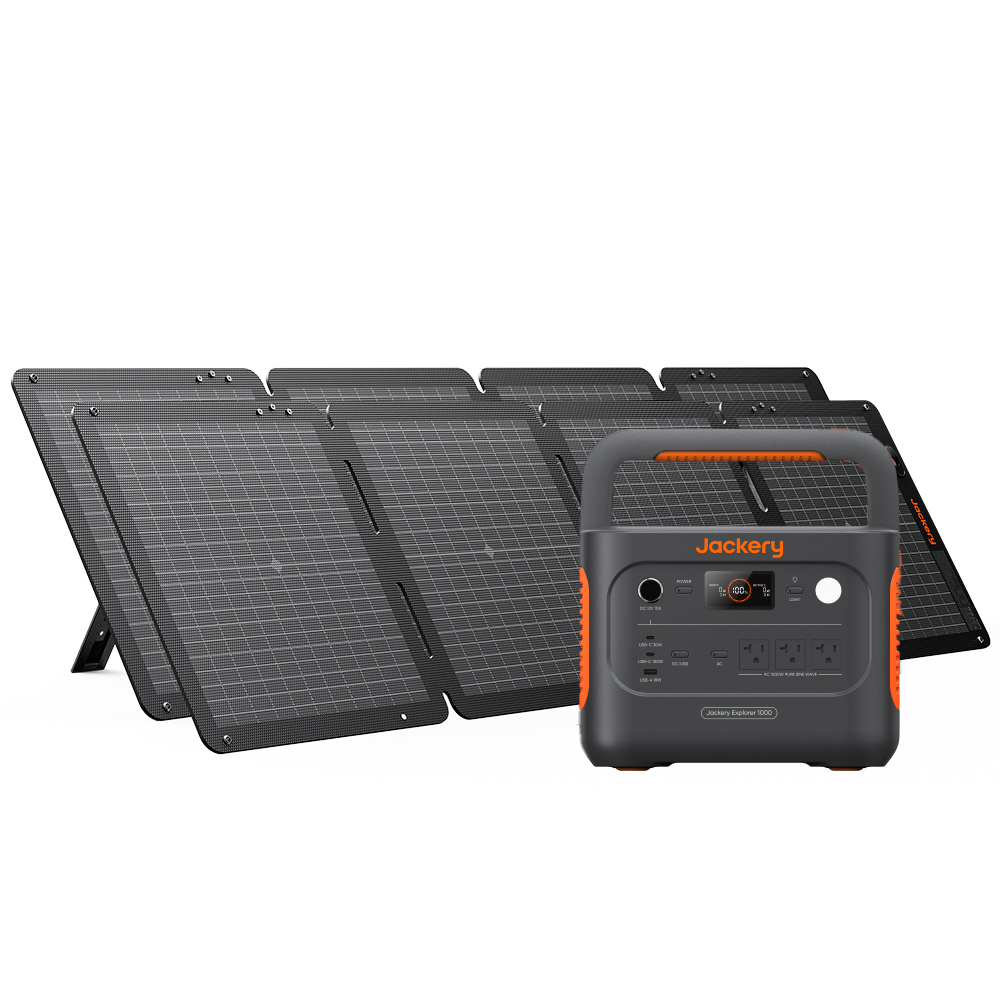
| Solar input | 400W max (12–60V) |
| Car charging | 12V, ~12 hrs |
| UPS / bypass | ≤20 ms switchover; 1500W bypass mode |
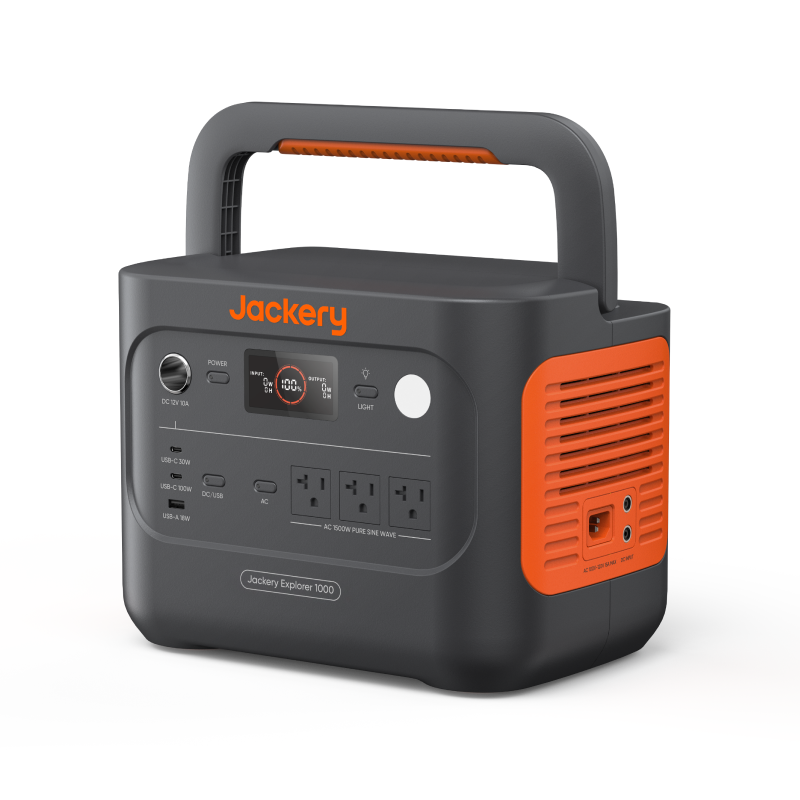
| USB ports | 2× USB-C (100W + 30W), 1× USB-A (18W) |
| Other DC | 1× car port (12V/10A) |
| Noise | ≤22 dB in Quiet Charging mode (per Jackery) |
| Expandable | No |
| Connectivity | Wi-Fi + Bluetooth, Jackery app |
| Weight / dimensions | 23.8 lbs (10.8 kg) / 12.87 × 8.82 × 9.72 in |
| Warranty | 3 years + 2-year extension (5 total via official store) |
Specs sourced from Jackery's official product pages and the Explorer 1000 v2 user manual.
Standout features
1. The lightest 1kWh LiFePO4 station in its class
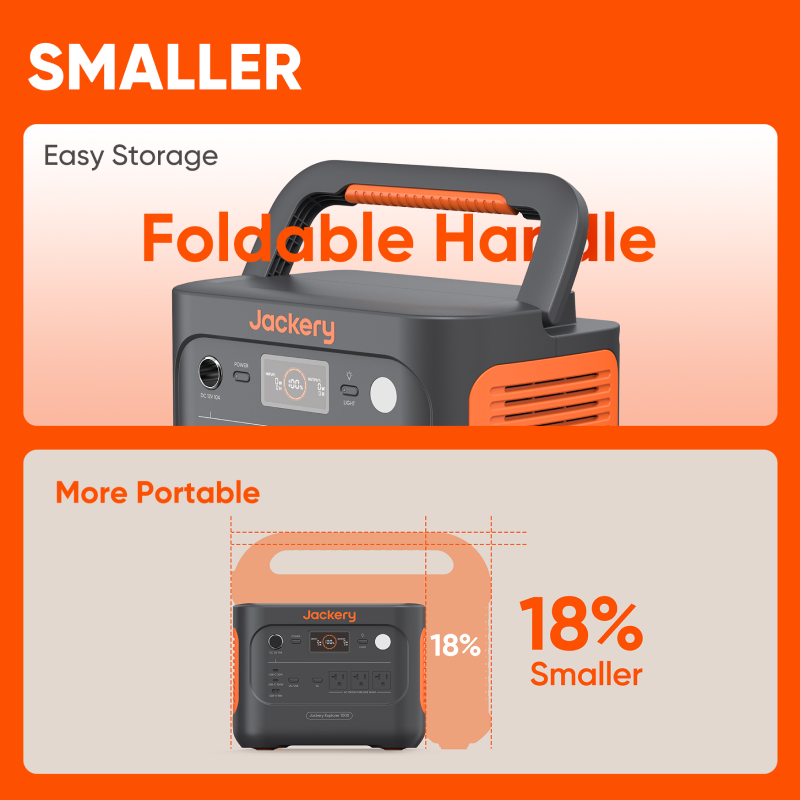
At 23.8 lbs, the Explorer 1000 v2 undercuts the EcoFlow Delta 3 Plus (~27.6 lbs) and Bluetti AC180 (~35.3 lbs) by a margin you'll feel on every carry. Jackery cites third-party market data ranking it the lightest and smallest 1kWh LiFePO4 station among Amazon's top sellers — and the fold-away handle keeps the footprint tidy in a car trunk or closet.
2. One-hour emergency recharge
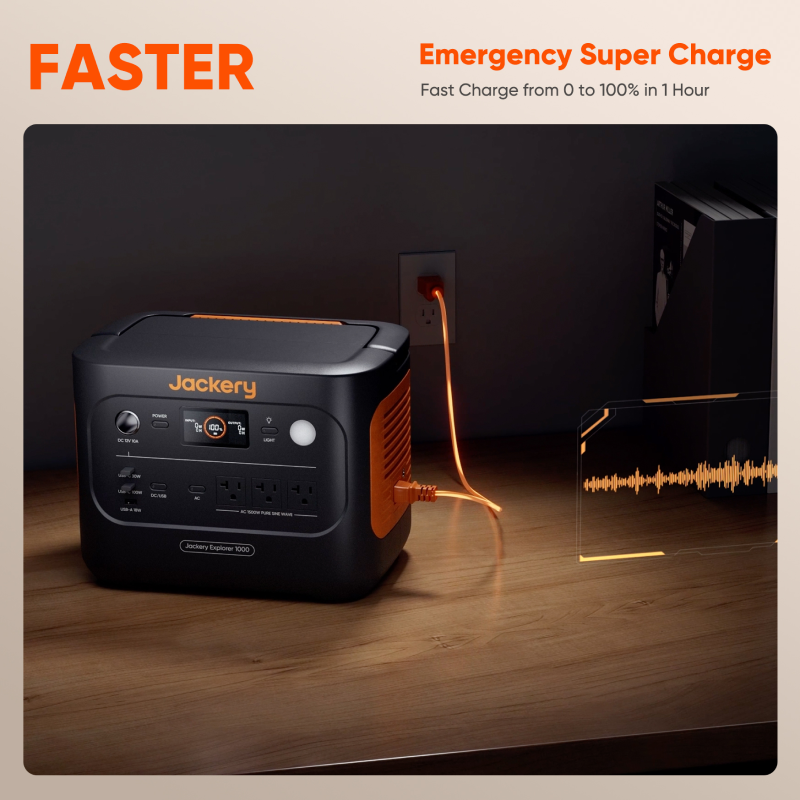
Enable Emergency Charge in the Jackery app and the unit goes from empty to full in about 59 minutes from a wall outlet — Jackery says roughly 7× faster than the previous generation. The default 1.58-hour charge is gentler on the cells for everyday use; the 59-minute mode is there for when the storm is already on the radar.
3. Whisper-quiet operation
Jackery rates the Quiet Charging mode at ≤22 dB — quieter than a whisper, and a genuine differentiator for bedroom, nursery, or home-office use. Even in normal operation, reviewers consistently describe the 1000 v2 as one of the quietest stations in its class.
4. Dead-simple to use
Seven ports, a clear round display, color-coded cables, and an app that doesn't get in the way. Multiple expert reviewers have called it the easiest 1kWh station to hand to a non-technical family member — which matters when the person using it during an outage isn't the person who bought it.
Battery & charging, in detail
Charging is wall-first: 1.58 hours standard, ~59 minutes in Emergency Charge mode (app-enabled), and a quiet ≤22 dB mode for overnight top-ups. The weak link is solar — 400W max means a full solar refill is a full day's work even with ideal panels, the lowest solar ceiling among the big-brand 1kWh stations. Car charging is a slow ~12 hours. The 1500W bypass mode lets it sit inline powering devices while plugged in, and the ≤20 ms UPS switchover covers routers, PCs, and CPAPs through brief outages. Jackery's ChargeShield 2.0 system (62 built-in protections per Jackery) handles the safety side.
Real-world use cases (with honest capacity math)
The following are watt-hour estimates at ~85% inverter efficiency, unless noted as Jackery's published figures:
Home backup during an outage
A full-size fridge (~150W cycling) should run roughly 12–16 hours. The 1500W inverter starts fridges, microwaves (1000W), and coffee makers without drama — but a 1800W hair dryer or a space heater on high will trip it. Know your loads before the outage, not during.
CPAP overnight
Jackery's own guidance puts a 40–60W CPAP at 2–3 nights per charge. At an estimated ~20 hours for a 40W machine, one charge comfortably covers a full night — and the quiet operation is a real plus for bedside use.
Camping and road trips
A 12V portable fridge (~60W) runs an estimated 15–20 hours, a 43" LED TV (~80W) runs 12–14 hours per Jackery's figures, and the whole unit is light enough to carry one-handed to the picnic table. The tuck-away handle and compact footprint are built for this.
What it won't do
It won't run 1800W-class appliances (large microwaves at full power, big air fryers, 1800W kettles) — the 1500W ceiling is a hard limit, and there's no X-Boost-style workaround. And with no expansion port, 1070Wh is all you ever get: for multi-day outages, pair it with solar or step up a class.
What could be better
The consistent criticisms across expert reviews and owner feedback:
- 1500W output trails the 1800W class standard. Fine for most things, but high-draw kitchen appliances and heaters that the EcoFlow/Bluetti/Anker units run will trip this one. The 3000W surge helps with motor startups, not sustained loads.
- 400W solar input is the weakest in class. Refilling 1070Wh from panels takes the better part of a day. If solar is your primary recharge path, the Bluetti AC180 (500W) or EcoFlow Delta 3 Plus (1000W) make more sense.
- No capacity expansion. Unlike the EcoFlow Delta 3 Plus and Anker C1000, there's no extra-battery port — what you buy is what you get, forever.
- Only three AC outlets. Enough for the basics, but a power strip becomes mandatory in a real outage setup.
- Emergency Charge needs the app. The 59-minute mode is app-enabled, not a physical button — a minor annoyance if your phone is dead during the outage when you need it most.
Who should buy it
- Anyone who'll carry their station regularly — campers, RVers, tailgaters: the 23.8-lb weight is the headline reason to choose it.
- Bedroom / home-office backup users who value the ≤22 dB quiet charging and simple interface.
- First-time buyers who want the least intimidating 1kWh station from the most established brand in the category.
- CPAP users needing 2–3 nights of quiet, reliable bedside power.
Who should skip it
- If you run 1500W+ appliances (big air fryer, 1800W kettle, space heater), the 1500W ceiling will frustrate you — get an 1800W unit.
- If solar is your main recharge method, the 400W cap is a real limitation.
- If you might need more than 1kWh later, buy an expandable station (EcoFlow Delta 3 Plus, Anker C1000) instead of outgrowing this one.
FAQ
How long does the Jackery Explorer 1000 v2 take to charge?
About 1.58 hours on a standard wall charge, or roughly 59 minutes in Emergency Charge mode (enabled in the Jackery app). Solar takes most of a day at the 400W input cap; car charging takes about 12 hours.
Can the Jackery Explorer 1000 v2 run a refrigerator?
Yes — the 1500W inverter starts a standard fridge, and the 1070Wh battery should keep it cold for roughly 12–16 hours depending on the fridge's duty cycle.
Is the Jackery Explorer 1000 v2 expandable?
No. Unlike the Explorer 1000 Plus and several competitors, the v2 has no extra-battery port — 1070Wh is the maximum.
How quiet is the Explorer 1000 v2?
Jackery rates Quiet Charging mode at ≤22 dB, and reviewers consistently describe it as one of the quietest 1kWh stations available — suitable for bedrooms and home offices.
What is the Jackery Explorer 1000 v2 warranty?
3 years standard, plus a 2-year extension (5 years total) when purchased through Jackery's official store.
Verdict
The Explorer 1000 v2 doesn't win the spec sheet — 1500W output and 400W solar are modest next to the 1800W competition. It wins on livability: the lightest body in the class, one-hour emergency charging, whisper-quiet operation, and an interface anyone can use. For campers, CPAP users, and anyone who'll actually carry their station, those traits matter more than an extra 300W of inverter headroom. At 2026 sale prices of roughly $469–$499 (list ~$559–$599), it's the friendly default pick in the 1kWh class — just make sure your heaviest appliance fits under 1500W before you buy.
Pricing note: the Explorer 1000 v2 is heavily discounted during sale events — observed around $469–$499 during October 2026 promotions against a $559–$599 list. Check the current price before buying.
About our reviews
Specs come from published manufacturer data sheets, cross-checked against owner feedback. Figures go stale. Check the current data sheet before you buy. This is not electrical or purchasing advice.
Related guides
 ReviewsDJI Power 500 Review: The Drone Pilot's 512Wh StationThe DJI Power 500 packs 512Wh of LFP storage with 1000W of continuous output, a full recharge in 70 minutes, and DJI's SDC…
 ReviewsDJI Power 1000 Review: The Drone Pilot's 1kWh StationThe DJI Power 1000 packs 1024Wh of LiFePO4 storage with 2200W of continuous output — the strongest 1kWh inverter in its class…
 ReviewsJackery Explorer 2000 v2 Review: Light & FastThe Jackery Explorer 2000 v2 is the lightest 2kWh power station in its class at 39.5 lbs, with a 52-minute emergency recharge,…