Bluetti EB3A Review: 268Wh, 600W, Fast Charge
7 min read
On this page
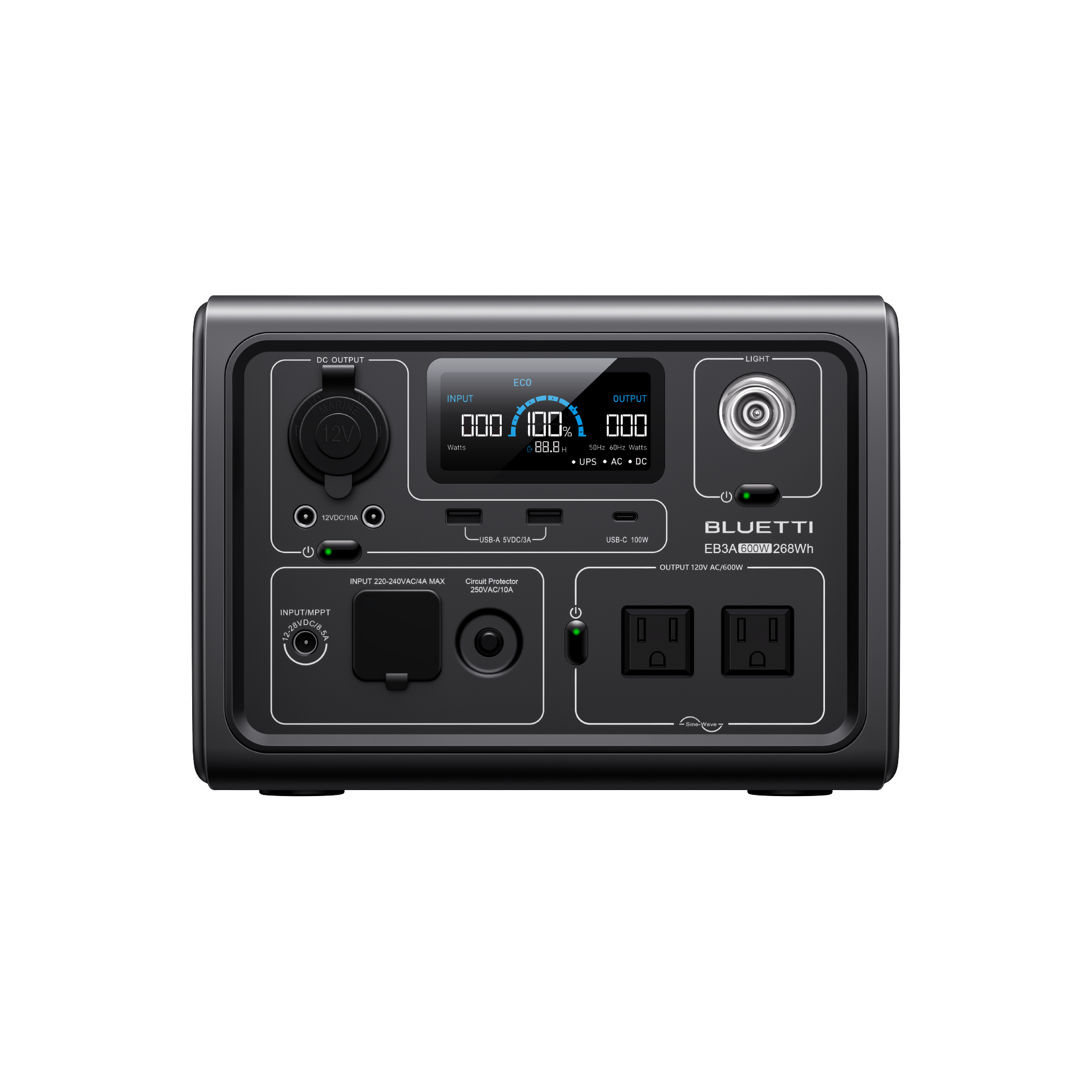
The Bluetti EB3A packs a 268Wh LiFePO4 battery, a 600W inverter, 430W dual charging (80% in about 30–40 minutes) and a 15W wireless charging pad into a 10.1 lb box — still one of the strongest small-station spec sheets, now succeeded…
Research-based review: this article is built from Bluetti's official specifications and product documentation — not hands-on testing. Prices and specs were verified against official Bluetti sources in October 2026. Product photos are official Bluetti images.
The Bluetti EB3A is the small station that made fast charging mainstream: a 268Wh LiFePO4 battery, a 600W pure sine wave inverter (1,200W surge) that out-punches everything else at this weight, dual AC-plus-solar charging at up to 430W that refills 80% in roughly 30–40 minutes, nine outputs including a 15W wireless charging pad on top — all in a 10.14 lb body you carry with one hand. It sits at the compact end of the range we cover in our Bluetti AC180 review and below, and it remains a reference point for the whole sub-300Wh class.
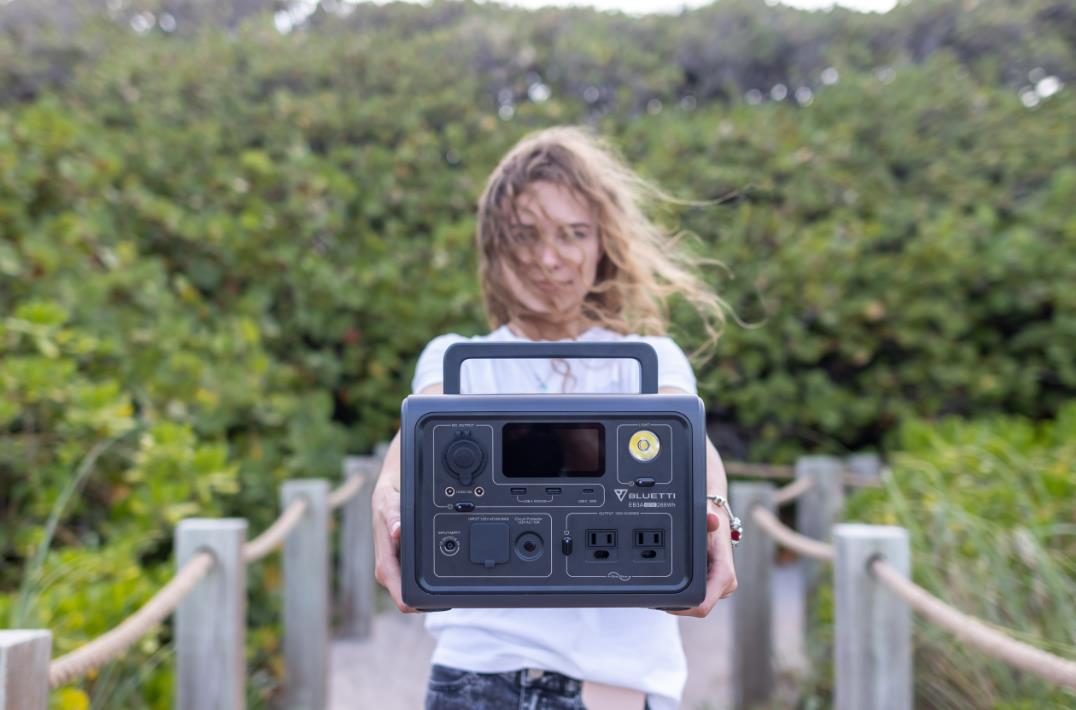
Bluetti EB3A specifications
| Specification | Bluetti EB3A |
|---|---|
| Capacity | 268Wh |
| Battery type | LiFePO4 (LFP) |
| Cycle life | 2,500+ cycles to 80% capacity |
| AC output | 600W rated / 1,200W surge, pure sine wave |
| AC outlets | 2x 120V |
| USB-C output | 1x 100W max |
| USB-A output | 2x 5V/3A |
| DC outputs | 1x 12V/10A car outlet, 2x 12V/10A DC5521 (all regulated) |
| Wireless charging | 1x 15W pad (top panel) |
| Total outputs | 9 |
| AC input | 268W standard mode / 350W turbo mode |
| Solar input | 200W max, VOC 12–28VDC / 8.5A (MPPT) |
| Maximum input | 430W with AC and solar simultaneously |
| AC recharge time | About 1.3–1.8 hours (turbo) / 1.5–2.0 hours (standard); ~80% in 30–40 minutes |
| Solar recharge time | About 1.8–2.0 hours at 200W (ideal conditions) |
| Car recharge time | About 3.2–3.7 hours (12V) / 1.9–2.4 hours (24V) |
| Backup mode | EPS (emergency power supply) pass-through — not a true 0ms UPS |
| App control | Yes — Bluetti app via Bluetooth |
| Expandable | No |
| Pass-through charging | Yes |
| Weight | 10.14 lbs (4.6 kg) |
| Dimensions | 10.04 x 7.09 x 7.20 in (255 x 180 x 183 mm) |
| Operating temperature | -4°F to 104°F (-20°C to 40°C) |
| Certifications | UL, CEC, DOE, FCC, CA Prop 65 |
| Warranty | 2 years (24 months) |
Why the EB3A still matters
The output-to-weight ratio is the headline. Most stations under 300Wh top out at 300W of AC output. The EB3A delivers 600W with a 1,200W surge from a 10.1 lb box — enough for a mini fridge, a small TV, power-tool battery chargers or a brief run of a low-wattage kitchen gadget that would trip smaller rivals outright. If your loads outgrow that ceiling entirely, the 512Wh class in our EcoFlow River 2 Max review is the natural step up.
Charging speed is the second headline. Bluetti rates the EB3A at roughly 80% in 30–40 minutes when the 430W dual input (AC + solar) or turbo AC charging is working hard, and a full charge in about 1.3–1.8 hours on turbo AC alone. In outage use, where your grid or generator window may be short, that refill speed matters more than another 30Wh of capacity.
The wireless pad is a small thing people actually use. The 15W pad on the top panel, the 100W USB-C port and Bluetooth app control give the EB3A a desk-and-nightstand life most rivals in our best camping power stations guide do not have — it is as much an everyday charging hub as a camping battery.
What can it run?
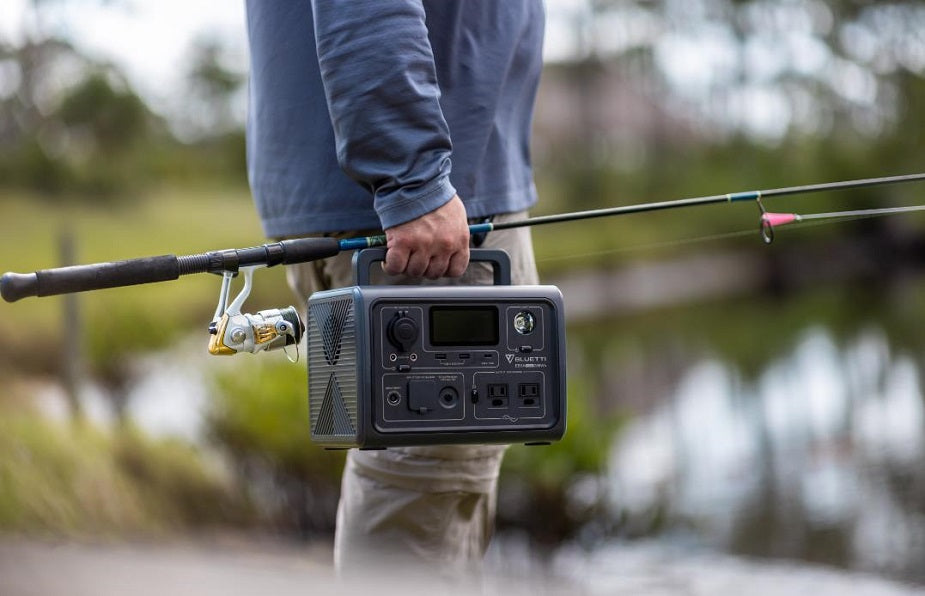
With 268Wh (plan on roughly 220–230Wh usable after inverter losses) and a 600W ceiling, realistic runtimes look like this — estimates based on Bluetti's own published device figures:
- Phone (10–15Wh per charge): around 20–25 charges, including wireless top-ups
- Laptop (60–100W): about 2–3.5 hours of active use, or 3–4 full charges
- CPAP (25–40W, humidifier off): roughly one night at low draw — borderline for a full 8 hours, so check our CPAP overnight sizing guide before relying on it
- Mini fridge (60W cycling): about 3.5–4 hours of compressor time
- Fan (20W): around 11 hours; LED lights (5W): around 30 hours
- Camera and drone batteries: dozens of small charges — the classic EB3A use case
What it will not do: heaters, kettles, microwaves or hair dryers (all above 600W in practice), and there is no expansion battery — 268Wh is the whole budget. Buyers who need a true fast-switching UPS for a home office should also weigh the EcoFlow River 3 Plus, whose UPS mode is a step above the EB3A's EPS pass-through.
Charging and solar
Six ways in, per Bluetti: AC wall charging (268W standard / 350W turbo), solar (200W max through the MPPT input, 12–28V), 12/24V car charging, generator, AC + solar combined (430W max), and dual AC with Bluetti's optional T200 adapter. Eco mode trims standby draw, the built-in LED lamp covers campsite lighting, and the Bluetti app (Bluetooth) handles monitoring and settings. Against its closest-name rival, the Jackery Explorer 300 Plus, the EB3A trades a little capacity for double the AC output and a much faster wall charge.
Availability note (October 2026)
Bluetti lists the EB3A at $299 on its US store, with sale pricing around $270 observed — but at the time of writing the standalone unit showed unavailable on the official store, and Bluetti's own EB3A review page now steers new buyers to the Elite 30 V2 (288Wh, 3,000+ cycles, 140W USB-C, ≤10ms UPS) as its successor in the same 600W class. Retailer stock of the EB3A remains, often discounted, and at a street price well under $299 it is still easy to recommend. At full list price, compare the Elite 30 V2 first. Either way, the EB3A lands squarely in our best budget power stations under $500 bracket.
Pros and cons
Pros
- 600W AC output (1,200W surge) — double most sub-300Wh rivals, in a 10.14 lb body
- Very fast charging: ~80% in 30–40 minutes, 430W max dual input
- LiFePO4 battery rated for 2,500+ cycles to 80%
- 9 outputs including a 15W wireless charging pad and 100W USB-C
- Bluetooth app control, Eco mode, built-in LED light, EPS pass-through
- 200W solar input with MPPT; UL/CEC/DOE/FCC certified
Cons
- 268Wh is a small budget — one CPAP night or a few fridge hours, not home backup
- EPS is not a true UPS: switchover is not rated in milliseconds like newer models
- Not expandable; 2-year warranty is shorter than the 5-year cover on EcoFlow rivals
- Official-store standalone stock was unavailable at check time — successor Elite 30 V2 is Bluetti's current push
- USB-A ports are basic 5V/3A — no fast-charge protocol support
FAQs
Can the Bluetti EB3A run a refrigerator?
A mini fridge, yes — Bluetti rates a 60W mini fridge at about 3.6 hours. A full-size fridge's startup surge can exceed the 1,200W surge limit and 268Wh would only buy a few hours anyway; for outage fridge duty, step up to a 1kWh-class station.
How long does the EB3A take to charge?
About 80% in 30–40 minutes and a full charge in roughly 1.3–1.8 hours on turbo AC (350W), 1.5–2.0 hours on standard AC (268W), or about 1.8–2.0 hours from a 200W solar panel in strong sun. AC and solar together reach a 430W maximum input.
Is the EB3A a UPS?
It has an EPS (emergency power supply) pass-through mode that switches to battery when the grid drops, but Bluetti does not rate it as a millisecond-class UPS. It is fine for routers, lamps and chargers; for a desktop PC or medical device, choose a model with a rated ≤10ms or ≤20ms UPS switchover — and never rely on any consumer station as a medical UPS without testing your exact device.
Can the EB3A charge from solar while powering devices?
Yes — pass-through charging is supported, so you can run loads while AC, solar, or both refill the battery, up to the 430W combined input limit.
EB3A vs Elite 30 V2: which should I buy?
The Elite 30 V2 is the newer design: 288Wh vs 268Wh, 3,000+ vs 2,500+ cycles, 140W vs 100W USB-C and a ≤10ms UPS vs EPS. Buy the EB3A when you find it discounted well under the Elite 30 V2's price; at similar money, the V2 is the better buy.
What is the EB3A's warranty?
24 months (2 years) per Bluetti's official specifications, with UL, CEC, DOE and FCC certifications.
Verdict
The Bluetti EB3A earned its reputation honestly: no other 10 lb station of its generation combined 600W output, 430W dual charging and a LiFePO4 battery at this price. In late 2026 it is a buy-on-discount product rather than a buy-at-list one — Bluetti itself points new buyers at the Elite 30 V2 — but if you find the EB3A near $199–$229, it remains one of the best small-station values on the market: fast to refill, easy to carry, and strong enough for the loads its size class is actually bought for.
About our reviews
Specs come from published manufacturer data sheets, cross-checked against owner feedback. Runtime estimates use usable capacity (Wh × 0.85 ÷ watts). We do not lab-test units unless an article says so. Figures go stale. Check the current data sheet before you buy. This is not electrical or purchasing advice. How we research.
Related guides
 ReviewsJackery Explorer 500 v2 Review: 512Wh, 500WThe Explorer 500 v2 rebuilds Jackery's classic 500-class station around LiFePO4: 512Wh, 500W output, 6,000 cycles, 1-hour hybrid…
 ReviewsJackery HomePower 3600 Plus Review: 3584Wh, 3600WJackery HomePower 3600 Plus review: 3584Wh LFP, 3600W output, expandable to 21kWh and 10ms UPS. Full specs, runtimes, pros/cons…
 ReviewsJackery Explorer 2000 Plus Review: 2043Wh, 3000WThis is a research-based review. Specs are verified against Jackery's official US product pages and user manual — we do not…
Reader comments
No comments yet. Own this model or have a question about it? Share it below.