Jackery Explorer 500 v2 Review: 512Wh, 500W
6 min read
On this page
The Explorer 500 v2 rebuilds Jackery's classic 500-class station around LiFePO4: 512Wh, 500W output, 6,000 cycles, 1-hour hybrid charging and a
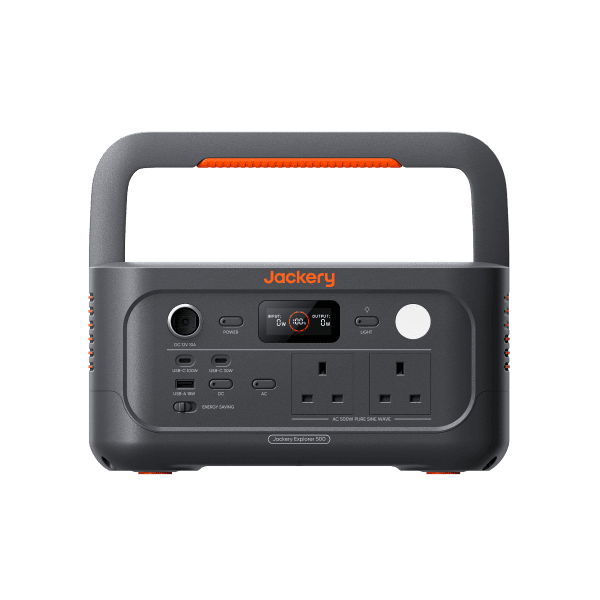
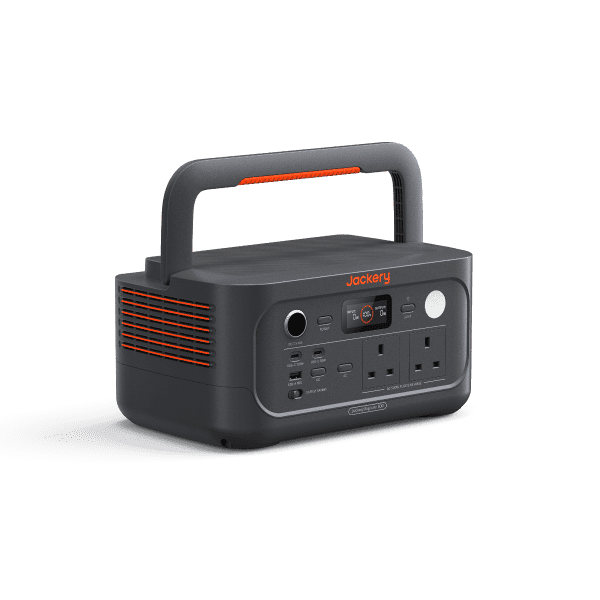
Research-based review: this article is built from Jackery's official specifications, manual and product documentation — not hands-on testing. Prices and specs were verified against official Jackery sources in October 2026. Product photos are official Jackery images; they show the UK variant's sockets — the US version ships with 120V US outlets.
The original Explorer 500 was one of the stations that defined the 500Wh class — and one of the last still running on old NMC lithium cells. The Jackery Explorer 500 v2 is a ground-up rebuild: a 512Wh LiFePO4 battery rated for 6,000 cycles, 500W of AC output (1,000W surge), hybrid AC-plus-solar charging that can refill it in about an hour, and a UPS mode that switches in under 10 milliseconds — all in a body Jackery calls the smallest and lightest 0.5kWh LiFePO4 station on the market, at 12.6 lbs. If you are cross-shopping the smaller end of the Jackery range, it sits a step above the Jackery Explorer 300 Plus and well below the 1kWh class.
Jackery Explorer 500 v2 specifications
| Specification | Explorer 500 v2 |
|---|---|
| Capacity | 512Wh |
| Battery type | LiFePO4 (LFP) |
| Cycle life | 6,000 cycles to 70% capacity |
| AC output | 500W rated / 1,000W surge, pure sine wave |
| AC outlets | 2x (120V on the US version) |
| USB-C output | 2x — 1x 100W, 1x 30W |
| USB-A output | 1x 18W |
| Car port | 12V / 10A |
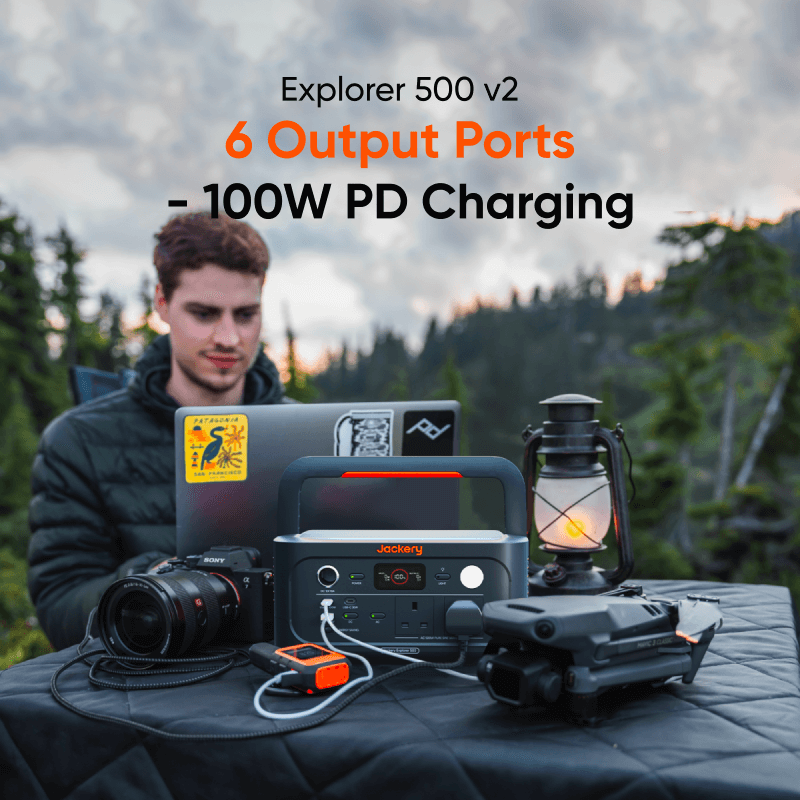
| Total outputs | 6 |
| Solar input | 200W max (up to 2x 100W panels, connector sold separately for two) |
| AC recharge | 0–100% in about 1.3 hours (0–80% in about 52 minutes) |
| Hybrid recharge (AC + solar) | 0–100% in about 1 hour |
| Solar recharge | About 2.8 hours at 200W input |
| Car recharge | About 6 hours (12V) |
| UPS switchover | <10ms |
| App control | No — on-unit controls only, by design |
| Expandable | No |
| Weight | 12.6 lbs (5.7 kg) |
| Dimensions | 12.2 x 8.1 x 6.2 in |
| Operating temperature | -4°F to 113°F (-20°C to 45°C) |
| Noise | About 28dB discharging / 36dB charging (Jackery figures) |
| Warranty | 3 years + 2 years extended (Jackery terms) |
What the v2 actually changes
The battery is the headline. Moving from NMC to LiFePO4 takes the cycle rating from the old model's roughly 800 cycles to 6,000 cycles to 70% capacity — Jackery translates that into a decade-plus, even up to 30 years of light use. In practical terms, the v2 is a buy-it-for-years station rather than a consumable.
Charging speed is the second headline. The old 500 took most of a working day to refill. The v2 does 0–80% in about 52 minutes on AC, a full charge in about 1.3 hours, and about 1 hour when AC and solar are combined. For outage use — where you may only have a short generator or grid window — that difference matters more than raw capacity. The same fast-charge story is what makes the larger Jackery Explorer 1000 v2 so easy to live with, and it has now reached the small end of the range.
UPS mode in a 500-class station is unusual. A sub-10ms switchover keeps a router, lights or a desktop alive through a blackout. Jackery's own fine print is worth repeating plainly: this is not a 0ms medical/server-grade UPS, Jackery recommends testing compatibility with your device first and connecting one device at a time in UPS use. Treat it as excellent outage insurance for home-office essentials, not as data-center equipment.
What can it run?
With 512Wh and a 500W ceiling (usable energy is roughly 430–460Wh after inverter losses), realistic runtimes look like this:
- Wi-Fi router (10W): roughly 30+ hours — a full outage weekend of connectivity
- Laptop (60W): about 7 hours of work, or 6–8 full charges
- CPAP (40W, humidifier off): roughly one full night — see our best power stations for CPAP picks for longer-runtime options
- Mini / small fridge (60–100W cycling): roughly 4–8 hours depending on duty cycle
- Phones and tablets: dozens of charges via the 100W and 30W USB-C ports
- LED lights, fans, camera and drone batteries: all-day camping use — this class is a staple of our best camping power stations guide
What it will not do: space heaters, kettles, microwaves, hair dryers or anything else that lives above 500W — and there is no expansion battery, so 512Wh is the whole budget. If your loads are bigger, the honest step-ups are the 768Wh class — our EcoFlow River 2 Pro review covers the closest rival — or a full 1kWh station.
Charging and solar
Four ways in: AC wall charging (about 1.3 hours), AC + solar hybrid (about 1 hour), solar alone (200W max; about 2.8 hours in strong sun with a 200W panel, or two 100W SolarSaga panels with Jackery's separately sold connector), and 12V car charging (about 6 hours). ChargeShield 2.0 manages the fast charging, and a one-touch Energy Saving mode shuts idle outputs down after 6 hours of low draw so standby loads do not quietly drain the battery overnight. There is deliberately no app — Jackery kept this model simple and compact, with everything controlled on the unit itself. Buyers who want app monitoring should look at the 1000 v2 instead. At around $449 as of October 2026 on Jackery's US list (US retailer sales have run lower), it also lands inside our best budget power stations under $500 bracket.
Pros and cons
Pros
- LiFePO4 battery rated for 6,000 cycles — roughly 8x the old model's lifespan
- Very fast charging: about 1 hour hybrid, 1.3 hours AC-only
- UPS switchover under 10ms — rare at this size and price
- Smallest, lightest 0.5kWh LFP station Jackery makes: 12.6 lbs with a fold-down handle
- 100W USB-C for fast laptop charging; quiet (28dB discharge per Jackery)
- Works from -4°F to 113°F; built-in LED light with SOS mode
Cons
- 500W ceiling rules out heaters, kettles and most kitchen appliances
- Not expandable — 512Wh is fixed
- No app control (a deliberate trade-off, but some buyers will miss it)
- Two-panel solar setups need Jackery's connector, sold separately
- UPS is not 0ms — Jackery itself advises testing device compatibility first
FAQ
Is the Explorer 500 v2 better than the old Explorer 500?
Yes, on almost every axis: LiFePO4 chemistry with 6,000 cycles instead of roughly 800, far faster charging, a UPS mode, USB-C at 100W, and a smaller, lighter body — at the same 500W output class and effectively the same capacity (512Wh vs 518Wh).
Can the Explorer 500 v2 run a refrigerator?
A mini fridge or small efficient fridge, yes — expect roughly 4–8 hours depending on the fridge's duty cycle. A full-size kitchen fridge's start-up surge can exceed what a 500W station handles comfortably; for whole-fridge outage backup, size up using our refrigerator sizing guide.
Can it run a CPAP all night?
One night, yes, with the heated humidifier off (roughly 40W draw). With humidification on, runtime can fall below a full night — a 768Wh–1kWh station is the safer CPAP pick for multi-night use.
Does the Explorer 500 v2 have an app?
No. Jackery designed this model without app control to keep it compact and simple; all functions are on the unit. Models like the Explorer 1000 v2 offer app control if you need it.
How long does it take to charge with solar?
About 2.8 hours at the full 200W solar input in strong sun. A single 100W SolarSaga panel will take roughly twice that in real conditions.
Is the Explorer 500 v2 expandable?
No — there is no expansion battery for this model. If you expect your needs to grow, start with an expandable 1kWh-class station instead.
Verdict
The Explorer 500 v2 fixes everything that dated the original 500 — battery chemistry, charging speed and port selection — and adds a genuinely useful UPS mode, without giving up the one-hand portability that made the class popular. It is not a home-backup powerhouse and it cannot grow with you, but as a camping, road-trip and essentials-backup station built to last a decade of cycles, it is one of the strongest 500Wh options of 2026. Buyers who need more output should compare it against the EcoFlow River 2 Max (same capacity, similar output class) before deciding.
About our reviews
Specs come from published manufacturer data sheets, cross-checked against owner feedback. Runtime estimates use usable capacity (Wh × 0.85 ÷ watts). We do not lab-test units unless an article says so. Figures go stale. Check the current data sheet before you buy. This is not electrical or purchasing advice. How we research.
Related guides
 ReviewsJackery HomePower 3600 Plus Review: 3584Wh, 3600WJackery HomePower 3600 Plus review: 3584Wh LFP, 3600W output, expandable to 21kWh and 10ms UPS. Full specs, runtimes, pros/cons…
 ReviewsJackery Explorer 2000 Plus Review: 2043Wh, 3000WThis is a research-based review. Specs are verified against Jackery's official US product pages and user manual — we do not…
 ReviewsJackery Explorer 1000 Plus Review: 1264Wh, 2000WThe Jackery Explorer 1000 Plus pairs 1264Wh of LiFePO4 capacity with a full 2000W inverter in a 32 lb box. Research-based review:…
Reader comments
No comments yet. Own this model or have a question about it? Share it below.