Jackery Explorer 1000 Plus Review: 1264Wh, 2000W
5 min read
On this page
The Jackery Explorer 1000 Plus pairs 1264Wh of LiFePO4 capacity with a full 2000W inverter in a 32 lb box. Research-based review: specs, runtimes, pros, cons and verdict.
This is a research-based review. Specs are verified against Jackery's official US product pages — we do not claim hands-on testing.
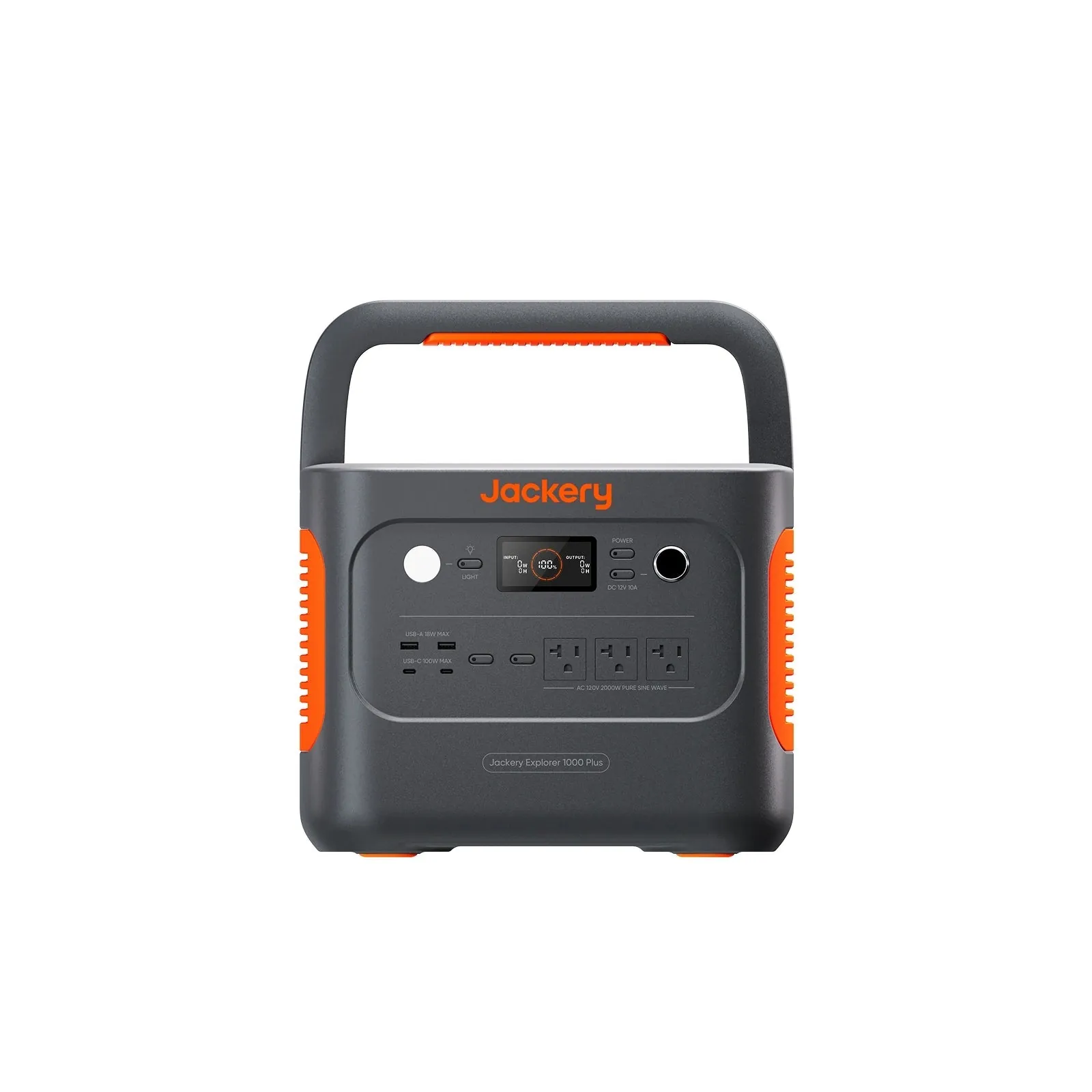
The Jackery Explorer 1000 Plus is the heavy-duty member of Jackery's 1kWh class: 1,264Wh of LiFePO4 capacity paired with a full 2,000W AC inverter — output more typical of a 2kWh station — in a 32 lb box. It is built for buyers who found the smaller Explorer 1000 v2 a little short on power, but who do not want to carry a 2kWh unit.
If you are cross-shopping the lighter model, start with our Jackery Explorer 1000 v2 review and the head-to-head in EcoFlow Delta 2 vs Jackery Explorer 1000 v2. The 1000 Plus answers a different question: how much real appliance power can you get without stepping up in size?
Jackery Explorer 1000 Plus — Key Specs
| Specification | Jackery Explorer 1000 Plus |
|---|---|
| Capacity | 1,264.64Wh (30.4Ah / 41.6V) |
| Battery chemistry | LiFePO4 (LFP) |
| Cycle life | 4,000 cycles to 70%+ capacity |
| AC output | 3 outlets, 120V 60Hz, 2,000W rated (4,000W surge) |
| USB-C output | 2 ports, 100W max each (PD) |
| USB-A output | 2 ports, 18W max |
| Car port | 12V, 10A |
| Expandable capacity | Up to 5,056Wh with up to 3 Battery Pack 1000 Plus (see note below) |
| AC input | 100–120V, 15A max in charge mode; 12A max in bypass mode |
| Solar / DC input | 2x DC8020 ports, 12–60V, 11A each, up to 800W max combined |
| AC recharge time | About 1.7 hours |
| Solar recharge time | About 2 hours with 4x SolarSaga 200W panels |
| Car recharge time | About 7 hours |
| App control | Wi-Fi and Bluetooth (Jackery app) |
| Weight | 32 lbs (14.5 kg) |
| Dimensions | 14 x 10.24 x 11.14 in (35.6 x 26 x 28.3 cm) |
| Operating temperatures | Charge 32–113°F (0–45°C); discharge 14–113°F (-10–45°C) |
| Warranty | 3+2 years (5 years total for official-store purchases) |
| Price | Around $699 as of October 2026 (Jackery US store; pricing varies) |
What Makes the Explorer 1000 Plus Stand Out
2,000W output from a 1.26kWh box
Most 1kWh-class stations stop at 1,500–1,800W. The 1000 Plus delivers 2,000W continuous with 4,000W surge, so kettles, hair dryers, microwaves and power tools that trip smaller inverters run here. That is why it keeps a place in our best portable power stations for home backup shortlist for essential circuits.
Expandable to 5kWh — with an honest caveat
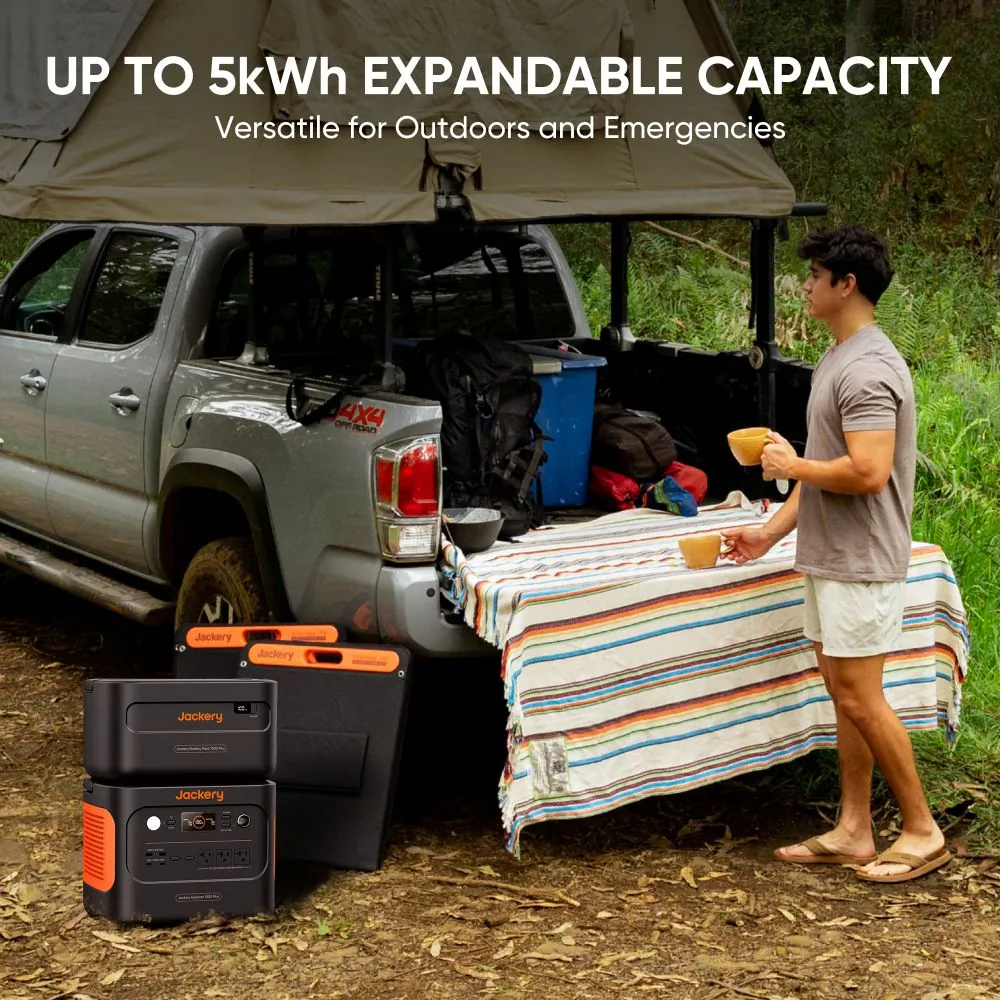
On paper, adding up to three Battery Pack 1000 Plus units expands capacity to 5,056Wh — enough for 1–3 days of essential home backup, per Jackery. The caveat buyers must know in October 2026: Jackery's US product page currently states the Battery Pack 1000 Plus has been discontinued. If expansion is your main reason to buy, verify pack availability before ordering; otherwise treat the 1000 Plus as a strong standalone 1.26kWh station.
Long-life LFP battery
The LiFePO4 cells are rated for 4,000 cycles to 70%+ capacity, which Jackery translates to 10+ years of use. A fully upgraded BMS adds the standard over-voltage, short-circuit and temperature protections.
Fast charging, three ways
Wall charging takes about 1.7 hours. Solar input accepts up to 800W across two DC8020 ports — about 2 hours with four SolarSaga 200W panels in ideal sun. Car charging takes about 7 hours. App control over Wi-Fi and Bluetooth rounds out the package for monitoring from the couch or the campsite, which is part of why it also fits our best portable power stations for camping picks for heavier camp kitchens.
What Can It Run? Realistic Runtimes
Using the standard 85% usable-capacity estimate for inverter losses (1,264Wh x 0.85 ≈ 1,075Wh usable):
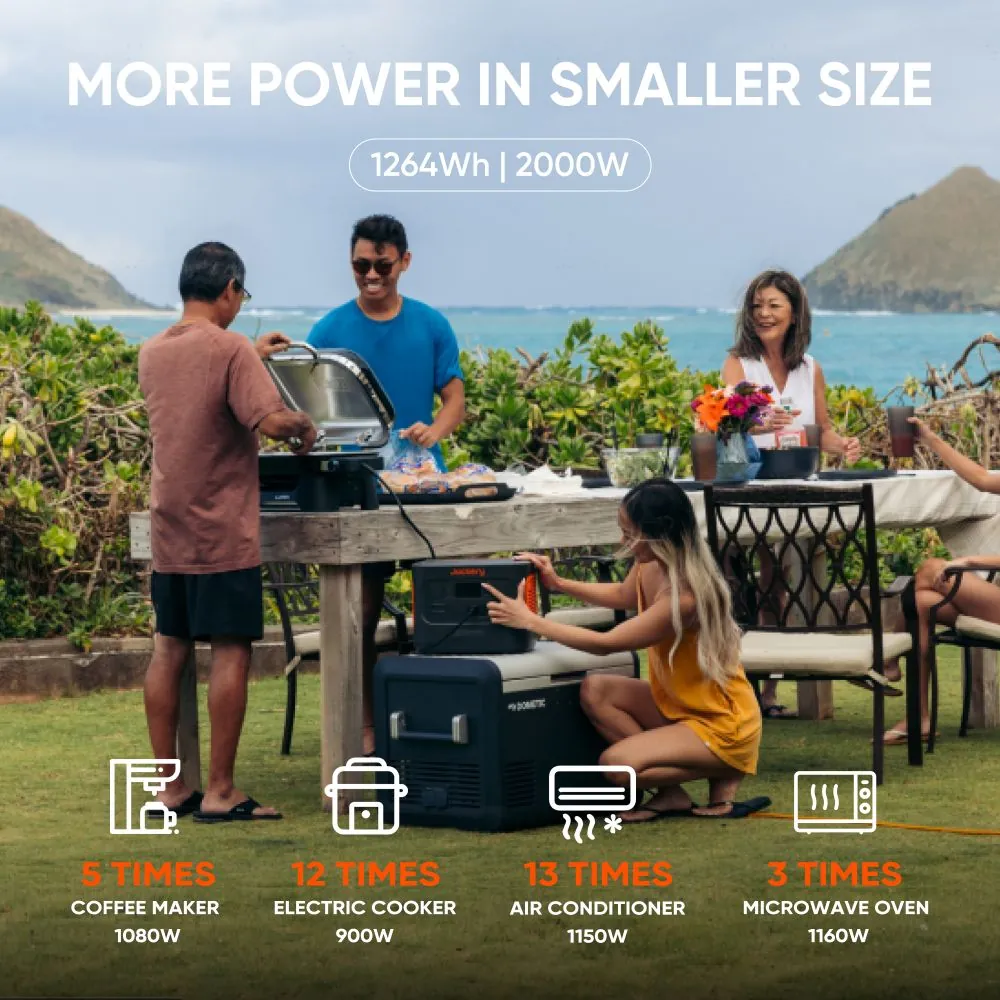
- Full-size refrigerator (100–150W cycling): roughly 10–18 hours depending on duty cycle
- Wi-Fi router (10W): about 100 hours
- CPAP (40W, no heated humidifier): about 25 hours — roughly 3 nights
- TV (100W): about 10 hours
- Laptop (60Wh): about 17 charges
- Electric kettle (1,600W): about 40 minutes of total boil time
- Microwave (1,160W): about 55 minutes
- Coffee maker (1,120W): about 1 hour
For the full method behind these estimates, see how long a 1000Wh power station actually runs. If you regularly need more than a day of fridge backup, step up to the class covered in our Jackery Explorer 2000 v2 review.
Pros and Cons
Pros
- 2,000W / 4,000W surge output — strongest in the 1kWh class
- 1,264Wh LFP battery rated for 4,000 cycles
- Fast 1.7-hour wall recharge and up to 800W solar input
- Three AC outlets plus dual 100W USB-C
- App control via Wi-Fi and Bluetooth, EPS mode for essentials
- 5-year total warranty on official-store purchases
Cons
- Expansion Battery Pack 1000 Plus is listed as discontinued on Jackery's US store — expansion availability is uncertain
- 32 lbs is portable, but not light for long carries
- 4000 cycles are rated to 70%+ capacity, a lower threshold than some rivals quote at 80%
- No 240V or RV TT-30 outlet — not a whole-home or large-RV solution on its own
FAQ
How long does the Explorer 1000 Plus take to charge?
About 1.7 hours from a wall outlet. Solar charging with four SolarSaga 200W panels (800W max input) takes about 2 hours in ideal conditions, and car charging takes about 7 hours.
Can the Explorer 1000 Plus run a refrigerator?
Yes. With roughly 1,075Wh usable, a typical full-size fridge cycling at 100–150W runs about 10–18 hours. Adding capacity or solar extends that, but for multi-day outages a 2kWh-class station is a better fit.
Is the Explorer 1000 Plus expandable?
Technically yes — up to three Battery Pack 1000 Plus units take it to 5,056Wh. However, Jackery's US store currently lists that battery pack as discontinued, so check real availability before counting on expansion.
Explorer 1000 Plus vs Explorer 1000 v2 — which should I buy?
Buy the v2 for lower weight and price for camping and light backup. Buy the Plus for the 2,000W inverter, larger 1,264Wh battery and higher 800W solar input — it runs demanding appliances the v2 cannot.
Can it run a CPAP overnight?
Easily. At about 40W without heated humidification, expect roughly 25 hours — about three nights — from a full charge.
Does it have an app?
Yes. The Jackery app connects over Wi-Fi or Bluetooth for monitoring input, output and remaining runtime, and for adjusting settings.
Verdict
The Jackery Explorer 1000 Plus is the pick for buyers who want maximum appliance power without a 2kWh carry: 1,264Wh of LFP capacity, a genuine 2,000W inverter, 800W solar input and a 1.7-hour wall recharge at around $699 as of October 2026. Its one real question mark is expansion — the add-on battery pack is listed as discontinued in the US — so buy it for what the base unit does today, and it is one of the strongest 1kWh-class stations on the market.
About our reviews
Specs come from published manufacturer data sheets, cross-checked against owner feedback. Figures go stale. Check the current data sheet before you buy. This is not electrical or purchasing advice.
Related guides
 ReviewsEcoFlow River 2 Max Review: 512Wh, 500W Fast ChargeEcoFlow River 2 Max review: 512Wh LFP, 500W output (1,000W X-Boost), 60-min full charge and 220W solar. Specs, runtimes,…
 ReviewsEcoFlow River 2 Pro ReviewThis is a research-based review. Specs are verified against EcoFlow's official US product pages — we do not claim hands-on…
 ReviewsEcoFlow Delta 2 Max Review: 2048Wh, 2400W PowerThe EcoFlow Delta 2 Max pairs 2048Wh of LFP capacity with 2400W output, expansion to 6144Wh and dual 1000W solar input — around…