Can a Portable Power Station Run a Gas Furnace? (Watts and Runtime)
8 min read
On this page
- Why does a gas furnace stop working when the power goes out?
- How many watts does a gas furnace use?
- What size power station do you need for a furnace?
- How long will a power station run a gas furnace?
- Which power stations can start and run a furnace?
- How do you safely connect a power station to a furnace?
- How can you make the battery last longer?
- FAQ
- Sources
Yes, if it has pure sine wave output, enough surge to start the blower, and a safe connection. How many watts a gas furnace uses, how long 1,000 to 4,000Wh stations run it, and how to hook one up safely.
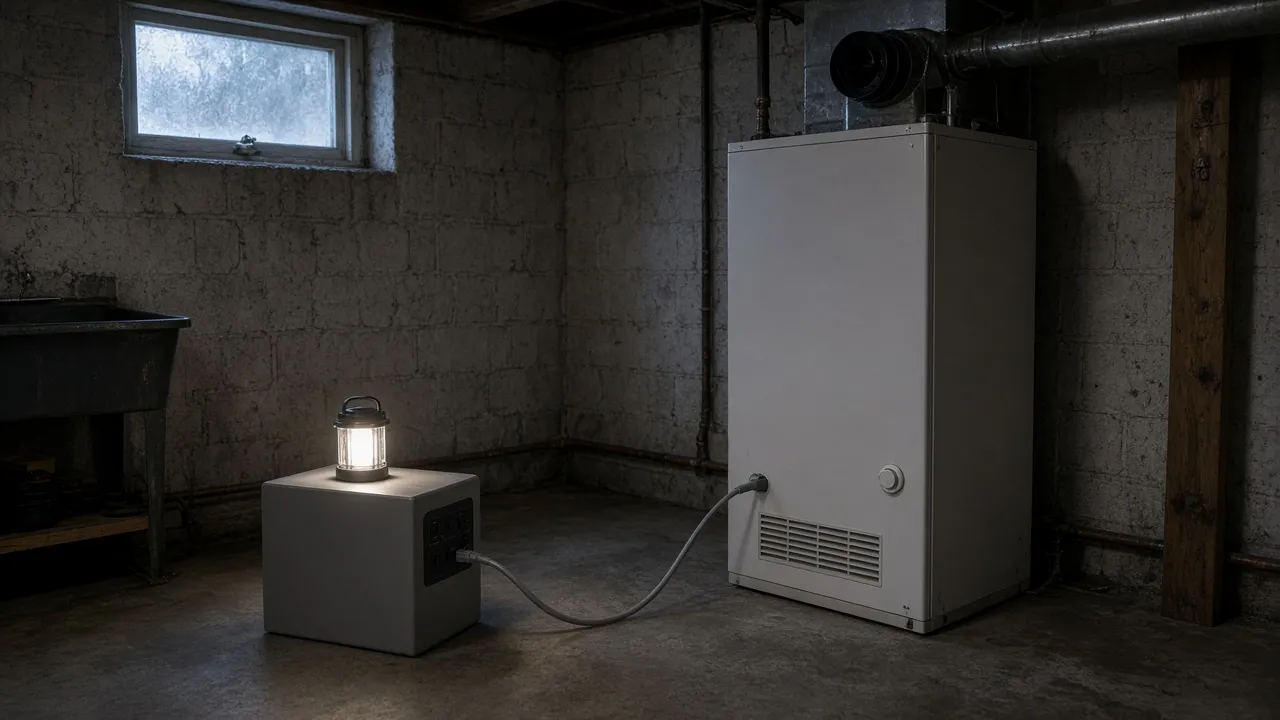
Short answer: yes, a portable power station can run most 120V gas furnaces during an outage, as long as it has pure sine wave output, enough surge power to start the blower, and a safe, code-compliant connection. The gas makes the heat, but the blower, draft inducer, igniter and control board all need electricity. A typical furnace draws roughly 300 to 800 watts while it runs, so a 2,000Wh station keeps it going for about 3.5 hours of nonstop blower time, or around 7 hours when the furnace cycles on and off.
Why does a gas furnace stop working when the power goes out?
A modern forced-air gas furnace can't light or move heat without electricity. Every heating cycle follows the same sequence: the thermostat calls for heat, the control board starts the draft inducer fan to clear the exhaust, a hot surface igniter or spark lights the burners, a flame sensor confirms the flame, and then the blower pushes warm air through your ducts. If any of those steps loses power, the gas valve stays shut for safety.
That's good news for battery backup. You don't need to replace the heat, only the few hundred watts that run the fans and controls. That's a far easier job than running a 1,500W space heater, which empties a 1,000Wh station in about 34 minutes (see our space heater runtime guide).
How many watts does a gas furnace use?
Most of the power goes to the blower motor. Older furnaces use a PSC (permanent split capacitor) blower, which commonly draws about 300 to 700 watts. Newer furnaces often use an ECM (electronically commutated, variable-speed) blower that can run below 100 watts at low speed and a few hundred watts at high speed.
| Furnace part | Typical draw | When it runs |
|---|---|---|
| Control board and 24V transformer | 5 to 15W | Always |
| Draft inducer fan | 50 to 150W | Whole burn cycle |
| Hot surface igniter | 300 to 500W | 15 to 60 seconds per start |
| Blower, PSC motor | 300 to 700W | Most of the burn cycle |
| Blower, ECM motor | 75 to 500W | Most of the burn cycle, speed varies |
Honda's generator sizing guide lists a 1/3-horsepower furnace fan at about 700 running watts and 1,400 starting watts, and a 1/2-horsepower furnace fan at about 875 running watts and 2,350 starting watts. Those are cautious planning figures for older motors; many furnaces measure lower.
The igniter usually shuts off before the blower starts, so the two biggest loads rarely overlap. Your real peak is the larger of "inducer plus igniter" or "inducer plus blower starting up."
How to find your furnace's real number
- Read the nameplate. It's usually inside the front panel and lists volts and amps. Volts times amps gives a worst-case figure (for example, 120V × 7A = 840W), which usually overstates the running load.
- Check the blower motor label for its horsepower and whether it's PSC or ECM.
- Measure it. Furnaces are usually hardwired, so a plug-in watt meter won't work, but an electrician can read the running draw with a clamp meter during a full heating cycle.
What size power station do you need for a furnace?
Check three numbers on the power station's spec sheet, in this order:
- Output waveform: pure sine wave. Furnace control boards, flame sensing and ECM motors can fault, buzz or lock out on modified sine wave power. Most name-brand lithium power stations list pure sine wave output, but confirm it on the spec sheet, especially on cheaper inverters.
- Surge (peak) rating above the blower's starting watts. A 1/2-hp PSC blower may need about 2,350W for a split second; an ECM blower needs far less. A station with 3,000W or more of surge covers nearly any residential furnace.
- Capacity in watt-hours for runtime. This decides how many hours of heat you get.
For most homes, a station with at least 1,800W continuous output, 3,000W or more of surge, and 2,000Wh or more of capacity is the practical starting point for overnight furnace backup.
How long will a power station run a gas furnace?
Use the same formula we use across the site:
Runtime (hours) = Capacity (Wh) × 0.85 ÷ Furnace watts
The 0.85 covers inverter and conversion losses. A furnace also doesn't run nonstop: it cycles on and off with the thermostat. On a cold night it might run about half of each hour, which roughly doubles the runtime. The table shows both cases.
| Power station capacity | Efficient ECM furnace (250W) | Typical PSC furnace (500W) | Large 1/2-hp blower (875W) |
|---|---|---|---|
| 1,000Wh | 3.4 h nonstop / 6.8 h cycling | 1.7 h / 3.4 h | 1.0 h / 1.9 h |
| 2,000Wh | 6.8 h / 13.6 h | 3.4 h / 6.8 h | 1.9 h / 3.9 h |
| 3,000Wh | 10.2 h / 20.4 h | 5.1 h / 10.2 h | 2.9 h / 5.8 h |
| 4,000Wh | 13.6 h / 27.2 h | 6.8 h / 13.6 h | 3.9 h / 7.8 h |
A 2,000Wh power station runs a typical 500W furnace for about 3.4 hours of continuous blower time, or roughly 6.8 hours if the furnace runs half of each hour. A furnace with an efficient ECM blower can get through a whole night on the same battery.
Which power stations can start and run a furnace?
Here's how popular models compare, using manufacturer-published capacity, continuous output and surge ratings, and a 500W furnace load.
| Power station | Capacity | Continuous / surge | Covers a 2,350W start? | 500W furnace, nonstop / cycling |
|---|---|---|---|---|
| EcoFlow Delta 3 | 1,024Wh | 1,800W / 3,600W | Yes | 1.7 h / 3.5 h |
| Anker Solix C1000 | 1,056Wh | 1,800W / 2,400W | Barely | 1.8 h / 3.6 h |
| Jackery Explorer 1000 Plus | 1,264Wh | 2,000W / 4,000W | Yes | 2.1 h / 4.3 h |
| Jackery Explorer 2000 v2 | 2,042Wh | 2,200W / 4,400W | Yes | 3.5 h / 6.9 h |
| Anker Solix C2000 Gen 2 | 2,048Wh | 2,400W / 4,000W | Yes | 3.5 h / 7.0 h |
| Jackery HomePower 3000 | 3,072Wh | 3,600W / 7,200W | Yes | 5.2 h / 10.4 h |
| EcoFlow Delta Pro 3 | 4,096Wh | 4,000W / 8,000W | Yes | 7.0 h / 13.9 h |
The 1kWh class can start most furnaces but only buys a few hours. For a full winter night, a 2kWh station is the realistic minimum, and a 3 to 4kWh unit or an expandable system is better if outages in your area last more than a day. Our 2000Wh runtime guide shows what else fits in that budget, and the best home backup power stations list compares the bigger units.
How do you safely connect a power station to a furnace?
This is the part that matters most. Most furnaces are hardwired to their own circuit with a service switch, not plugged into an outlet. There are two safe ways to power one from a battery:
- A transfer switch or generator inlet installed by a licensed electrician. Larger home-backup stations are often built to connect this way; check the manufacturer's install guide.
- A furnace power inlet or cord-and-plug connection, where local code allows it, also installed by an electrician. You then plug the furnace straight into the power station during an outage.
Never plug a power source into a wall outlet to feed power back into the house. This "backfeeding" can energize utility lines and electrocute line workers; OSHA warns it can energize wiring "for great distances." Some furnace control boards also check polarity and grounding before they'll light, so have the electrician test the setup with your actual power station before winter, not during the first outage.
A battery power station makes no exhaust, so it's safe to keep indoors next to the furnace. A gas generator is not: it belongs outdoors, far from doors and windows, because of carbon monoxide. Our power station vs. gas generator comparison covers the trade-offs for long outages.
How can you make the battery last longer?
- Turn the thermostat down a few degrees. Fewer cycles means less blower time.
- Close off unused rooms and shut their vents so the house holds heat longer.
- Unplug everything else on the station except essentials like the router and phone chargers.
- Recharge during the day from solar panels or a car if the outage stretches on. Our guide to how many solar panels charge a power station has the math.
- Size the whole outage, not just the furnace. Add the fridge, lights and medical devices with our home backup sizing worksheet.
FAQ
Can a 1000W power station run a gas furnace?
Often, yes, if the furnace runs under about 800W and the station's surge rating covers the blower's startup. Runtime is short, though: a 1,000Wh battery runs a 500W furnace for about 1.7 hours of nonstop blower time.
Can I plug my furnace into a power station?
Only if the furnace already has a code-approved cord and plug, or an electrician has installed an inlet or transfer switch. Most furnaces are hardwired, so don't splice cords yourself.
Does a furnace need a pure sine wave inverter?
Yes. Furnace control boards, flame sensors and ECM blower motors can fail to light, buzz or lock out on modified sine wave power. Use a pure sine wave power station.
How many watts does a furnace blower need to start?
Honda's sizing chart lists about 1,400 starting watts for a 1/3-hp furnace fan and about 2,350 starting watts for a 1/2-hp fan. ECM variable-speed blowers ramp up gently and need much less.
Will a power station run a furnace all night?
A 2,000Wh station can usually get a typical furnace through about 7 hours if it cycles half the time, and an efficient ECM furnace much longer. For multi-day outages, plan on 3,000Wh or more, extra batteries, or solar recharging.
Is it safe to run a power station indoors next to the furnace?
Yes. A lithium power station produces no fumes, so it can sit indoors. Keep it dry, off the floor if the basement floods, and within its operating temperature range.
Sources
- Honda Power Equipment: What wattage generator do I need? (furnace fan running and starting watts)
- OSHA: Using Portable Generators Safely (transfer switch and backfeed warning)
- Seattle City Light: Generator safety and backfeeding
- U.S. Department of Energy: Furnace fan energy use analysis (PSC vs. ECM blowers)
- EcoFlow: Gas furnace without electricity
- Power Fallback: Furnace component power draw and pure sine wave requirement
How we got these numbers: runtimes are our calculations from manufacturer-rated capacity with an 85% efficiency factor, not lab tests. The 250W, 500W and 875W loads are example furnace draws based on the ranges above; the "cycling" column assumes the furnace runs about half of each hour. Your furnace's nameplate or a clamp-meter reading is the number to trust. Power station specs come from manufacturer pages (accessed October 2026). See how we research.
About our reviews
Specs come from published manufacturer data sheets, cross-checked against owner feedback. Runtime estimates use usable capacity (Wh × 0.85 ÷ watts). We do not lab-test units unless an article says so. Figures go stale. Check the current data sheet before you buy. This is not electrical or purchasing advice. How we research.
Related guides
 Sizing guidesCan a Portable Power Station Run a Window Air Conditioner?Yes, but only a mid-size or larger station, and not for long. Window AC watts by BTU from ENERGY STAR data, startup surge, and…
 Sizing guidesHow Many Solar Panels Do I Need to Charge a Power Station?How many watts of solar panels it takes to refill a 300Wh, 1000Wh, or 2000Wh power station in a day, with a charge-time chart for…
 Sizing guidesCan a Portable Power Station Run a Space Heater? (Real Runtime Math)Yes, but not for long. How many minutes a 1000Wh, 2000Wh, or 3600Wh power station runs a 1500W space heater, why an electric…
Reader comments
No comments yet. Own this model or have a question about it? Share it below.