How Many Solar Panels Do I Need to Charge a Power Station?
7 min read
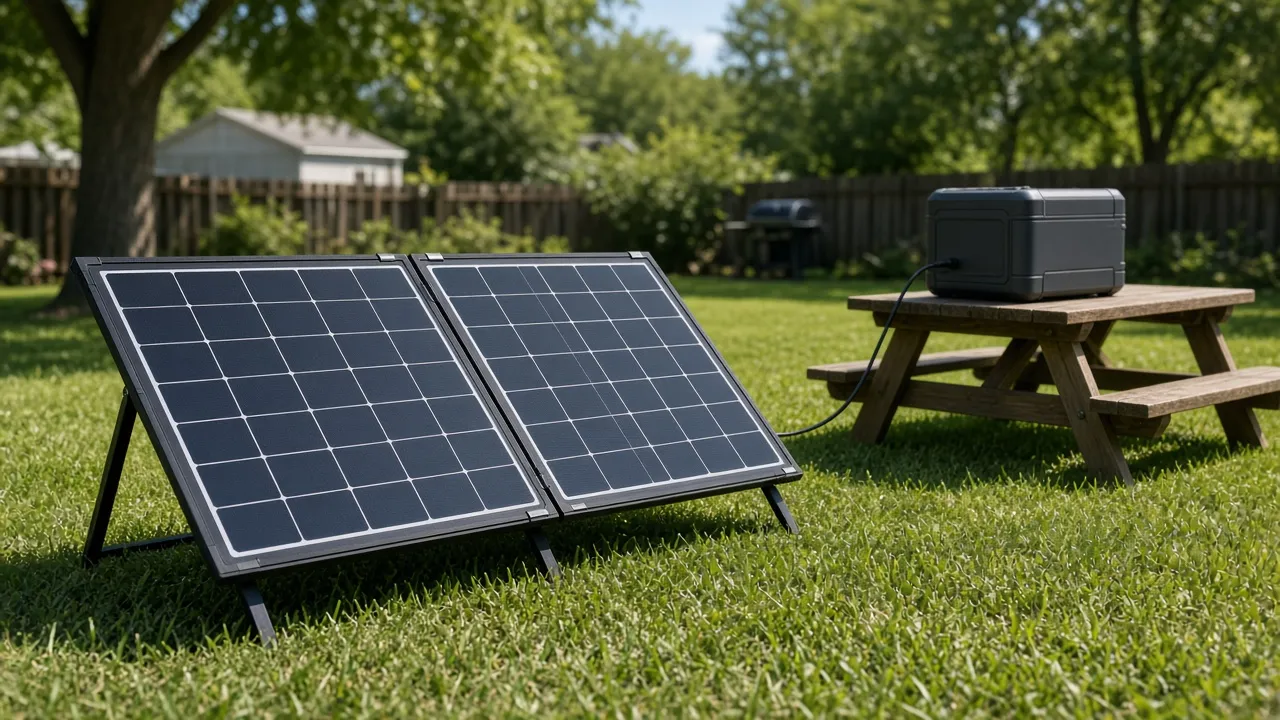
On this page
How many watts of solar panels it takes to refill a 300Wh, 1000Wh, or 2000Wh power station in a day, with a charge-time chart for popular models, the simple formula, and the volt and amp limits to check.
Short answer: for most 1,000Wh power stations, 400–600 watts of solar panels will refill the battery in one sunny day. A 2,000Wh unit needs roughly 800–1,000 watts to do the same. The real limit is often not your panels but the station's maximum solar input, so check that number first. Below is the math, a chart for popular models, and the mistakes that keep panels from delivering their rated watts.

The simple formula
You need three numbers: your station's capacity in watt-hours (Wh), your panels' rated watts, and the peak sun hours where you are. A peak sun hour is one hour of full-strength sunlight. A clear summer day might give you five or six of them spread across the whole day; a cloudy winter day might give you one or two.
Hours of peak sun to refill = battery Wh ÷ (panel watts × 0.75)
The 0.75 factor is our planning assumption for real-world output. Panels are rated in lab conditions, and in the field they lose power to heat, dust, wiring, imperfect angles, and charge-controller conversion. For reference, NREL's PVWatts solar model uses a 14% default for system losses like soiling, shading, wiring, and mismatch, and it models heat losses separately on top of that. Planning on 75% of the rated watts keeps you from being disappointed on a warm, slightly hazy day.
One more rule: the station can only take in as much as its solar input limit allows. If a station accepts 400W of solar, a 1,000W array will not charge it any faster in good sun. Extra panels only help on cloudy days or early and late in the day, and only if the station's voltage and current limits allow them.
How much energy does each panel make per day?
This table uses the 0.75 factor. Find your typical peak sun hours with NREL's free PVWatts calculator, which shows solar data month by month for any U.S. address.
| Panel array | 3 peak sun hours | 4 peak sun hours | 5 peak sun hours | 6 peak sun hours |
|---|---|---|---|---|
| 100W | 225Wh | 300Wh | 375Wh | 450Wh |
| 200W | 450Wh | 600Wh | 750Wh | 900Wh |
| 400W | 900Wh | 1,200Wh | 1,500Wh | 1,800Wh |
| 600W | 1,350Wh | 1,800Wh | 2,250Wh | 2,700Wh |
| 800W | 1,800Wh | 2,400Wh | 3,000Wh | 3,600Wh |
| 1,000W | 2,250Wh | 3,000Wh | 3,750Wh | 4,500Wh |
So a single 200W panel on a 4-peak-sun-hour day puts about 600Wh into a battery. That is a little over half of a 1,000Wh station, which is why one panel is usually a top-up tool rather than a full daily recharge.
Solar charging chart for popular power stations
Here is how long each station takes to refill from empty if you buy panels that match its maximum solar input. Capacities and solar limits come from each manufacturer's published specs, summarized in our reviews. Times are our estimates using the 0.75 factor, not lab results, so manufacturer claims in perfect conditions are often a bit faster.
| Power station | Capacity | Max solar input | Peak sun hours to refill | Days at 4 peak sun hours |
|---|---|---|---|---|
| EcoFlow River 3 Plus | 286Wh | 220W | ~1.7 h | under half a day |
| Jackery Explorer 300 Plus | 288Wh | 100W | ~3.8 h | about 1 day |
| EcoFlow Delta 3 | 1,024Wh | 500W | ~2.7 h | under 1 day |
| EcoFlow Delta 2 | 1,024Wh | 500W | ~2.7 h | under 1 day |
| Anker Solix C1000 | 1,056Wh | 600W | ~2.3 h | under 1 day |
| Jackery Explorer 1000 v2 | 1,070Wh | 400W | ~3.6 h | about 1 day |
| Bluetti AC180 | 1,152Wh | 500W | ~3.1 h | under 1 day |
| Jackery Explorer 1000 Plus | 1,264Wh | 800W | ~2.1 h | under 1 day |
| Jackery Explorer 2000 v2 | 2,042Wh | 400W | ~6.8 h | about 2 days |
| EcoFlow Delta 2 Max | 2,048Wh | 1,000W (two 500W ports) | ~2.7 h | under 1 day |
| Bluetti Elite 200 V2 | 2,073Wh | 1,000W | ~2.8 h | under 1 day |
The standout lesson is the Jackery Explorer 2000 v2. It is a big battery with a small 400W solar ceiling, so it needs about two good days of sun to refill. If solar is your main charging plan, a station whose solar input is at least half its capacity in watts (for example, 500W or more for a 1,000Wh unit) refills in a single day.
Worked example: keeping a fridge going in an outage
Say you want to run a fridge, a Wi-Fi router, and some lights that together use about 1,200Wh per day (check your own fridge with our fridge sizing guide). You need to account for losses on both ends:
- Battery energy needed: 1,200Wh ÷ 0.85 (inverter losses when running AC devices) ≈ 1,410Wh.
- Daily panel output needed: 1,410Wh ÷ (4 peak sun hours × 0.75) ≈ 470W of panels.
- Round up: about 500W of panels, on a station that accepts at least 500W of solar and holds at least 1,500Wh so it can carry the load overnight.
On a cloudy day with only two peak sun hours, that same 500W array would make about 750Wh, so plan to cut back to the fridge and essentials. If you are building a full outage plan, start with our home backup sizing worksheet and compare bundled kits in our best solar generators for power outages guide.
Quick sizing by use case
- Phones, lights, and a laptop at a campsite: 100–200W of panels with a 300–500Wh station is plenty. See our camping power station picks.
- Weekend RV or van trips with a 12V fridge: 200–400W, often mounted on the roof. Our RV and van life guide covers stations with strong solar inputs.
- Outage backup for a fridge and essentials: 400–600W with a 1,000–2,000Wh station.
- Running larger loads every day off-grid: 800W or more, which means a station that accepts 800–1,000W or more of solar.
Volts and amps: the part people skip
Every station lists a solar input voltage range and a current limit, and your panel setup must stay inside both. Wiring panels in series adds their voltages together. Wiring them in parallel adds their currents together. The ranges vary a lot: the Jackery Explorer 300 Plus accepts 12–27V at up to 5A, while the EcoFlow Delta 2 accepts 11–60V at up to 15A, and the Bluetti Elite 200 V2 accepts 12–60V.
- Check the open-circuit voltage (Voc) printed on each panel's label. Add them up for a series string and make sure the total stays under the station's maximum input voltage.
- Leave headroom in cold weather. Panel voltage rises as temperatures drop, so a string that sits right at the limit on a mild day can exceed it on a cold, sunny morning.
- Too little voltage is a problem too. If the string falls below the minimum, the station won't charge at all. That is common with a single small panel in shade.
- Follow the manufacturer's wiring guidance. Some small stations advise against paralleling panels, and some use proprietary connectors that need an adapter for third-party panels.
Getting full output from your panels
- Aim the panels at the sun and re-angle them two or three times a day. Flat on the ground loses a noticeable amount of output, especially in winter.
- Avoid partial shade. A shadow across part of one panel can drag down the whole string's output.
- Keep the station cool and shaded while the panels sit in the sun. Batteries charge best at moderate temperatures and may slow down when hot.
- Use the right cable gauge and keep runs short. Long, thin extension cables waste power as heat.
- Keep the glass clean. Dust and pollen are one of the losses PVWatts budgets for, and they are easy to fix.
Method note
Panel output figures use rated watts × peak sun hours × 0.75 as a real-world planning factor. When we estimate how long a battery runs AC devices, we use capacity × 0.85 to account for inverter losses. Capacities and solar input limits come from manufacturer spec pages, accessed October 2026 and summarized in our reviews. These are calculations, not test results; your results will vary with weather, temperature, panel angle, and battery age. See how we research.
Sources
- NREL PVWatts: System losses (default 14% and its categories)
- NREL: PVWatts Version 5 Manual
- NREL PVWatts Calculator (local solar data)
FAQ
How many solar panels do I need to charge a 1000Wh power station?
About 400–600 watts of panels will refill a 1,000Wh station in one day with four to five peak sun hours. That could be two 200W panels or three to four 150W panels, as long as the station's solar input limit is at least that high.
Can a 100W solar panel charge a power station?
Yes, but slowly. A 100W panel makes roughly 300Wh on a day with four peak sun hours, which fully charges a small 300Wh station or adds about a third to a 1,000Wh unit.
Will more panels than the max solar input damage my power station?
Extra watts are usually just left unused, but extra voltage is the real risk. Never exceed the station's maximum input voltage, and always follow the manufacturer's limits for voltage and current.
How long does it take to charge a power station with solar?
Divide the battery's Wh by 75% of your panel watts to get hours of full sun. A 1,000Wh station with 400W of panels needs about 3.3 peak sun hours, which is roughly one clear day.
Can I charge a power station with solar on a cloudy day?
Yes, but output can drop sharply under heavy cloud. Plan for a fraction of a sunny day's output and save your stored energy for essentials like a fridge, lights, and phones.
Can I use any brand of solar panel with my power station?
Often yes, if the panel's voltage and current fit the station's input range and you have the right connector or adapter. Check both specs before buying third-party panels.
About our reviews
Specs come from published manufacturer data sheets, cross-checked against owner feedback. Runtime estimates use usable capacity (Wh × 0.85 ÷ watts). We do not lab-test units unless an article says so. Figures go stale. Check the current data sheet before you buy. This is not electrical or purchasing advice. How we research.
Related guides
 Sizing guidesCan a Portable Power Station Run a Space Heater? (Real Runtime Math)Yes, but not for long. How many minutes a 1000Wh, 2000Wh, or 3600Wh power station runs a 1500W space heater, why an electric…
 Sizing guidesHow Long Will a 1000Wh Power Station Run? (Chart)The simple runtime formula — (watt-hours × 0.85) ÷ watts — plus a full chart: how long a 1000Wh power station runs a…
 Sizing guidesHow Many Watts Do I Need for Home Backup? (2026)Sizing home backup power is two separate math problems: how much power at once (watts) and how much energy over time…
Reader comments
No comments yet. Own this model or have a question about it? Share it below.