Can a Portable Power Station Run a Window Air Conditioner?
8 min read
On this page
- How many watts does a window air conditioner use?
- Why does startup surge matter so much?
- How long will a power station run a window AC?
- Which power stations can run a window AC?
- Is a power station a good way to cool during a summer outage?
- Can you run a window AC from a power station while camping or in an RV?
- FAQ
- Sources
Yes, but only a mid-size or larger station, and not for long. Window AC watts by BTU from ENERGY STAR data, startup surge, and runtimes on 1,000 to 4,000Wh power stations.
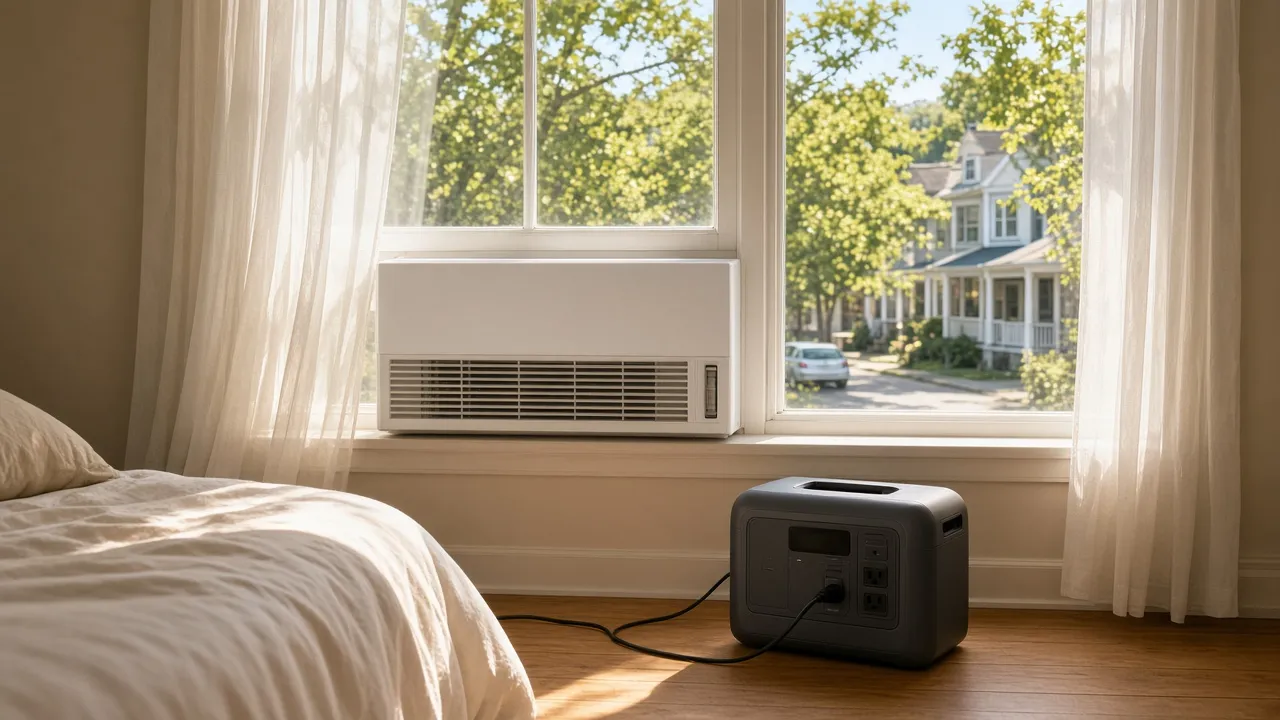
Short answer: yes, a portable power station can run a window air conditioner, but only a mid-size or larger one, and usually not for long. A modern 8,000 BTU inverter window unit draws about 530 watts at full cooling, so a 1,000Wh station runs it for roughly 1.6 hours and a 2,000Wh station for about 3.2 hours. Older fixed-speed units also need a startup surge of up to about 2,200 watts, which rules out small stations entirely.
How many watts does a window air conditioner use?
The quickest estimate is cooling capacity divided by efficiency: watts ≈ BTU per hour ÷ CEER. CEER (combined energy efficiency ratio) is printed on the yellow EnergyGuide label and listed for every ENERGY STAR model. Most current ENERGY STAR window units with variable-speed (inverter) compressors are rated around CEER 15.
ENERGY STAR publishes each certified model's annual energy use, based on the federal test method's assumption of 750 hours of cooling per year. Dividing that figure by 750 gives the unit's average draw while it's cooling. We did that for every certified window model in the ENERGY STAR database (October 2026):
| Window AC size (inverter, ENERGY STAR) | Typical annual use | Average draw while cooling |
|---|---|---|
| 5,000 BTU | 260 kWh/yr | About 350W |
| 6,000 BTU | 329 kWh/yr | About 440W |
| 8,000 BTU | 400 kWh/yr | About 530W |
| 10,000 BTU | 500 kWh/yr | About 670W |
| 12,000 BTU | 600 kWh/yr | About 800W |
| 14,000 BTU | 700 kWh/yr | About 930W |
| 18,000 BTU | 900 kWh/yr | About 1,200W |
Older and cheaper fixed-speed units are less efficient. Honda's generator sizing guide lists a 10,000 BTU window air conditioner at about 1,500 running watts and 2,200 starting watts. Those are cautious planning numbers for older units, but they show why the age and type of your AC matter as much as its BTU rating.
A 10,000 BTU inverter window AC rated by ENERGY STAR averages about 670 watts while cooling, while Honda plans for up to 1,500 watts for an older 10,000 BTU unit.
How to find your unit's real number
- Check the label. The nameplate on the side or back lists volts and amps. Volts times amps (for example, 115V × 6A = 690W) is a worst-case running figure.
- Look up the model in the ENERGY STAR product finder and divide its annual kWh by 750.
- Measure it. A window AC plugs into a normal outlet, so a plug-in watt meter shows the real draw. Run it on high cooling for 15 minutes on a hot afternoon for an honest number.
Why does startup surge matter so much?
A traditional window AC has a fixed-speed compressor that starts at full power every time the thermostat calls for cooling. For a split second it can pull two to three times its running watts. If the power station's surge (peak) rating can't cover that spike, the station's overload protection shuts its AC outlets off and the compressor never starts.
Inverter window units work differently. Their variable-speed compressor ramps up gradually and then slows down instead of switching on and off, so the startup spike is much smaller. That's the single biggest reason an inverter AC is the better match for battery power: it's easier to start and it uses less energy once it's running.
Check three numbers on the power station's spec sheet:
- Pure sine wave output. Compressors and inverter electronics can run hot, buzz or fault on modified sine wave power. Nearly all name-brand lithium power stations are pure sine wave; confirm it anyway.
- Continuous output at least 20% above the AC's running watts. For a 670W unit, that's 800W or more. Leave room for anything else plugged in.
- Surge rating above the AC's starting watts. For an older fixed-speed 10,000 BTU unit, plan on at least 2,200W of surge.
How long will a power station run a window AC?
We use the same formula across the site:
Runtime (hours) = Capacity (Wh) × 0.85 ÷ AC watts
The 0.85 covers inverter and conversion losses. The table assumes the AC runs at full cooling the whole time, which is the worst case on a hot day.
| Power station capacity | 6,000 BTU inverter (440W) | 8,000 BTU inverter (530W) | 10,000 BTU inverter (670W) | 12,000 BTU inverter (800W) | Older 10,000 BTU (1,000W) |
|---|---|---|---|---|---|
| 1,000Wh | 1.9 h | 1.6 h | 1.3 h | 1.1 h | 0.9 h |
| 2,000Wh | 3.9 h | 3.2 h | 2.5 h | 2.1 h | 1.7 h |
| 3,000Wh | 5.8 h | 4.8 h | 3.8 h | 3.2 h | 2.6 h |
| 4,000Wh | 7.7 h | 6.4 h | 5.1 h | 4.3 h | 3.4 h |
A 2,000Wh power station runs an 8,000 BTU inverter window air conditioner for about 3.2 hours at full cooling. Once the room reaches the set temperature, an inverter unit slows its compressor and draws less, so real runtime in a small, shaded room is often longer than the table shows. A fixed-speed unit cycles on and off instead, which also stretches the battery, but every restart brings another surge.
For a 1,000Wh station, cooling is a short-burst job: about 1.6 hours with an 8,000 BTU unit. Our 1000Wh runtime guide shows how that same battery stretches much further on a fan, a fridge and lights.
Which power stations can run a window AC?
Here's how popular models line up, using manufacturer-published capacity, continuous output and surge ratings, a 670W load (10,000 BTU inverter unit) for runtime, and Honda's 2,200W starting figure for an older fixed-speed unit.
| Power station | Capacity | Continuous / surge | Starts an older 10,000 BTU unit (2,200W)? | 10,000 BTU inverter runtime |
|---|---|---|---|---|
| EcoFlow Delta 3 | 1,024Wh | 1,800W / 3,600W | Yes | 1.3 h |
| Anker Solix C1000 | 1,056Wh | 1,800W / 2,400W | Barely | 1.3 h |
| Jackery Explorer 1000 Plus | 1,264Wh | 2,000W / 4,000W | Yes | 1.6 h |
| Jackery Explorer 2000 v2 | 2,042Wh | 2,200W / 4,400W | Yes | 2.6 h |
| Anker Solix C2000 Gen 2 | 2,048Wh | 2,400W / 4,000W | Yes | 2.6 h |
| Jackery HomePower 3000 | 3,072Wh | 3,600W / 7,200W | Yes | 3.9 h |
| EcoFlow Delta Pro 3 | 4,096Wh | 4,000W / 8,000W | Yes | 5.2 h |
Small stations in the 300 to 500Wh class, with 300 to 600W outputs, can't run a window AC at all. The 1kWh class can start most units but only cools for an hour or two. For an afternoon or a few hours of sleep, a 2kWh station is the realistic minimum, and 3 to 4kWh or an expandable system makes sense if you want cooling through a whole night. Our 2000Wh runtime guide shows what else fits in that budget.
Is a power station a good way to cool during a summer outage?
It works, but air conditioning is one of the hungriest loads you can put on a battery. In a summer outage, most people get more out of the same watt-hours by keeping the refrigerator cold (see what size power station runs a fridge), running fans, and saving the AC for the hottest hours or for one person who really needs it, such as an older relative or someone with a medical condition.
Good habits that make the battery last:
- Cool one small room, close the door, and draw the curtains.
- Set the thermostat a few degrees higher, around 78°F, so the compressor slows down or cycles less.
- Pre-cool on grid or solar power before the battery takes over.
- Recharge from solar during the day. A sunny afternoon is when you need cooling most and when panels produce the most. Our guide to how many solar panels charge a power station has the math.
- Plan the whole outage, not just the AC, with our home backup sizing worksheet.
For multi-day heat waves with long outages, a battery alone rarely keeps an AC running around the clock. Compare the trade-offs in our power station vs. gas generator guide; a gas generator must always run outdoors, far from windows, because of carbon monoxide.
Can you run a window AC from a power station while camping or in an RV?
Yes, and it's one of the more practical uses, because you're usually cooling a small space for a few hours. A small 5,000 to 6,000 BTU inverter unit draws roughly 350 to 440 watts, so a 2,000Wh station gives you about 4 to 5 hours of full cooling, often enough to take the edge off a hot evening and fall asleep. RV rooftop units are bigger: Honda lists a 13,500 BTU RV air conditioner at about 1,800 running and 2,800 starting watts, which only the larger stations can handle. See our best power stations for RV and van life for units sized for that job.
FAQ
Can a 1000W power station run a window air conditioner?
It can run a small inverter unit up to about 8,000 BTU if the station's surge covers startup, but runtime is short. A 1,000Wh battery runs an 8,000 BTU inverter AC drawing 530W for about 1.6 hours.
How many watts does a 10,000 BTU window AC use?
An ENERGY STAR inverter model averages about 670 watts while cooling, based on its rated annual energy use over 750 hours. Older fixed-speed units can use up to about 1,000 to 1,500 watts, and Honda plans for 2,200 starting watts.
Will a power station run a window AC all night?
Only a large one. An 8,000 BTU inverter unit at full cooling needs about 5,000Wh of rated capacity for 8 hours after the 85% loss factor, though it uses less once the room is cool. Most 1 to 2kWh stations last a few hours.
Is an inverter window AC better for battery power?
Yes. Inverter units draw less power for the same cooling and ramp up gently instead of pulling a big startup surge, so they're easier for a power station to start and they run longer on the same battery.
Can a power station run a portable air conditioner?
Yes, with the same math, but a portable AC with an exhaust hose usually draws somewhat more power than a window unit of similar capacity, so expect shorter runtimes.
Why does my power station shut off when the AC starts?
The compressor's startup surge exceeded the station's peak rating and tripped its overload protection. Try an inverter AC, a station with a higher surge rating, or unplug other loads before the AC starts.
Sources
- ENERGY STAR: Certified room air conditioners (cooling capacity, CEER and annual energy use)
- U.S. Department of Energy (FEMP): Purchasing energy-efficient room air conditioners (750-hour test assumption)
- Honda Power Equipment: What wattage generator do I need? (window and RV AC running and starting watts)
- EcoFlow: Can battery backup run your air conditioner? (startup surge and sizing)
- EcoFlow: Can a portable power station run an air conditioner?
How we got these numbers: average draws come from ENERGY STAR's listed annual energy use for certified window units (median per size, October 2026) divided by the 750 cooling hours in the federal test method. Runtimes are our calculations from manufacturer-rated capacity with an 85% efficiency factor, not lab tests, and assume full cooling the whole time. The 1,000W "older unit" figure is an example load; your AC's label or a watt-meter reading is the number to trust. Power station specs come from manufacturer pages (accessed October 2026). See how we research.
About our reviews
Specs come from published manufacturer data sheets, cross-checked against owner feedback. Runtime estimates use usable capacity (Wh × 0.85 ÷ watts). We do not lab-test units unless an article says so. Figures go stale. Check the current data sheet before you buy. This is not electrical or purchasing advice. How we research.
Related guides
 Sizing guidesCan a Portable Power Station Run a Gas Furnace? (Watts and Runtime)Yes, if it has pure sine wave output, enough surge to start the blower, and a safe connection. How many watts a gas furnace uses,…
 Sizing guidesHow Many Solar Panels Do I Need to Charge a Power Station?How many watts of solar panels it takes to refill a 300Wh, 1000Wh, or 2000Wh power station in a day, with a charge-time chart for…
 Sizing guidesCan a Portable Power Station Run a Space Heater? (Real Runtime Math)Yes, but not for long. How many minutes a 1000Wh, 2000Wh, or 3600Wh power station runs a 1500W space heater, why an electric…
Reader comments
No comments yet. Own this model or have a question about it? Share it below.