Bluetti AC300 + B300 Review: 3072Wh Modular Power
8 min read
On this page
The Bluetti AC300 + B300 is a fully modular home backup system: the AC300 inverter module has no battery of its own, the B300 adds 3072Wh of LiFePO4, and up to four B300s grow it to 12288Wh — with a 3000W inverter, 2400W of solar input…
Research-based review: this article is built from Bluetti's official specifications, product page and user manuals — not hands-on testing. Prices and specs were verified against official Bluetti sources in October 2026. Product photos are official Bluetti images.
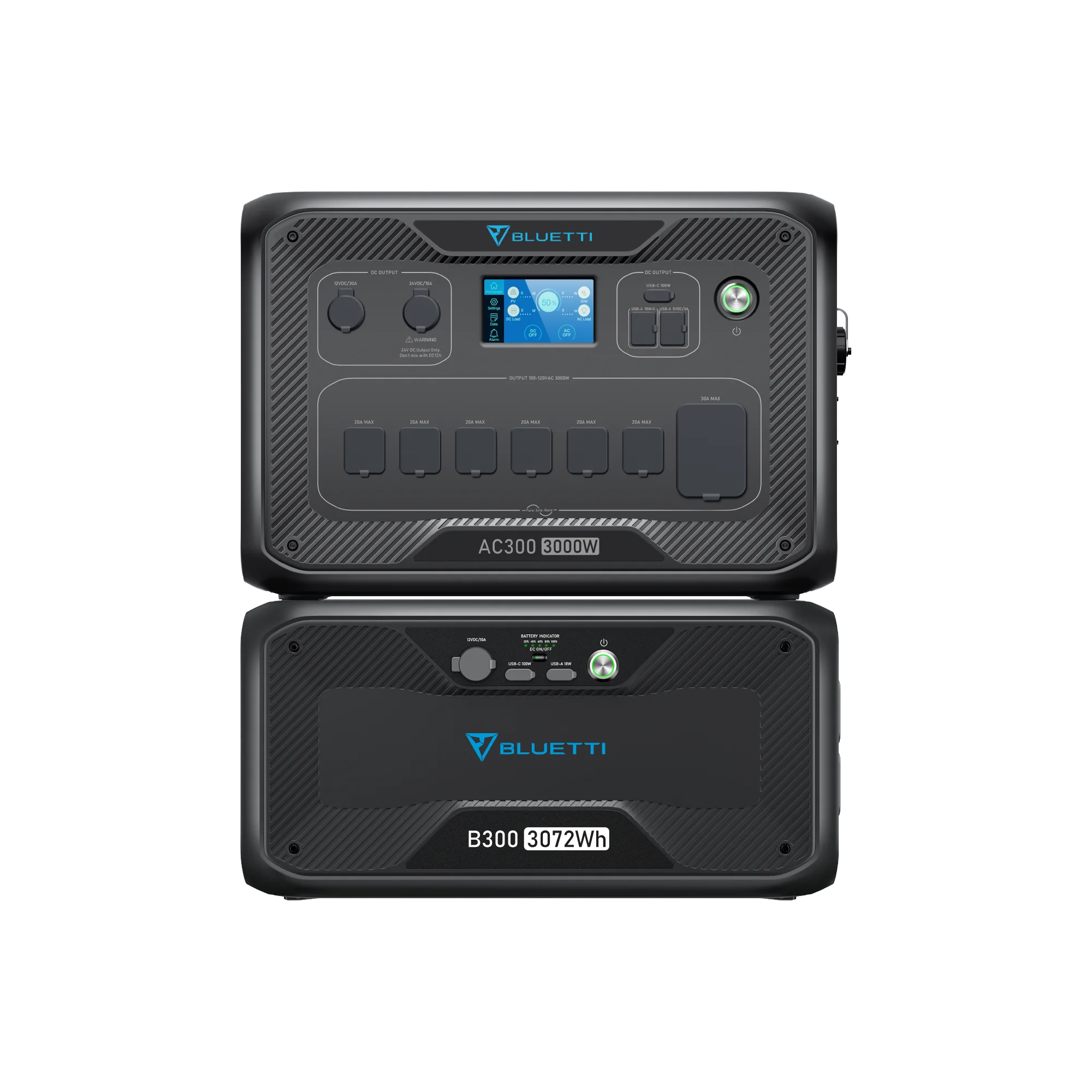
The Bluetti AC300 + B300 is built differently from almost every other power station on this site: the AC300 is an inverter module with no battery inside it at all, and the B300 is a separate 3,072Wh LiFePO4 battery that supplies the storage. Start with one B300 and you have a 3,000W / 3,072Wh home backup system; add up to four B300 batteries and the same inverter grows to 12,288Wh without being replaced. Add 2,400W of dual-MPPT solar input, a 30A TT-30 outlet, an optional 240V split-phase pairing and Bluetti's home integration kit, and you get the modular template that later systems — including the one in our Bluetti Apex 300 review — still follow.
Availability note — read this first
Honesty first: on Bluetti's official US store in October 2026, the AC300+B300 kit was listed at around $2,299 (list $3,299), but every variant showed sold out at check time, and Bluetti's newer AC300+B300K bundle page carries a discontinued label. Owners are well supported with manuals and parts, and kits still surface through retailers and the used market, but if you need to buy new today with a warranty from the official store, check stock first — and compare the newer models named in the verdict below before paying a markup for this one.
Bluetti AC300 + B300 specifications
| Specification | Bluetti AC300 + B300 |
|---|---|
| System type | Fully modular — AC300 inverter module (no internal battery) + B300 expansion battery; at least 1x B300 required |
| Capacity (1x B300) | 3,072Wh (51.2V, 60Ah) from the B300 battery |
| Battery type | LiFePO4 (LFP) |
| Cycle life | 3,500+ cycles to 80% capacity (B300) |
| AC output | 3,000W rated / 6,000W surge, pure sine wave |
| AC outlets (US version) | 7 total: 6x 120V/20A + 1x 120V/30A NEMA TT-30 (only the TT-30 delivers the full 3,000W / 30A) |
| USB-C output (AC300) | 1x 100W max (PD 3.0) |
| USB-A output (AC300) | 2x 5V/3A + 2x 18W fast charging |
| DC outputs (AC300) | 1x 12V/30A RV port, 1x 24V/10A car outlet (both regulated) |
| Wireless charging | 2x 15W pads (top panel) |
| B300 standalone outputs | 1x USB-C 100W, 1x USB-A 18W, 1x 12V/10A car outlet — the battery can power small DC loads on its own |
| AC input | Up to 3,000W max with the optional 30A charging cable (about 1,800W from a standard 120V household outlet with the included 15A cable) |
| Solar input | 2,400W max, dual MPPT (2x 1,200W, VOC 12–150VDC, 12A each) |
| Maximum input | 5,400W with AC and solar simultaneously (requires 2 or more B300 batteries) |
| B300 standalone input | 500W max AC via T500 adapter; 200W max solar (12–60V) |
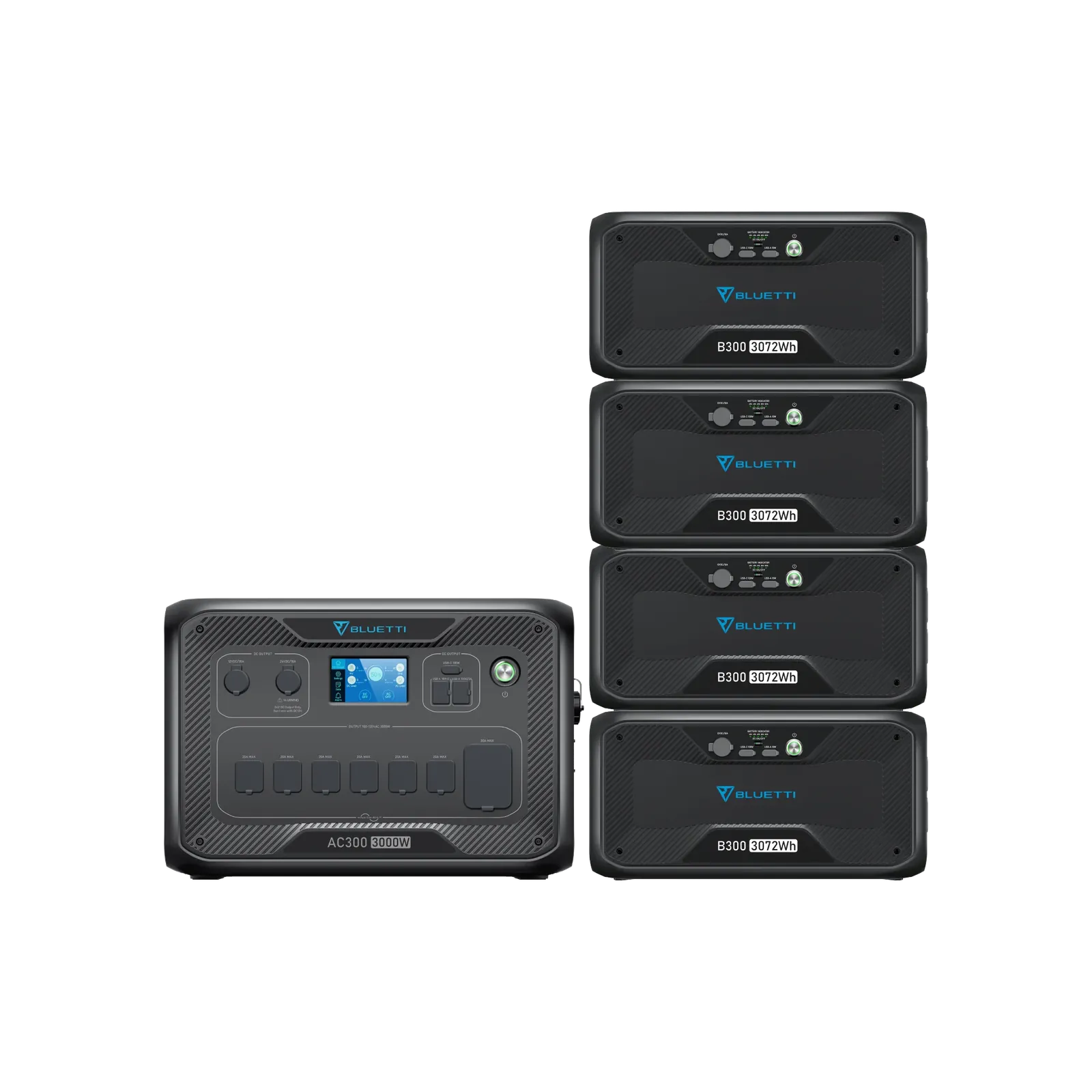
| Expandable | Yes — up to 4x B300 per AC300 for 12,288Wh; two AC300 units with Fusion Box Pro (P030A) give 240V split-phase, 6,000W and up to 24,576Wh |
| UPS function | 24/7 UPS home backup modes (Standard, Time Control, PV Priority, Customized) — Bluetti's manual does not publish a millisecond switchover rating |
| App control | Yes — BLUETTI app via Wi-Fi and Bluetooth |
| Pass-through charging | Yes |
| Weight | AC300: 47.6 lbs (21.6 kg); B300: 79.6 lbs (36.1 kg) each — 127.2 lbs for the base kit |
| Dimensions | AC300: 20.5 x 12.5 x 14.1 in; B300: 20.5 x 12.5 x 10.5 in (same footprint, designed to stack) |
| Operating temperature | Discharge -4°F to 104°F (-20°C to 40°C); charge 32°F to 104°F (0°C to 40°C) |
| Certifications | UL, FCC, CE, UN38.3, RoHS (per official manual) |
| Warranty | 4 years |
Why the modular design still matters
You buy capacity separately from power. In a normal station the battery and inverter are one sealed bet: outgrow the battery and the whole unit is replaced. Here, a household that starts at 3,072Wh for overnight essentials can add a second, third or fourth B300 as budgets or needs change, while the 3,000W inverter, outlets and solar input stay in service. It is the same growth argument as our Bluetti AC200MAX review, scaled up — the AC200MAX tops out at 8,192Wh; the AC300 system reaches 12,288Wh on one inverter and double that in a paired 240V setup.
Solar input is the headline number. 2,400W of dual-MPPT solar (two independent 1,200W strings, 12–150V) is still large by 2026 standards, and it is what makes the big battery practical off-grid: in strong sun the base kit can refill in roughly 1.5–2 hours of peak production, and a multi-battery system stops being a multi-day charging project. Seven recharge methods in total — AC, solar, car, generator, lead-acid battery, dual AC and AC+solar — cover the rest.
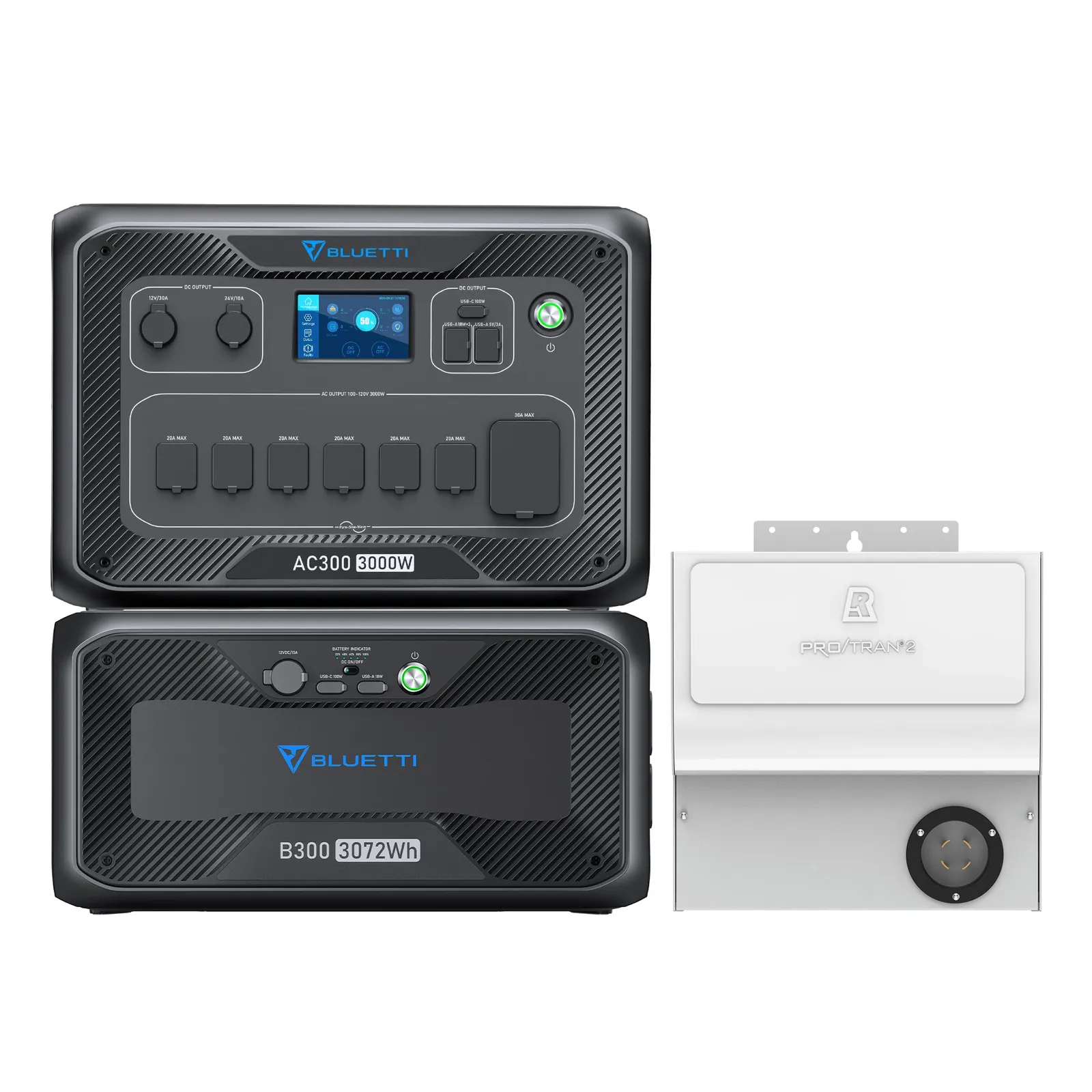
Home integration is a real path, not a slogan. Through Bluetti's home integration kit / sub-panel, the system can back up selected home circuits as a 24/7 UPS, with time-control and PV-priority modes that charge off-peak or from solar first. That is the use case it shares with the systems in our best whole-home battery backup systems guide — with the caveat that a licensed electrician is required for the grid-tied installation, per Bluetti's own manual.
What can it run?
With 3,072Wh (plan on roughly 2,550Wh usable after depth-of-discharge and inverter losses) and a 3,000W ceiling, realistic runtimes for the base one-battery kit look like this — estimates that scale almost linearly as you add B300 batteries:
- Full-size refrigerator (100–150W running, cycling): about 15–20 hours — see our refrigerator sizing guide for the math
- CPAP (30–40W, humidifier off): roughly 55–65 hours — close to a week of nights per charge
- Microwave (1,000W): about 2.5 hours of total cooking time
- TV + streaming box (120W): around 20 hours
- Laptop (60W): around 40 hours of active use
- Window air conditioner (800–1,000W): roughly 2.5–3 hours per B300 — a job for a multi-battery setup
- Power tools and workshop loads: saws, drills and compressors within the 3,000W / 6,000W surge envelope, well beyond the loads in our guide to what a 2000Wh power station can run
What one AC300 will not do alone: 240V loads. Well pumps, dryers and ranges need the two-unit Fusion Box Pro pairing for 240V split-phase — possible with this system, but it doubles the inverter cost, a point buyers should price before committing.
AC300 + B300 vs Bluetti's newer models
Against the sealed 2kWh class in our Bluetti AC200L review, the AC300 system wins on capacity ceiling, solar input and 240V potential, and loses on convenience: there is no single box to grab, and the base kit already weighs 127.2 lbs across two pieces. Against Bluetti's current modular flagship, the Apex 300, the AC300 gives up the newer model's lower entry capacity options and updated battery ecosystem in exchange for the huge installed base of B300 batteries. For most new buyers in 2026 the honest framing is this: the AC300+B300 is an excellent system to already own or to buy well-priced used, and a harder sell at full list price against its successors — which is why it still earns its place in our best home backup power stations roundup with the availability caveat attached. RV owners also get the TT-30 outlet and 12V/30A port covered in our best power stations for RV and van life guide, though the weight suits a parked rig far better than a touring one.
Pros and cons
Pros
- Fully modular: grow from 3,072Wh to 12,288Wh on the same inverter
- 3,000W pure sine output (6,000W surge) with a true 30A TT-30 outlet
- 2,400W dual-MPPT solar input — refills big battery banks in useful time
- 5,400W maximum dual charging with two or more B300 batteries
- 240V split-phase possible with two AC300 units and Fusion Box Pro
- B300 battery works standalone for DC loads (100W USB-C, 12V/10A)
- LiFePO4 rated 3,500+ cycles to 80%; Wi-Fi + Bluetooth app; 4-year warranty
Cons
- Sold out on Bluetti's official US store at check time (October 2026) — new stock is uncertain
- Base kit weighs 127.2 lbs across two pieces; each added B300 is another 79.6 lbs
- The AC300 is useless alone — at least one B300 is mandatory, cables included
- Full 3,000W AC charging needs the optional 30A cable; a normal outlet gives about 1,800W
- 240V requires buying a second AC300 plus the Fusion Box Pro
- No millisecond UPS switchover rating is published in Bluetti's manual
FAQs
Can the Bluetti AC300 work without a B300 battery?
No. The AC300 is an inverter module with no internal battery. It requires at least one B300 (or compatible B300K) connected to operate, and supports up to four per unit.
How far can the AC300 + B300 expand?
Up to 12,288Wh with four B300 batteries (3,072Wh each) on one AC300. Two AC300 units joined with the Fusion Box Pro (P030A) double that to 24,576Wh and add 240V split-phase output at 6,000W.
Can the AC300 + B300 run a house during an outage?
Selected circuits, yes. Through Bluetti's home integration kit / sub-panel it can back up essential 120V circuits as a 24/7 UPS, and Bluetti's manual requires a licensed electrician for that grid-tied installation. Whole-house 240V loads need the two-unit pairing.
How long does the AC300 + B300 take to charge?
At the maximum 3,000W AC input (optional 30A cable), the base 3,072Wh kit refills in roughly 1.5 hours; from a standard household outlet at about 1,800W, expect closer to 2 hours. With 2,400W of solar in ideal sun, figure roughly 1.5–2 hours, and AC+solar together reach 5,400W when two or more B300s are connected.
Can the B300 battery be used on its own?
Partly. The B300 has its own 100W USB-C, 18W USB-A and 12V/10A car outputs, and can recharge itself slowly (500W AC adapter, 200W solar), so it works as a big DC power bank. It has no AC inverter — AC power always comes from the AC300.
Is the AC300 + B300 still worth buying in 2026?
At the right price, yes — especially for existing B300 owners expanding a system, or used buyers who find a complete kit well under list. At full list price from a third-party seller, compare Bluetti's newer Apex 300 ecosystem first, because official-store stock of the AC300+B300 was sold out in October 2026.
Verdict
The Bluetti AC300 + B300 remains one of the most flexible home backup systems ever sold in this class: a 3,000W inverter you can feed with one to four 3,072Wh batteries, 2,400W of solar, an honest path to 240V, and a B300 ecosystem deep enough that expansion batteries are easy to find. Its weaknesses are weight, the extra hardware its best tricks require, and — decisively in October 2026 — availability, with the official US store sold out at around $2,299 list-checked price. Buy it confidently if you already own B300s or find a complete kit sensibly priced; buy Bluetti's current generation instead if you are starting fresh at full price.
About our reviews
Specs come from published manufacturer data sheets, cross-checked against owner feedback. Runtime estimates use usable capacity (Wh × 0.85 ÷ watts). We do not lab-test units unless an article says so. Figures go stale. Check the current data sheet before you buy. This is not electrical or purchasing advice. How we research.
Related guides
 ReviewsAnker Solix C800 Plus Review: 768Wh, 1200WThe Anker Solix C800 Plus pairs 768Wh of LiFePO4 with 1200W of output, a 58-minute full recharge, and something no rival offers:…
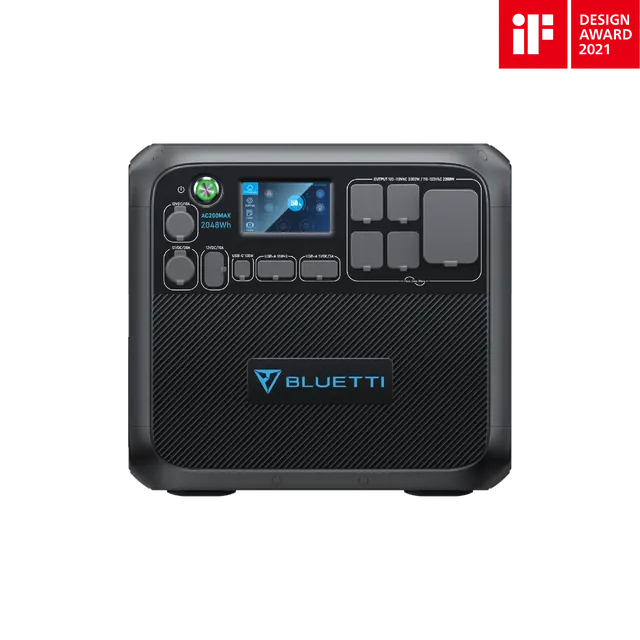 ReviewsBluetti AC200MAX Review: 2048Wh, 2200W ExpandableThe Bluetti AC200MAX pairs a 2048Wh LiFePO4 battery and a 2200W inverter with something most 2kWh stations still lack: real…
 ReviewsBluetti EB3A Review: 268Wh, 600W, Fast ChargeThe Bluetti EB3A packs a 268Wh LiFePO4 battery, a 600W inverter, 430W dual charging (80% in about 30–40 minutes) and a 15W…
Reader comments
No comments yet. Own this model or have a question about it? Share it below.