Can a Portable Power Station Run a Well Pump?
8 min read
On this page
Yes, but only a large, usually 240V-capable one. Well pump watts by horsepower from Franklin Electric data, why the startup surge matters, and runtime on 2.7 to 4kWh power stations.
Short answer: yes, a large portable power station can run a well pump, but most small and mid-size ones can't. A typical 1/2 HP submersible well pump draws about 670 to 960 watts while running, yet it needs a big burst of current to start, and most deep-well pumps run on 240V, which only a handful of power stations supply. In practice you need a 240V-capable station with 4,000W or more of output (or a 120V station for a 115V pump), plus a transfer switch or inlet to connect a hardwired pump safely.
How many watts does a well pump use?
Running watts are the easy part. Franklin Electric, a major maker of submersible well motors, publishes full-load and maximum-load watts for its 4-inch single-phase motors. Maximum load (the motor working at its service factor) is the safer number to plan with.
| Motor (4-inch, single-phase) | Running watts (full load) | Running watts (max load) | Locked-rotor amps, 2-wire / 3-wire (230V) | Franklin minimum generator, 2-wire / 3-wire |
|---|---|---|---|---|
| 1/2 HP | 670W | 960W | 32.2A / 23A | 3kW / 2kW |
| 3/4 HP | 940W | 1,310W | 40.7A / 34.2A | 4.5kW / 3kW |
| 1 HP | 1,210W | 1,600W | 48.7A / 41.8A | 6kW / 4kW |
| 1.5 HP | 1,710W (2-wire) | 2,280W (2-wire) | 66.2A / 51.4A | 7.5kW / 5kW |
A 1/2 HP submersible well pump uses about 670 watts at full load and up to 960 watts at maximum load, according to Franklin Electric's motor data. Franklin also makes a 115V version of the 1/2 HP 2-wire motor with the same 670W rating, which matters if your power station only has 120V outlets.
Check your own pump first: the nameplate on a 3-wire pump's control box (or the installation paperwork) lists horsepower, voltage and amps.
Why is starting a well pump the hard part?
An induction motor pulls several times its running current for the first fraction of a second as it gets the pump and water column moving. Franklin lists that worst-case figure as locked-rotor amps: 32.2A for a 1/2 HP 2-wire motor at 230V, which is roughly 7.4kVA at the instant of start, about eight times its maximum running watts. That spike is why a generator for a 1/2 HP 2-wire pump should be at least 3kW in Franklin's chart, even though the pump only runs at about 1kW.
Three things change how hard the start is:
- 2-wire vs. 3-wire. A 2-wire pump has its starting components inside the motor, down the well. A 3-wire pump has a control box in the house and starts more gently. Franklin's minimum generator size for a 2-wire motor is 50% higher than for a 3-wire motor of the same horsepower.
- Soft-start and constant-pressure pumps. Grundfos SQ/SQE pumps have a built-in soft start that ramps up in a maximum of 2 seconds, and Grundfos says their starting current equals the highest value on the nameplate. Grundfos recommends a 1,500W generator for a 0.5 HP SQ pump (1,200W minimum). Variable-speed constant-pressure drives also start gently.
- What else is running. A fridge compressor starting at the same moment adds its own surge.
Engine generators sag in voltage during a surge; a power station's overload protection simply cuts the output if the spike is too big. Most makers don't publish a motor-starting figure, so treat generator numbers as a rough guide and test the real combination before an outage.
Do you need a 240V power station for a well pump?
Usually, yes. In Franklin's 4-inch single-phase line, every motor is offered at 230V and only the 1/2 HP 2-wire also comes in 115V. A 230V pump won't run from a 120V-only power station at all, no matter how big the battery is. Here's what the larger 240V-capable stations publish, alongside a 120V-only model:
| Power station | Capacity | Continuous output | 240V? | What the maker says about motor starting |
|---|---|---|---|---|
| EcoFlow Delta Pro 3 | 4,096Wh | 4,000W (8,000W surge) | Yes, 120V or 240V (not both at once) | EcoFlow says it can power a 1 HP water pump |
| Anker SOLIX F3800 Plus | 3,840Wh | 6,000W max | Yes, via L14-30R | Anker lists 80A locked-rotor amps capability |
| BLUETTI Apex 300 | 2,764.8Wh | 3,840W | Yes, 120V and 240V at once | 7,680W "Power Lifting" is for resistive loads only, per BLUETTI's manual |
| Jackery HomePower 3000 | 3,072Wh | 3,600W (7,200W surge) | No, 120V only | Only suitable for a 115V pump |
The Anker SOLIX F3800 Plus is the only station here whose maker publishes a locked-rotor amps figure: 80A, above every 4-inch single-phase Franklin motor in the first table. EcoFlow states that the Delta Pro 3 can run a 1 HP water pump. For other stations, ask the manufacturer before you rely on one for water. Our Bluetti Apex 300 vs. Anker SOLIX F3800 comparison and EcoFlow Delta Pro 3 review go deeper on these units.
Two details are easy to miss: Anker says the F3800 Plus's 240V output isn't available while it charges from 120V AC, and Franklin's constant-pressure drive manual says not to use its drives with a GFCI, while some stations (such as the Delta Pro 3) have internal GFCI protection. Check with both manufacturers.
How long will a power station run a well pump?
A well pump only runs when the pressure tank needs refilling. We use the same formula across the site:
Runtime (hours) = Capacity (Wh) × 0.85 ÷ pump watts
The 0.85 covers inverter losses. Daily pump time is gallons used ÷ pump flow in gallons per minute. The EPA says the average American family uses more than 300 gallons of water a day at home. At an assumed 10 gallons per minute, that's about 30 minutes of pumping a day.
| Battery capacity | Continuous pumping, 1/2 HP (960W) | Continuous pumping, 1 HP (1,600W) | Pump-only days at 300 gal/day, 1/2 HP | Pump-only days at 300 gal/day, 1 HP |
|---|---|---|---|---|
| 2,764.8Wh | 2.4 h | 1.5 h | 4.9 days | 2.9 days |
| 3,840Wh | 3.4 h | 2.0 h | 6.8 days | 4.1 days |
| 4,096Wh | 3.6 h | 2.2 h | 7.3 days | 4.4 days |
A 4,096Wh power station can run a 1/2 HP well pump drawing 960 watts for about 3.6 hours of actual pumping, roughly a week of a family's typical water use if the pump is the only load. Add a refrigerator, lights and a furnace blower and those numbers shrink fast. Real flow depends on your pump and well depth; time how long it takes to fill a 5-gallon bucket.
To size the whole outage, use our home backup sizing worksheet and our guide to what size power station runs a fridge.
How do you connect a well pump to a power station safely?
Most well pumps are hardwired to a 240V breaker, not plugged into an outlet, so there's no cord to plug into the station. The safe options are:
- A transfer switch or power inlet with an interlock, installed by a licensed electrician, so the station feeds the pump circuit and the house is disconnected from the grid. Franklin's manual warns that a transfer switch must be used any time a generator backs up a building, to prevent electrocution of utility workers. The same applies to a battery.
- A manufacturer home panel, such as EcoFlow's Smart Home Panel 2 or Anker's Home Power Panel, which wires the station into selected circuits.
Never backfeed a dryer outlet with a double-male cord. Anker also notes that the inlet box or transfer switch must have neutral and ground properly connected for its 240V output. Before storm season, switch the pump circuit to the station, open a faucet until the pump kicks on, and confirm it starts with the fridge running too.
How can you make the battery last longer during an outage?
- Use the pressure tank. It stores water under pressure, so short draws may not start the pump.
- Skip big water users: laundry, irrigation and long showers.
- Fill jugs and a bathtub before a forecast storm for flushing.
- Recharge from solar or a generator on long outages. Our power station vs. gas generator guide covers the trade-offs, and the same surge logic applies to a sump pump.
FAQ
Can a 2,000W power station run a well pump?
Only a small 115V pump with a gentle start, and not reliably. A 1/2 HP pump runs at up to about 960W, but its start-up surge is many times higher, and most 2,000W stations are 120V-only, so they can't run a 230V pump at all.
What size power station do I need for a 1/2 HP well pump?
Plan for a 240V-capable station with about 4,000W or more of continuous output if the pump is 230V, or a strong 120V station for a 115V pump. A 3- to 4kWh battery gives roughly 2.4 to 3.6 hours of actual pumping.
Can a power station run a 1 HP well pump?
Some can. EcoFlow says the Delta Pro 3 can power a 1 HP water pump, and Anker publishes an 80A locked-rotor rating for the F3800 Plus. A 1 HP motor draws up to about 1,600W running and far more to start.
Can I plug my well pump into a power station?
Usually not directly, because most well pumps are hardwired to a 240V breaker. You need a transfer switch, a power inlet with an interlock, or a manufacturer home panel, installed by a licensed electrician.
Is a constant-pressure or soft-start pump easier to run on battery?
Yes. Soft-start pumps such as the Grundfos SQ ramp up over about 2 seconds instead of pulling a full locked-rotor surge, so they need far less surge capacity. Check whether your drive conflicts with GFCI-protected outlets.
Will my well pump work if the power station is too small?
Usually the station's overload protection trips the moment the pump tries to start, and the pump never runs. Switch the pump circuit off and use a larger or 240V-capable station instead.
Sources
- Franklin Electric: AIM Manual, 60 Hz submersible systems (4-inch single-phase motor specs, generator minimum ratings, transfer switch warning)
- Grundfos: SQ/SQE installation and operating instructions (soft start, generator sizing)
- U.S. EPA WaterSense: How we use water (300 gallons per family per day)
- USGS: Domestic (private) supply wells
- EcoFlow: Delta Pro 3 specifications
- Anker SOLIX: F3800 Plus user guide (240V output, locked-rotor amps)
- BLUETTI: Apex 300 specifications
- Jackery: HomePower 3000 specifications
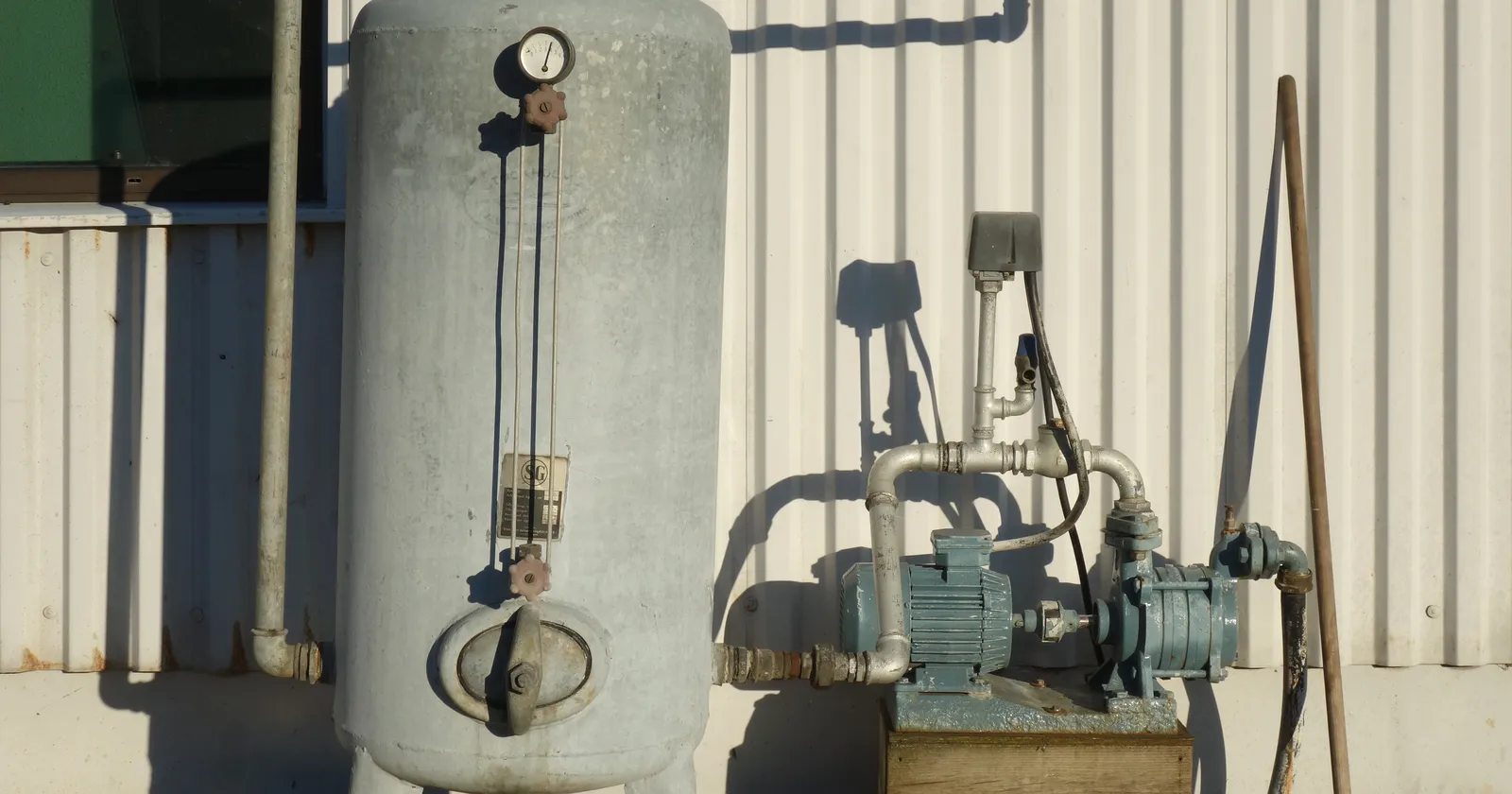
- Featured photo: "Hydrophore and pump at sunset" by W.carter, Wikimedia Commons, CC BY-SA 4.0 (cropped)

How we got these numbers: pump watts, locked-rotor amps and generator minimums come from Franklin Electric's 2026 AIM manual (4-inch single-phase motors). Starting kVA is locked-rotor amps × 230V. Runtimes are our calculations from manufacturer-rated capacity with an 85% efficiency factor, using Franklin's maximum-load watts; the 10 gallons-per-minute flow is an example, not a measurement. They're not lab tests, and we haven't run these power stations on a well pump ourselves. Power station specs come from manufacturer pages (accessed October 2026). See how we research.
About our reviews
Specs come from published manufacturer data sheets, cross-checked against owner feedback. Runtime estimates use usable capacity (Wh × 0.85 ÷ watts). We do not lab-test units unless an article says so. Figures go stale. Check the current data sheet before you buy. This is not electrical or purchasing advice. How we research.
Related guides
 Sizing guidesCan a Portable Power Station Run a Window Air Conditioner?Yes, but only a mid-size or larger station, and not for long. Window AC watts by BTU from ENERGY STAR data, startup surge, and…
 Sizing guidesCan a Portable Power Station Run a Gas Furnace? (Watts and Runtime)Yes, if it has pure sine wave output, enough surge to start the blower, and a safe connection. How many watts a gas furnace uses,…
 Sizing guidesHow Many Solar Panels Do I Need to Charge a Power Station?How many watts of solar panels it takes to refill a 300Wh, 1000Wh, or 2000Wh power station in a day, with a charge-time chart for…
Reader comments
No comments yet. Own this model or have a question about it? Share it below.