Jackery 2000 Plus vs EcoFlow Delta 2 Max: Which Wins?
7 min read
On this page
- The short version
- Side-by-side specs
- Output and outlets: Jackery wins on watts, EcoFlow wins on count
- Expansion: two different ceilings
- Charging: EcoFlow is faster from the wall, Jackery takes more sun
- Size, weight and living with them
- Availability and price: read this before you decide
- Winner by use case
- FAQ
- Verdict
Two 2kWh LiFePO4 stations, two philosophies: the Jackery Explorer 2000 Plus brings 3000W output and expansion to 24kWh, while the EcoFlow Delta 2 Max counters with 15 outlets, faster AC charging and a price around $1,049. Research-based…
The short version
On paper these two look identical — both are 2kWh LiFePO4 stations — but they are built for different buyers. The Jackery Explorer 2000 Plus is the output-and-expansion pick: 3000W of AC power (600W more than the EcoFlow), a 25A outlet for heavier loads, and a growth path that runs to 12kWh with one unit or 24kWh with two in parallel. The EcoFlow Delta 2 Max is the value-and-everyday pick: around $1,049 as a standalone unit on EcoFlow's US store as of October 2026, about 11.5 lbs lighter, with more outlets (15 vs 10), faster 1800W AC recharging, and a simpler expansion ceiling of 6144Wh that most homes will never outgrow. If you are building toward serious whole-home backup or need the extra 600W, buy the Jackery system. If you want one proven 2kWh station for outages, camping and RV trips at the lowest sensible price, buy the EcoFlow.
This is a research-based comparison: every spec below comes from Jackery's and EcoFlow's official US documentation, re-verified in October 2026. We did not bench-test either unit. Full single-product reviews: our Jackery Explorer 2000 Plus review and our EcoFlow Delta 2 Max review.
Side-by-side specs
| Spec | Jackery Explorer 2000 Plus | EcoFlow Delta 2 Max |
|---|---|---|
| Capacity | 2042.8Wh LiFePO4 | 2048Wh LiFePO4 |
| Cycle life | 4,000 cycles to 70%+ | 3,000 cycles to 80%+ |
| AC output | 3000W rated / 6000W surge | 2400W rated / 4800W surge |
| Boost mode | — | X-Boost up to 3400W (resistive loads) |
| AC outlets | 5 (4x 120V/20A + 1x 120V/25A) | 6x 120V |
| USB-C | 2x 100W | 2x 100W |
| USB-A | 2x 18W (QC 3.0) | 2x 12W + 2x 18W fast charge |
| DC outputs | 1x car port 12V/10A | 1x car outlet 126W + 2x DC5521 38W |
| Total outlets | 10 | 15 |
| Expandable | Yes — to 12kWh (5 packs); 24kWh / 6000W / 120-240V with 2 units in parallel | Yes — to 6144Wh (2 extra batteries) |
| AC recharge input | 120V, 15A charge / 12A bypass | 1800W X-Stream |
| Solar input | Up to 1400W; ~2h with 6x SolarSaga 200W | 1000W max — dual ports, 500W each |
| Backup switchover | EPS supported | EPS under 30ms |
| App control | Wi-Fi + Bluetooth | Wi-Fi + Bluetooth |
| Weight | 61.5 lbs (27.9 kg), wheels + telescopic handle | 50 lbs (23 kg) |
| Dimensions | 18.6 x 14.1 x 14.7 in | 19.6 x 9.5 x 12 in |
| Warranty | 3 + 2 years | 5 years |
| Typical US price (Oct 2026) | No standalone new listing — see Availability note | Around $1,049 standalone |
A note on the cycle-life row: the two brands rate lifespan to different remaining-capacity thresholds (Jackery 70%, EcoFlow 80%), so 4,000 vs 3,000 is not a clean win for either side. Treat both as decade-class LFP batteries under normal use.
Output and outlets: Jackery wins on watts, EcoFlow wins on count
The Jackery's 3000W inverter is the headline difference. It runs heavier single loads without help, and its 25A outlet is the one to use for demanding RV and workshop gear. The EcoFlow answers with X-Boost up to 3400W — useful for resistive loads like kettles and heaters, but it is a voltage-reduction mode, not true 3400W output, and the Jackery still wins for motor-driven and electronics loads near the limit.
For everyday plugging-in, the EcoFlow is friendlier: six AC outlets instead of five, four USB-A ports instead of two, and two DC5521 outputs the Jackery lacks entirely. If your outage kit is a fridge, lights, phones, a laptop and a CPAP, the Delta 2 Max's port layout serves it better. What that load mix actually draws is covered in our guide to what a 2000Wh power station can run.
Expansion: two different ceilings
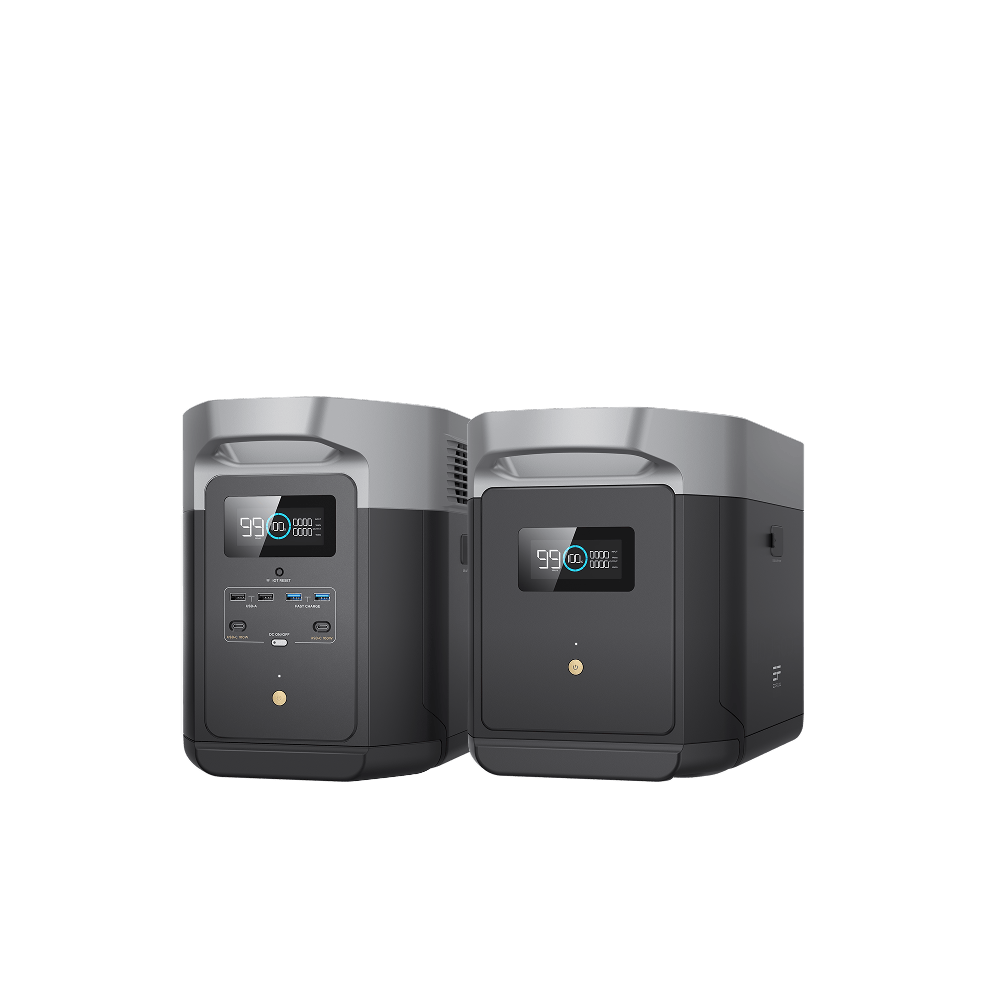
This is where the two products stop being rivals and become different categories. The Delta 2 Max doubles or triples itself — 4096Wh with one extra battery, 6144Wh with two — and then it stops. That is enough for overnight fridge-plus-essentials backup for most homes, and the extra batteries are simple plug-in boxes.
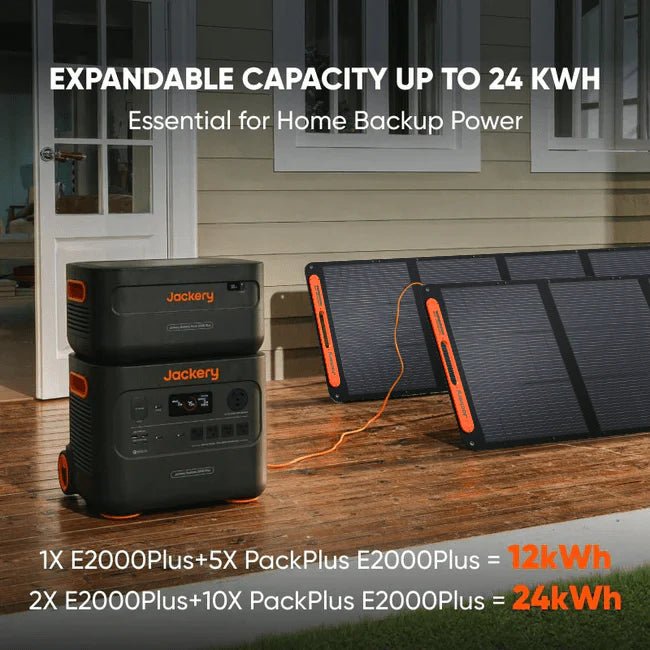
The Explorer 2000 Plus keeps going: up to five Battery Pack 2000 Plus units take a single station to about 12kWh, and two stations in parallel reach about 24kWh with 6000W output and 120/240V — genuine whole-home territory that the EcoFlow cannot enter at any price. The trade-off is cost and bulk: each Jackery battery pack is around $799 as of October 2026, and the base unit already weighs 61.5 lbs before you add one.
Charging: EcoFlow is faster from the wall, Jackery takes more sun
From a wall outlet the EcoFlow wins clearly: its 1800W X-Stream input refills 2048Wh far faster than the Jackery's 15A-limited AC charging. From the sun the Jackery wins on paper: up to 1400W of DC input and a claimed ~2-hour full charge with six SolarSaga 200W panels, against the EcoFlow's 1000W dual-port ceiling. In practice, either station pairs well with a home setup from our best portable power stations for home backup guide; the Jackery's edge only shows if you actually deploy a large panel array.
Size, weight and living with them
Neither station is light, but the 11.5-lb gap matters every time you move one. The Delta 2 Max at 50 lbs is a two-hand carry with a slimmer 9.5-inch depth that tucks beside furniture. The Explorer 2000 Plus at 61.5 lbs compensates with wheels and a telescopic handle — easier on flat ground and in an RV park, harder on stairs. For RV and van use both appear in our best portable power stations for RV and van life guide; if weight is your top priority, also look at the lighter sibling in our Jackery Explorer 2000 v2 review.
Availability and price: read this before you decide
The EcoFlow is the straightforward buy: the Delta 2 Max standalone unit was around $1,049 (list $1,299) on EcoFlow's US store as of October 2026. The Jackery needs an honest note: as of October 2026, Jackery's US store no longer lists a standalone new Explorer 2000 Plus variant. The current new option is the Explorer 2000 Plus + 2x SolarSaga 100W mini bundle at around $1,429; refurbished standalone units list at around $1,999 and refurbished 6kWh kits at $2,399–$2,499. That makes the EcoFlow dramatically cheaper to buy new today — budget shoppers should also cross-check EcoFlow's newer generation in our EcoFlow Delta 3 Max review before paying a premium for the Jackery name.
Winner by use case
- Best value 2kWh station: EcoFlow Delta 2 Max — around $1,049 new, more outlets, faster AC charging.
- Heaviest loads (25A outlet, 3000W): Jackery Explorer 2000 Plus.
- Growing toward whole-home backup: Jackery Explorer 2000 Plus — 12kWh single-unit and 24kWh parallel ceilings vs the EcoFlow's 6144Wh cap.
- RV and camping: EcoFlow Delta 2 Max for most — lighter, slimmer, extra DC outputs; Jackery only if you need the 25A outlet.
- Big solar arrays: Jackery Explorer 2000 Plus — 1400W solar input vs 1000W.
- Simple one-box outage backup: EcoFlow Delta 2 Max.
FAQ
Is the Jackery Explorer 2000 Plus more powerful than the EcoFlow Delta 2 Max?
Yes on output: 3000W rated (6000W surge) vs 2400W (4800W surge), plus a 25A outlet. Capacity is effectively tied — 2042.8Wh vs 2048Wh.
Which power station expands further?
The Jackery, by a wide margin: about 12kWh with one unit and five battery packs, or about 24kWh with two units in parallel. The Delta 2 Max stops at 6144Wh with two extra batteries.
Which charges faster?
From the wall, the EcoFlow — its AC input is 1800W against the Jackery's 15A-limited charging. From solar, the Jackery accepts more: up to 1400W vs 1000W.
Why is the Jackery so hard to buy new as a standalone unit?
As of October 2026, Jackery's US store lists the Explorer 2000 Plus in bundles and refurbished form rather than as a standalone new variant, and promotes its newer HomePower line. The bundles and refurbished units are the current routes to buy one.
Which one is better for a refrigerator during an outage?
Both run a typical fridge for a similar number of hours — capacity is nearly identical. The EcoFlow's extra outlets and lower price make it the simpler pick; runtime math is in our 2000Wh runtime guide.
Do both use LiFePO4 batteries?
Yes. Jackery rates the Explorer 2000 Plus at 4,000 cycles to 70% remaining capacity; EcoFlow rates the Delta 2 Max at 3,000 cycles to 80% — different thresholds, so the figures are not directly comparable.
Verdict
For most buyers in October 2026, the EcoFlow Delta 2 Max wins this comparison: it matches the Jackery on capacity, beats it on outlet count, AC charging speed, weight and — decisively — price and availability as a new standalone unit. The Jackery Explorer 2000 Plus is the right buy for a narrower, serious brief: you need 3000W and a 25A outlet today, or you are deliberately building toward a 12–24kWh expandable system and accept bundle/refurbished pricing to get there. Choose by your ceiling, not by the spec-sheet tie on capacity.
Research-based comparison — specs verified against official Jackery and EcoFlow US sources in October 2026; no hands-on testing is claimed. Prices are as of October 2026 and change frequently.
About our reviews
Specs come from published manufacturer data sheets, cross-checked against owner feedback. Runtime estimates use usable capacity (Wh × 0.85 ÷ watts). We do not lab-test units unless an article says so. Figures go stale. Check the current data sheet before you buy. This is not electrical or purchasing advice. How we research.
Related guides
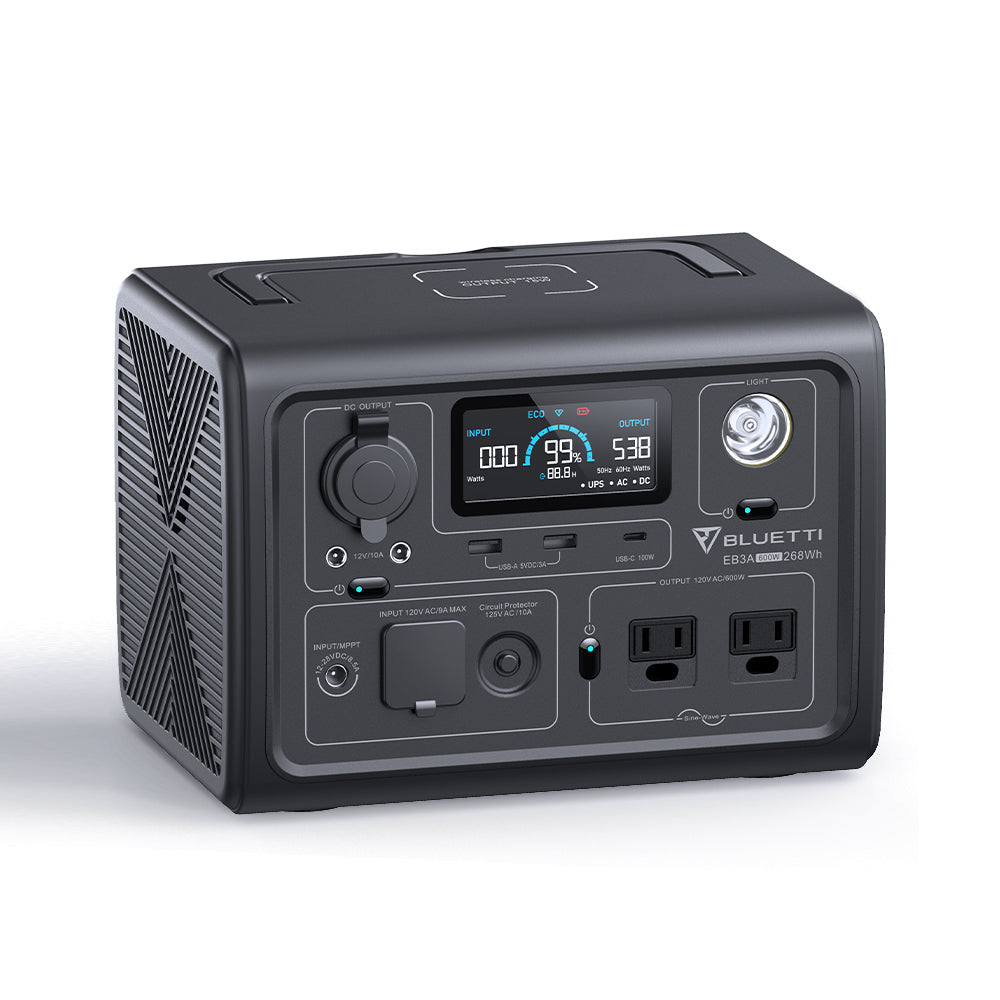 ComparisonsBluetti EB3A vs EcoFlow River 2: Which Wins?Two sub-300Wh LiFePO4 classics go head to head: the Bluetti EB3A brings double the AC output, a wireless pad and 200W solar,…
 ComparisonsEcoFlow Delta 3 vs Jackery 1000 v2: Which Wins?Two 1kWh LiFePO4 stations, two philosophies: the EcoFlow Delta 3 Classic brings 1800W output, a 10ms UPS and a 45-minute…
 ComparisonsDJI Power 1000 vs EcoFlow Delta 2: Which Wins?Both hold exactly 1024Wh of LiFePO4 storage, but they spend it very differently: the DJI Power 1000 brings 2200W of output and…
Reader comments
No comments yet. Own this model or have a question about it? Share it below.