Bluetti EB3A vs EcoFlow River 2: Which Wins?
9 min read
On this page
- The short version
- Side-by-side specs
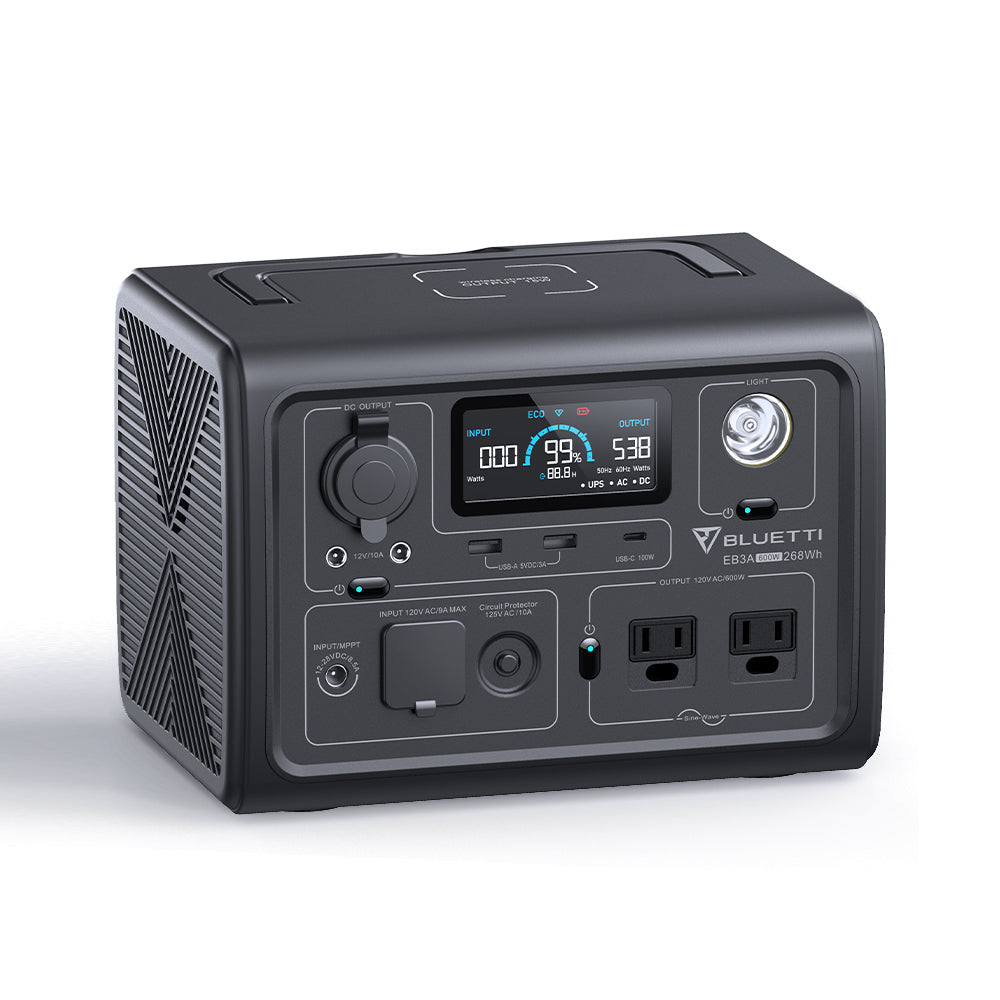
- Output and ports: the EB3A wins, and it is not close
- Charging and solar: RIVER 2 is faster to full, EB3A drinks more sun
- Runtime: a tie on paper, a split decision in practice
- Ownership: the RIVER 2 is built to be kept longer
- Availability note (October 2026): both are discontinued — buy accordingly
- Winner by use case
- FAQs
- Verdict
Two sub-300Wh LiFePO4 classics go head to head: the Bluetti EB3A brings double the AC output, a wireless pad and 200W solar, while the EcoFlow RIVER 2 counters with a 60-minute full charge, Wi-Fi app control and a 5-year warranty. Both are…
The short version
These are the two small stations that defined the sub-300Wh class — and in late October 2026 both are officially on their way out, which changes how you should buy them. The Bluetti EB3A is the power pick: 268Wh, a 600W inverter (double the EcoFlow's 300W), a 100W USB-C port, a 15W wireless charging pad and 200W of solar input. The EcoFlow RIVER 2 is the ownership pick: 256Wh, just 7.7 lbs, a full charge in 60 minutes, Wi-Fi plus Bluetooth app control, a longer 3,000-cycle battery rating and a 5-year warranty against the Bluetti's 2 years. If you will actually plug in loads above 300W — a mini fridge with a hungry compressor, power-tool chargers, a small TV setup — buy the EB3A. If your loads are phones, laptops, lights and a router, the RIVER 2 is lighter, longer-lived and better supported. And read the availability note before paying full price for either: both have newer successors that are often the smarter buy at the same money.
This is a research-based comparison: every spec below comes from Bluetti's and EcoFlow's official documentation and store feeds, re-verified in October 2026. We did not bench-test either unit. The single-product deep dive is our Bluetti EB3A review; the RIVER 2's bigger siblings are covered in our EcoFlow River 2 Max review and EcoFlow River 2 Pro review.
Side-by-side specs
| Spec | Bluetti EB3A | EcoFlow RIVER 2 |
|---|---|---|
| Capacity | 268Wh LiFePO4 | 256Wh LiFePO4 |
| Cycle life | 2,500+ cycles to 80% | 3,000+ cycles to 80% |
| AC output | 600W rated / 1,200W surge, pure sine wave | 300W rated / 600W surge, pure sine wave |
| Boost mode | Power Lifting for resistive loads above 600W | X-Boost up to 600W (resistive loads) |
| AC outlets | 2x 120V | 2x 120V (North American version) |
| USB-C | 1x 100W output | 1x 60W input/output |
| USB-A | 2x 5V/3A | 2x 5V/2.4A (12W per port) |
| DC outputs | 1x 12V/10A car outlet + 2x 12V/10A DC5521 | 1x car port, 12.6V/8A, 100W max (no DC5521) |
| Wireless charging | 1x 15W pad (top panel) | No |
| Total outputs | 9 | 6 |
| AC recharge | 268W standard / 350W turbo; ~80% in 30–40 min, full ~1.3–1.8 hrs (turbo) | 360W max; 0–80% in 48 min, 0–100% in 60 min |
| Solar input | 200W max (VOC 12–28V, 8.5A, MPPT) | 110W max (11–30V, 8A) |
| Maximum input | 430W (AC + solar together) | 360W AC (single-input charging) |
| Car charging | 12/24V | 12/24V, 100W max, ~3 hrs |
| Backup switchover | EPS pass-through | EPS, switchover under 30ms |
| App control | Bluetooth only | Wi-Fi + Bluetooth |
| Expandable | No | No |
| Weight | 10.14 lbs (4.6 kg) | 7.7 lbs (3.5 kg) |
| Dimensions | 10.04 x 7.09 x 7.20 in | 9.6 x 8.5 x 5.7 in |
| Warranty | 2 years | 5 years |
The capacity gap — 268Wh against 256Wh — is about 5%, inside the margin of inverter losses. Treat runtime as a tie and decide this comparison on output, ports, charging and ownership instead.
Output and ports: the EB3A wins, and it is not close
The EB3A's 600W inverter is the single biggest difference in this comparison. Most sub-300Wh stations, the RIVER 2 included, stop at 300W — enough for laptops, lights, a fan and a router, but marginal for anything with a motor or a heating element. The EB3A runs those same loads with headroom and adds a Power Lifting mode for resistive loads above its rating. Its port layout is also a generation ahead: a 100W USB-C port that can fast-charge a large laptop on its own, two DC5521 outputs for 12V gear, and the 15W wireless pad on top that turns it into a nightstand charging hub.
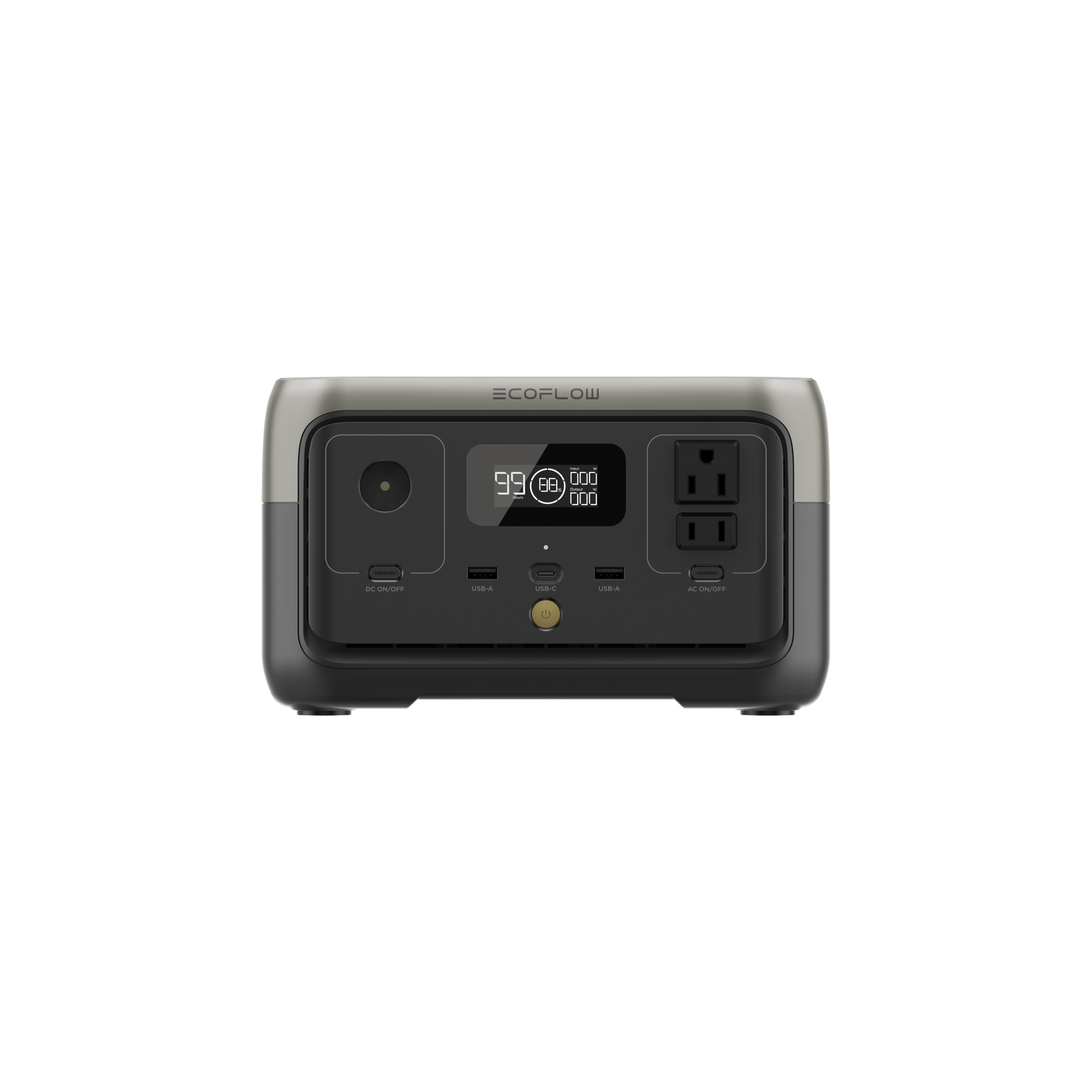
The RIVER 2's six outputs are honest but basic: two AC outlets, a 60W USB-C port that doubles as a charging input, two 12W USB-A ports and the car port. There is no DC5521 and no wireless pad. Against its closest-name rival from a third brand, the Jackery Explorer 300 Plus, the RIVER 2 competes on weight and charging speed rather than on ports — and that is exactly where it beats the EB3A, as the next sections show.
Charging and solar: RIVER 2 is faster to full, EB3A drinks more sun
EcoFlow's X-Stream charging is the RIVER 2's party trick: 360W of AC input refills it from empty to 80% in 48 minutes and to 100% in 60 minutes flat — still one of the fastest full charges in the class, and gentler on the battery than turbo modes because it is the standard rate, not an overdrive setting. The EB3A counters with speed at the top end: roughly 80% in 30–40 minutes using its 350W turbo mode or the 430W combined AC-plus-solar input, though a full turbo charge takes about 1.3–1.8 hours.
Off-grid, the advantage flips to Bluetti. The EB3A accepts 200W of solar — nearly double the RIVER 2's 110W ceiling — and can take AC and solar at the same time. The RIVER 2's 110W input is matched to a single small panel, fine for topping up phones and lights at camp but slow in winter sun. Panel pairing math for both brands is in our guide to how many solar panels you need to recharge a power station.
Runtime: a tie on paper, a split decision in practice
Plan on roughly 215–230Wh of usable energy from either unit after inverter losses. That buys about 20 phone charges, 3–4 hours of laptop work, around 11 hours of a 20W fan, or roughly one night of a low-draw CPAP — check the settings that make that work in our CPAP overnight sizing guide before relying on any station this size. Both units sit in the same bracket of our best budget power stations under $500 guide for exactly these grab-and-go jobs.
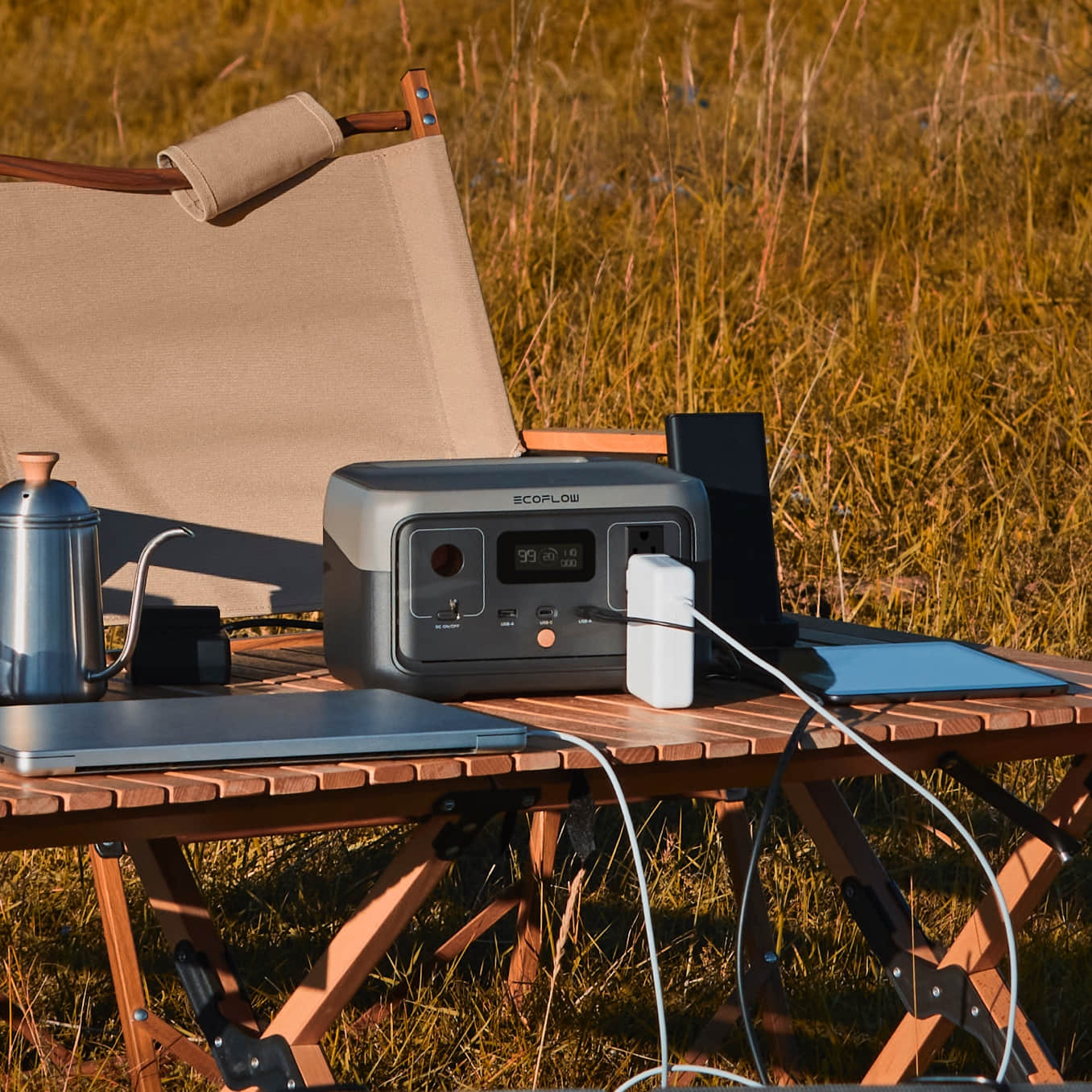
Where runtime stops being a tie is the load itself. A 60W mini fridge cycles happily on either unit, but its startup surge and a second plugged-in load can push past the RIVER 2's 300W ceiling while the EB3A shrugs it off. Conversely, for a tent-and-table setup like the one above — laptop, tablet, phones, lights — the RIVER 2's 2.4 lb weight saving matters more than watts you never use, which is why both models earned their place in our best camping power stations guide.
Ownership: the RIVER 2 is built to be kept longer
EcoFlow rates the RIVER 2's LFP battery for 3,000+ cycles to 80% capacity and backs the unit for 5 years; Bluetti rates the EB3A at 2,500+ cycles and 2 years. Both are decade-class batteries in normal use, but if you cycle a small station daily — van life, a work truck, a market stall — the EcoFlow's rating and warranty are worth real money. The RIVER 2 also wins the app comparison outright: Wi-Fi plus Bluetooth control from anywhere, against the EB3A's Bluetooth-only connection that stops at the edge of the campsite. Neither unit is expandable, and neither is a true UPS — both offer EPS pass-through (under 30ms on the RIVER 2), which keeps routers and lights alive but is not a substitute for a rated UPS on a desktop PC. Buyers who need that should look at the EcoFlow River 3 Plus instead.
Availability note (October 2026): both are discontinued — buy accordingly
Checked on October 28, 2026: Bluetti's official US store now titles this product "(Discontinued) BLUETTI EB3A" at $219, with every variant — standalone and solar kits — showing unavailable, and Bluetti steers new buyers to the Elite 30 V2 (288Wh, 600W, 3,000+ cycles, 140W USB-C, ≤10ms UPS). EcoFlow's US store no longer returns a live RIVER 2 product page at all, its other official stores list the model out of stock, and EcoFlow's own site directs RIVER 2 shoppers to the RIVER 3 line. None of that makes either unit a bad buy — it makes them closeout buys. Remaining retailer, refurbished and marketplace stock is where you will find them, and at a clear discount to the successors they are still excellent small stations. At prices close to an Elite 30 V2 or a RIVER 3 / RIVER 3 Plus, buy the successor: you get a current warranty start date, a newer battery and, on both successors, a faster rated UPS switchover.
Winner by use case
- Choose the Bluetti EB3A if: your loads push past 300W, you want the wireless pad and 100W USB-C, you charge from a 200W panel, or you found one discounted well under $219.
- Choose the EcoFlow RIVER 2 if: weight matters (7.7 lbs), you want the 60-minute full charge and Wi-Fi app control, you cycle the battery daily, or the 5-year warranty seals it.
- Skip both if: the price is close to the current successors (Bluetti Elite 30 V2, EcoFlow RIVER 3 or RIVER 3 Plus) — the newer models win on cycles, USB-C power and UPS rating.
FAQs
Which is more powerful, the EB3A or the RIVER 2?
The EB3A, by a wide margin: 600W rated and 1,200W surge against the RIVER 2's 300W rated and 600W surge. Both offer a boost mode (Power Lifting on the Bluetti, X-Boost on the EcoFlow) that runs resistive loads above the rating by reducing voltage, but for motors and electronics the EB3A's true 600W is the safer ceiling.
Which charges faster?
It depends on the finish line. The EB3A reaches about 80% sooner (roughly 30–40 minutes with turbo or dual input). The RIVER 2 reaches 100% sooner — a full charge in 60 minutes at its standard 360W rate, against about 1.3–1.8 hours for a full EB3A turbo charge.
Which is better for solar charging?
The EB3A. It accepts up to 200W of solar (12–28V) and can combine AC and solar for a 430W maximum input. The RIVER 2 caps solar at 110W (11–30V) — enough for one small panel, slower for a full refill.
Can either run a CPAP overnight?
Borderline for both. At a 25–40W draw with the humidifier and heated hose off, 215–230Wh of usable capacity covers most of a night. It is not a guaranteed full night for higher-pressure settings — size up if CPAP runtime is the main job.
Are the EB3A and RIVER 2 discontinued?
Yes, as of October 2026 both manufacturers have moved on: Bluetti labels the EB3A discontinued on its US store and promotes the Elite 30 V2 as its successor, and EcoFlow no longer lists the RIVER 2 new in its US store, pointing buyers to the RIVER 3 line. Existing stock, refurbished units and the used market are the remaining sources.
Which lasts longer?
On paper, the RIVER 2: 3,000+ cycles to 80% and a 5-year warranty, against the EB3A's 2,500+ cycles and 2-year warranty. Both use LiFePO4 cells and should serve for years of weekend use; the difference shows up under daily cycling.
Verdict
Split the decision by load, not by brand. The Bluetti EB3A is the stronger machine — double the AC output, better ports, a wireless pad and twice the solar input — and at the closeout prices it now sells for, it is the better buy for anyone whose gear list includes a fridge, tools or a TV. The EcoFlow RIVER 2 is the better companion — lighter, faster to a full charge, controllable over Wi-Fi and warranted for 5 years — and the right pick for phones, laptops and lights. Just shop both as the discontinued models they now are: discounted, they are bargains; at successor money, buy the successor.
About our reviews
Specs come from published manufacturer data sheets, cross-checked against owner feedback. Runtime estimates use usable capacity (Wh × 0.85 ÷ watts). We do not lab-test units unless an article says so. Figures go stale. Check the current data sheet before you buy. This is not electrical or purchasing advice. How we research.
Related guides
 ComparisonsJackery 2000 Plus vs EcoFlow Delta 2 Max: Which Wins?Two 2kWh LiFePO4 stations, two philosophies: the Jackery Explorer 2000 Plus brings 3000W output and expansion to 24kWh, while the…
 ComparisonsEcoFlow Delta 3 vs Jackery 1000 v2: Which Wins?Two 1kWh LiFePO4 stations, two philosophies: the EcoFlow Delta 3 Classic brings 1800W output, a 10ms UPS and a 45-minute…
 ComparisonsDJI Power 1000 vs EcoFlow Delta 2: Which Wins?Both hold exactly 1024Wh of LiFePO4 storage, but they spend it very differently: the DJI Power 1000 brings 2200W of output and…
Reader comments
No comments yet. Own this model or have a question about it? Share it below.